Friday Oct 16, 2026
Friday Oct 16, 2026
Monday, 27 July 2026 06:48 - - {{hitsCtrl.values.hits}}
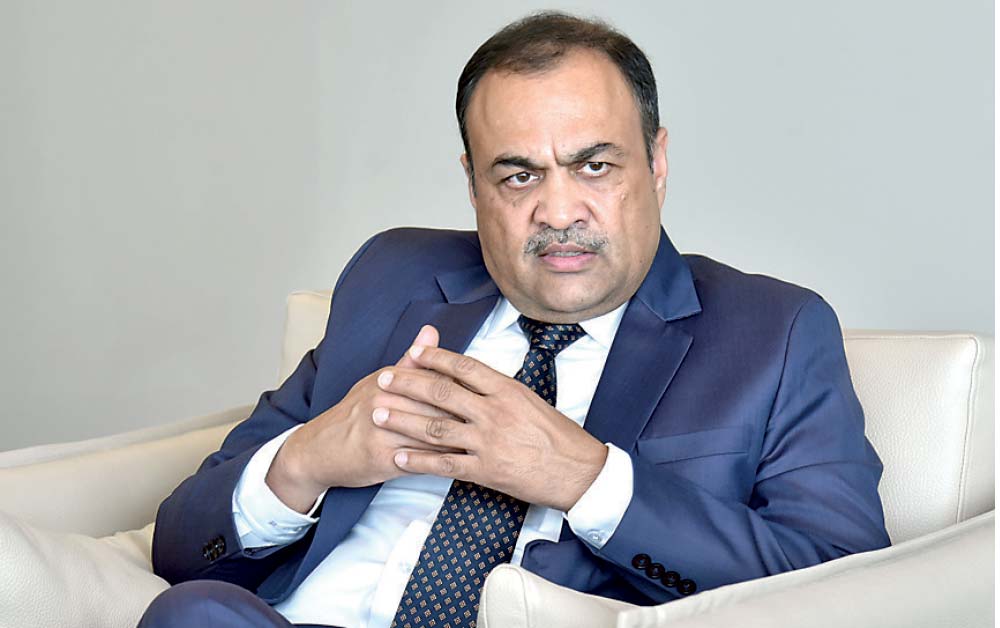
Chairman Anuj Jain – Pic by Sameera Wijesinghe
By Nisthar Cassim
Lanka IOC PLC (LIOC) has expressed its firm belief that Sri Lanka possesses one of the most attractive opportunities in the world for the development of its petroleum sector, provided planned initiatives and investments are implemented in a timely and expeditious manner.
This emphasis comes from Lanka IOC PLC Chairman Anuj Jain during his recent visit to Colombo to attend the company’s Annual General Meeting (AGM). Jain currently serves as Director – Finance and Chief Financial Officer of Indian Oil Corporation Ltd., a Fortune 500 global energy major. He also shares a strong association with Lanka IOC, having previously served as the company’s Senior Vice President from 2015 to 2018.
Drawing on his extensive experience in the energy sector and his deep familiarity with Sri Lanka’s petroleum industry, Jain expressed confidence in the country’s potential to emerge as a significant regional energy and petroleum hub.
Jain emphasised that petroleum would continue to play a critical role in ensuring energy security and shaping geopolitical dynamics. While acknowledging the importance of investments in renewable energy and the transition to cleaner sources, he noted that the oil sector remains indispensable for sustaining a nation’s energy needs and economic development.
He further observed that many countries are actively seeking to bridge the gap between domestic refining capacity and growing fuel demand, particularly considering the widening differential between crude oil prices and the value of refined petroleum products. This trend has reinforced the strategic importance of expanding refining and downstream infrastructure.
In an exclusive interview with the Daily FT along with Lanka IOC Managing Director K. Raghu, Chairman Jain highlighted the need for Sri Lanka to undertake major investments across the petroleum value chain, including the enhancement of refining capacity, pipeline networks, port facilities, fuel storage infrastructure, and other critical supply chain assets.
SL a significant regional energy and petroleum hub
According to Jain, strengthening the country’s petroleum sector should be viewed as a strategic energy security initiative that can deliver long-term economic benefits. Given Sri Lanka’s unique location at the crossroads of major international shipping routes in South Asia, he expressed confidence that the country is well positioned to develop into a significant regional energy and petroleum hub.
Jain further emphasised that diversifying sources of crude oil and petroleum product supplies will be equally important in strengthening supply resilience, enhancing energy security, and mitigating the impact of global market disruptions.
Reflecting on his previous tenure in Sri Lanka from 2015 to 2018, he noted that many of the key discussions and strategic plans for the country’s petroleum sector have already been identified and debated.
“Having been in Sri Lanka between 2015 and 2018 and being part of various stakeholder discussions, I believe the time has now come to translate those discussions into action. The roadmap is well understood. What is required now is the resolve and urgency to execute it,” Jain said.
For its part, Lanka IOC has consistently invested in the development of Sri Lanka’s energy ecosystem for more than two decades. Beginning with the retailing of automotive fuels, the company has progressively diversified its portfolio to include lubricants, bitumen, marine fuels, petrochemicals, greases, and a range of energy-related solutions. Lanka IOC has also undertaken significant investments in the modernisation of the Lower Tank Farm in Trincomalee, reinforcing its commitment to strengthening the country’s energy infrastructure.
Jain explained that in an energy landscape increasingly shaped by regulatory interventions, pricing controls, global market volatility, and evolving customer expectations, sustainable profitability cannot depend solely on conventional fuel retailing. Diversification, therefore, is a strategic imperative aimed at creating long-term value, improving business resilience, and unlocking new growth opportunities for the company.
“Lanka IOC is one of Indian Oil’s key overseas subsidiaries, and from day one, our focus has been on building and strengthening energy infrastructure,” Jain said.
He further highlighted Indian Oil’s expanding international presence, noting that the company has invested and established operations across more than 10 countries, including Mauritius, Nepal, Bhutan, Bangladesh, Singapore, Oman, the United Arab Emirates, Russia, Canada, the Netherlands, and Sweden. These global investments reflect Indian Oil’s commitment to enhancing its international footprint, strengthening supply chains, and leveraging global expertise to support the sustainable growth of subsidiaries such as Lanka IOC.
He stressed that in times of crises, being a highly import-dependent economy, petroleum storage is the most important thing. A recent wake-up call was the unprecedented closure of the Strait of Hormuz creating havoc in supply chains.
“Sri Lanka has the potential to become one of the most strategic energy storage hubs in the region,” Jain emphasised, highlighting the country’s unique geographical advantage and the significant opportunity to develop world-class petroleum storage infrastructure.
Pursue resilient mix in its energy basket
He also advised Sri Lanka to pursue a resilient mix in its energy basket, which, at present, comprises fossil fuel, hydro, coal, solar, and wind. He noted that the rapid expansion of renewables is not coming at the expense of petroleum but coal. The world is also increasingly moving towards e-mobility as the challenge of net zero targets looms and the growing need for energy-guzzling data centres.
Jain also explained that in view of supply shocks due to geopolitical tensions, countries are also moving to coal gasification whilst battery/storage bottlenecks are being addressed in the solar sphere.
The Lanka IOC Chief is also of the view that Sri Lanka is blessed with the best of opportunities to expand wind power, which is a more competitive source.
LIOC an integral part of solutions in times of energy crises
Focusing on operations in Sri Lanka, Jain said he was happy that Lanka IOC has done extremely well amidst multiple challenges.
“More importantly, Lanka IOC has remained an integral part of solutions in times of energy crises. This has been done with a lot of engagement with all stakeholders. ,” Jain said.
He expressed confidence that Lanka IOC will be able to support in time of need.
“IOC also stands ready to partner in the development of refining and creation of any new storage facility in Sri Lanka. IOC will be happy to both contribute technically, commercially, and financially,” he said.
“During times of crisis, we have consistently worked alongside the Government of Sri Lanka not only on pricing-related matters but also through Government-to-Government initiatives. As a responsible and leading national oil company of India, Indian Oil has always placed service to the nation above short-term commercial considerations, and Lanka IOC carries the same DNA. Our purpose is not merely to generate profits, but to serve the people and support the country’s energy security,” Jain said.
Jain noted that the above philosophy has guided the company’s operations throughout its two-decade presence in Sri Lanka, particularly during periods of economic and energy challenges. By ensuring continuity of fuel supplies, supporting national priorities, and investing consistently in critical energy infrastructure, Lanka IOC has remained a trusted partner in strengthening the country’s energy resilience.
Lanka IOC PLC in FY26 saw revenue of Rs. 280.65 billion, up from Rs. 276.29 billion in FY25 and Rs. 90 billion in FY21. The LIOC Chief is also of the view that the continuation of cost-reflective pricing is critical to ensure viability of companies, better demand management, as well as foster new investments.
“Any import-dependent country should have an international link pricing for their petroleum products,” he stressed.
Commitment to Sri Lanka
Jain reaffirmed Lanka IOC’s long-term commitment to Sri Lanka, stating that the company will continue to expand its presence by adopting global best practices while leveraging the unwavering support of its parent company, Indian Oil Corporation Ltd., particularly during periods of market volatility and crisis. He noted that this strong backing provides stability and resilience to Sri Lanka’s fuel industry and the broader energy sector.
“We are also committed to bringing further investments into the country, subject to the necessary Government approvals,” he added.
Looking ahead, Lanka IOC will continue to transform its conventional fuel retail outlets into integrated multi-energy centres, offering a broader range of energy solutions including electric vehicle (EV) charging facilities and other customer-centric services. This initiative reflects the company’s long-term strategy of supporting Sri Lanka’s evolving mobility landscape while remaining a future-ready energy solutions provider.
Welcomes new competition but stresses on importance of safety standards
Commenting on the entry of new participants into Sri Lanka’s fuel retail market, Jain welcomed increased competition, observing that a competitive marketplace encourages higher standards of efficiency, innovation, and customer service while ultimately benefitting consumers.
“Healthy competition always brings out the best in us and delivers greater value to customers. However, the one area where there can never be any compromise is safety. The petroleum industry requires substantial investment in safety systems, infrastructure, and operational excellence. While compromising on safety may reduce costs in the short term, sustainable success can only be achieved through the highest standards of safety, integrity, and ethical business practices,” he emphasised.
At the parent company level, Indian Oil is further strengthening its global energy footprint through the planned establishment of a joint venture in Singapore with a leading global energy company. This strategic initiative is expected to significantly enhance Indian Oil’s international trading capabilities and expand its access to global energy markets.
Combined with ongoing investments in India to increase refining capacity and strengthen export operations, these efforts will further reinforce Indian Oil’s integrated global supply chain and trading network. This enhanced capability is expected to support Lanka IOC’s long-term growth strategy, improve supply reliability, and contribute meaningfully to Sri Lanka’s energy security and economic development.


