Friday Oct 30, 2026
Friday Oct 30, 2026
Friday, 30 October 2026 00:00 - - {{hitsCtrl.values.hits}}
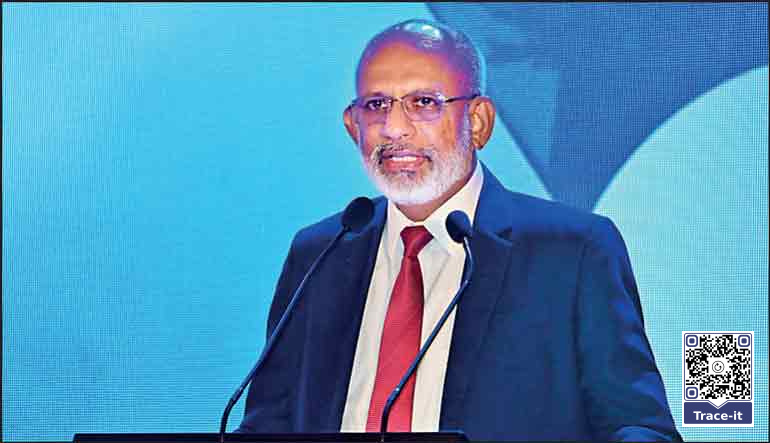
SEC Chairman Senior Prof. Hareendra Dissabandara
– Pic by Sameera Wijesingha
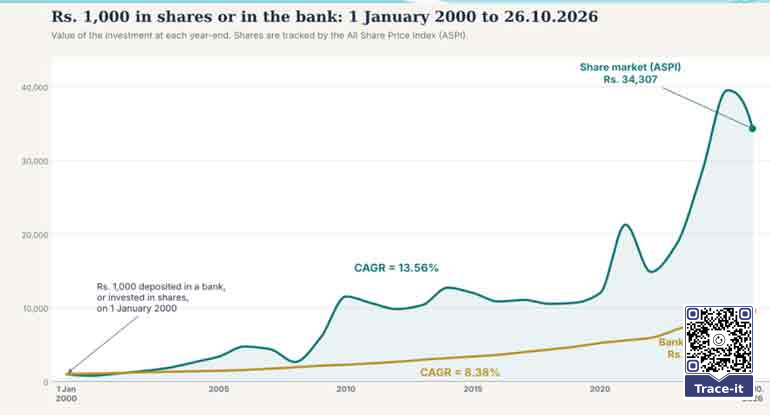
Perspective: SEC Chairman Senior Prof. Hareendra Dissabandara shared this graph during his presentation to explain the current downturn compared to the market’s trajectory
Securities and Exchange Commission (SEC) Chairman Senior Prof. Hareendra Dissabandara has called on the Government to make capital market development part of its growth strategy in the forthcoming Budget. He warned that Sri Lanka cannot reach higher growth by leaning excessively on Government borrowing and bank credit.
He was speaking on Tuesday at an institutional investors forum organised jointly by the SEC and the Colombo Stock Exchange (CSE), themed ‘From Resilience to Sustainable Growth: The Future of Sri Lanka’s Capital Market’.
Senior Prof. Dissabandara said recent growth of about 4% to 5% was encouraging given the severity of the crisis, but insufficient for the country’s long-term development aspirations. Sri Lanka should aspire to a sustained 7% to 9%, supported by gains in productivity, competitiveness and investment.
“We cannot simply announce a higher growth target and expect the economy to achieve it,” he said. Policymakers must first work out how much additional investment is needed, which sectors it should go to and how it will be financed. He said that question deserved serious attention from the Ministry of Finance, the Central Bank, the corporate sector and other institutions responsible for development.
Bank financing has an essential role, particularly for working capital and conventional lending, Senior Prof. Dissabandara said. But long-term productive investment requires long-term financing instruments. Since Independence, he argued, national financing discussions have centred on Government borrowing, commercial banking and external debt, while the capital market’s potential has been neither sufficiently recognised nor used. Equity lets businesses raise capital without fixed repayment obligations, and corporate debt can provide longer-term funding.
He urged the Minister of Finance and the Ministry to recognise that contribution in the forthcoming Budget, noting that the SEC and the CSE have identified proposals to strengthen the market’s capacity to mobilise investment. He said policy should encourage companies to raise capital, support new listings, facilitate new instruments, attract long-term institutional investors and broaden public participation. Suitable State-owned enterprises could also be considered for capital market participation, where consistent with Government policy, commercial viability, public interest and appropriate governance. Investors commit capital on the basis of policy stability, he added, so consistency in economic policy is essential.
Senior Prof. Dissabandara also sought to calm market nerves and put the CSE’s recent decline in perspective. He attributed the fall to a mix of domestic and external factors. These include geopolitical developments in the Middle East, higher international energy prices, foreign portfolio adjustments, changes in interest rates, inflationary pressures, exchange rate movements, profit-taking and periods of low liquidity. Some companies are also under pressure on costs and profitability.
A broad decline, he said, did not mean every company had become fundamentally weak, as some have maintained sound balance sheets and earnings prospects. Foreign outflows from equities had been accompanied by foreign inflows into Government securities. That, he said, showed the need to distinguish the performance of individual market segments from confidence in the economy as a whole. Inflation is above the medium-term target, but the Central Bank expects a gradual moderation, he noted.
To illustrate the longer view, Senior Prof. Dissabandara traced the All Share Price Index from 1985 to October 2026. Over those four decades, the market weathered numerous economic and political shocks, market disruptions and swings in investor confidence, yet also recorded substantial periods of growth and recovery. He made a similar point with the banking sector index, and compared hypothetical returns from share market investments with those from bank deposits over an extended period.
He was careful not to oversell the comparison. The purpose was not to suggest equities would always outperform, because they will not, he said. It was to show the relationship between risk, return, investment horizon and compounding. Strong historical equity returns had come with substantial volatility, and the additional return investors expect for taking that risk is neither guaranteed nor evenly spread across years. He urged investors to judge companies on their underlying business, earnings potential and dividends rather than on today’s share price, and to distinguish nominal returns from real gains after inflation.
The lesson from the market’s history, he said, was not that prices always rise. It was that the market has shown it can withstand difficult periods and recover while continuing to raise capital for businesses.
He cautioned investors against panic-driven decisions, saying that when liquidity is thin, even modest selling can move prices sharply. Investors at such times needed accurate information, objective analysis and responsible professional advice, he said, to tell genuine economic risks apart from market rumours.
Senior Prof. Dissabandara also warned that thin trading magnifies the effect of attempts to manipulate prices or create misleading impressions of activity. That risk is especially relevant while investors await major announcements such as the Budget. Referring with a smile to talk of a few ‘naughty boys’ in the market, and without naming anyone, he said the SEC already has the regulatory framework to address misconduct. “If anyone is tempted to take advantage of prevailing market conditions inappropriately, they should reconsider,” he said.


