S&P upgrades Sri Lanka, says out of default danger zone

Saturday, 28 November 2026 00:00 -     - {{hitsCtrl.values.hits}}

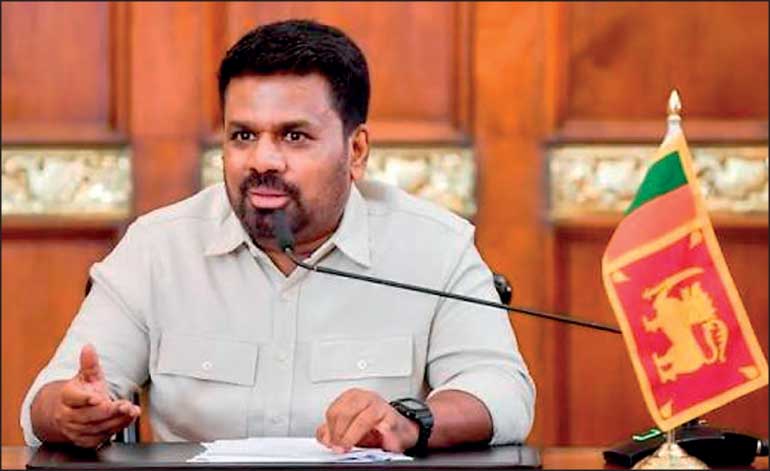
President and Finance Minister Anura Kumara Dissanayake


  • Sovereign ratings lifted to ‘B-/B’ from ‘CCC+/C’; outlook stable
  • Signals SL can now repay debt even in tough market conditions; default scenario over next two years unlikely
  • Warns Middle East conflict, impending El Nino could weigh on growth
  • Fiscal deficit to widen on Budget 2027 relief measures
  • Notes further upgrade depends on stronger fiscal and external metrics; renewed funding stress could trigger downgrade

S&P Global Ratings yesterday upgraded Sri Lanka’s long-term sovereign credit ratings to ‘B-’ from ‘CCC+’, with a stable outlook, saying the country’s willingness and capacity to repay its debt obligations had become less vulnerable to unfavourable external financing conditions, and that a default over the next two years was unlikely.

S&P also raised its short-term foreign and local currency ratings to ‘B’ from ‘C’. The transfer and convertibility assessment is unchanged at ‘B-’.

The rating agency said the stable outlook reflects its expectations that Sri Lanka’s economy will remain resilient over the next six to 12 months, despite prolonged disruptions to the global energy market, while the Government continues to build fiscal and external buffers through policies that improve macroeconomic stability.

“The ‘B-’ ratings reflect our assessment that the improvements in Sri Lanka’s macroeconomic settings have become more entrenched. This has led to a steady increase in fiscal and external buffers, which supports the Government’s capacity to manage further external volatility and the heavier external debt repayments in the coming years. We believe Sri Lanka’s willingness and capacity to repay debt obligations is less vulnerable to unfavourable external financing conditions, and that a default scenario over the next two years is unlikely,” it added.

However, the rating agency said risks remain high, as Sri Lanka is vulnerable to global shortages of crude oil and petrochemicals. The prolonged war in the Middle East will maintain pressure on the external balance, particularly if remittances falter. The impending El Nino could affect hydropower generation and agricultural production, worsening inflationary concerns and dampening growth.

It noted that despite substantial improvements in recent years, the general Government interest burden, at about 40% of revenue, is still heavy.

S&P believes support from multilateral institutions is likely to continue, and that the country’s economic recovery and structural reform efforts to anchor further fiscal and external improvements should remain intact.

“We expect Sri Lanka’s economic growth to slow to 4% in 2026 and rebound to 4.5% in 2027. We forecast Sri Lanka’s 10-year weighted average per capita real GDP growth at 3.2%. This is in line with peers with similar income levels and indicates that Sri Lanka has largely shaken off the effects of its 2022 economic crisis. We believe Sri Lanka’s GDP per capita would reach $ 5,200 in 2026 despite a weakening Sri Lankan rupee,” it added.

The agency said Sri Lanka’s economy has fared well so far despite the abrupt outbreak of the Middle East war. Proactive policy responses, including rationing fuel and shortening the work week, helped to preserve supply early and reduce disruptions to industrial and agricultural activities. Although real GDP growth slowed to 4.2% year-on-year (YoY) in the second quarter of 2026 from 5.1% in the first quarter, manufacturing industrial production expanded for nine months this year through to September.

S&P said it anticipates the Government will continue the reform agenda under the current International Monetary Fund (IMF) Extended Fund Facility program even after the program ends in March 2027, including implementing revenue-based Budget repair, cost-recovery pricing for utilities and other structural reforms of public financial and debt management. It added that the Government has demonstrated strong commitment to the IMF program, meeting most of the quantitative indicators and structural benchmarks, albeit some with delays, even under challenging circumstances.

On the fiscal front, the agency noted that Sri Lanka’s fiscal position has improved significantly since 2022, underpinned by a series of revenue measures and robust economic growth. The revenue growth momentum has not faltered much this year despite the more challenging external environment and moderation in economic growth. Government revenue grew 20% YoY in the first nine months of 2026, despite the strong base in 2025.

“We expect general Government revenue to exceed 17% of GDP in 2026, roughly double the rate in 2022. Even if growth slows substantially in the last quarter and expenditure execution improves, we expect the overall fiscal deficit to narrow in 2026 to below 2% of GDP. The primary balance will likely remain in surplus for four consecutive years,” it added.

On the expenditure front, the rating agency noted that spending is higher this year due to larger subsidies and transfers, as the Government disbursed, albeit slowly, funds for post-disaster relief and reconstruction for Cyclone Ditwah, which occurred in November 2025.

It said capital expenditure has also accelerated YoY in the first three quarters of this year, and it expects a further ramp-up in the last quarter. As a result, the agency projects that the fiscal deficit will increase to 1.8% of GDP in 2026, despite the Government running a surplus in the first nine months.

“We expect the fiscal deficit to widen in 2027 due to the various support measures introduced in the Budget, including the increase in the personal income tax thresholds, removal of the Value-Added Tax (VAT) on school supplies, and reductions in targeted levies, such as for solar batteries,” it added.

The agency expects Sri Lanka’s current account to flip to a deficit of 1.4% of GDP in 2026, while gross external financing needs as a share of current account receipts and usable reserves will widen to about 109% this year, from 104% in 2025, before improving to 104% by 2029. This still compares favourably with the pre-crisis average of more than 120%. It expects external debt net of public and financial sector external assets to average 96% of current account receipts over 2026-2029.

It also noted that gross official reserves fell to $ 6.5 billion in June before recovering to $ 7.09 billion in October. Remittances were still rising as of September 2026, but at a slower pace, while tourism earnings declined by 9.2% in the first nine months.

S&P forecasts net general Government debt, including State-owned enterprise (SOE) guarantees, at about 92% of GDP for 2026.

The rating agency said it could raise Sri Lanka’s ratings if two or more of the following become likely: the interest burden as a share of revenue falls substantially to levels more consistent with most countries it rates; net external debt falls below current account receipts on a sustained basis; the change in net general Government debt is consistently about 3% of GDP; and macroeconomic stability becomes more entrenched, with financing conditions normalising to the extent that the Government’s willingness to default reduces substantially.

Conversely, it said it could lower the ratings if it sees indications of renewed risks of funding and liquidity stresses, which could be preceded by significantly weaker external or fiscal performance.