Thursday Aug 20, 2026
Thursday Aug 20, 2026
Thursday, 20 August 2026 00:00 - - {{hitsCtrl.values.hits}}
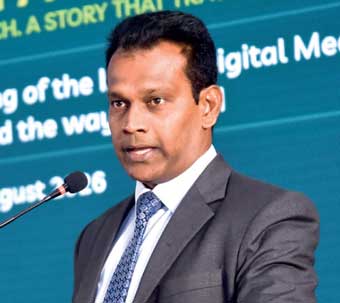 |
| Tourism Deputy Minister Prof. Ruwan Ranasinghe |
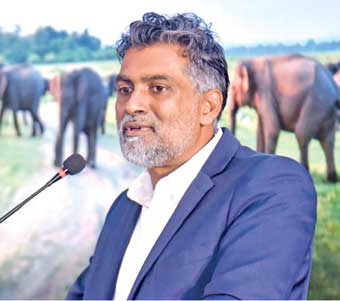 |
| SLTPB Chairman Buddhika Hewawasam |
By Charumini de Silva
Sri Lanka Tourism yesterday announced launching a Rs. 1.5 billion interim tourism promotion campaign covering six priority markets, as the Government seeks to revive long-delayed international destination marketing ahead of a larger global campaign planned for March/April next year.
Tourism Deputy Minister Prof. Ruwan Ranasinghe said the interim public relations (PR) and digital campaign would run from August 2026 to April 2027, providing continuity while preparations for the comprehensive global campaign are completed.
The Government had abandoned a tourism promotion program designed after the new administration raised concerns over aspects of the proposal and decided to start afresh. It has since engaged the Asian Development Bank (ADB), World Bank, and other development partners for technical assistance.
“Taking Sri Lanka to the world properly, across all countries and to global potential tourists, has been delayed for a considerable period,” Prof. Ranasinghe said, adding that such a comprehensive process required time.
The interim campaign will initially target Australia, the UK, Germany, India, China, and Russia, with France, Italy, Spain, the Middle East, Scandinavia, Poland, Japan, and South Korea among markets earmarked for subsequent expansion.
Sri Lanka Tourism Promotion Bureau (SLTPB) Chairman Buddhika Hewawasam said the campaign would combine digital marketing, PR, virtual reality activations, roadshows, and market-specific content.
“Australia will lead the rollout by end of August, followed by the other five markets, with activity expected across all six by October-November,” he added.
The approach will differ according to each market’s travel preferences and behaviour. “In Australia, for example, adventure will receive particular emphasis, while India will receive a stronger digital focus given its highly digitalised travel-planning and booking environment,” he explained.
Hewawasam said the campaign would promote seven core experiences; leisure, culture, nature, adventure, wellness, luxury, and Meetings, Incentives, Conferences, and Exhibitions (MICE) while developing niche products around marine tourism, diving, Ayurveda, trails, spiritual tourism, weddings, and other emerging segments.
The strategy also seeks to shift Sri Lanka from observational tourism towards experiential tourism, encouraging visitors to participate in cultural activities, engage with communities, and explore lesser-known destinations.
“Ultimately, our objective is not simply to attract more tourists. It is to attract the right tourists,” Hewawasam said, stressing the need for visitors who stay longer, spend more, and contribute to local economies.
The authorities are targeting 2.7 million tourist arrivals and around $ 4.2 billion in tourism revenue this year, compared with 2.36 million arrivals and around $ 3.2 billion in earnings last year. The target is to exceed 3 million arrivals next year and move towards $ 10 billion in tourism revenue by 2030.
Hewawasam said achieving the revenue target would require more than higher arrivals, pointing to longer stays, greater visitor spending, product diversification, and wider geographical distribution of tourism benefits.
He also noted that campaign will be driven by data, with dashboards tracking performance, engagement, and conversions to ensure spending deliveries measurable returns.
“One of the most important elements of this campaign is monitoring. We will continuously review the results and adjust our approach where necessary” he added.
The campaign will therefore seek to take visitors beyond established destinations into relatively unexplored areas, including the Eastern Province and parts of the North, North Central, and Uva Provinces.
The SLTPB is also working with international agencies and major digital platforms, including Meta, Google, and TikTok, while partnerships with airlines are being developed to jointly promote Sri Lanka and support greater air connectivity.
“Agreements have already been signed with Emirates, with discussions underway with IndiGo, Turkish Airlines, Qatar Airways, and other carriers,” he disclosed.
Hewawasam said Sri Lanka also needed to make it easier for tourists to spend money beyond hotels and traditional tourism businesses. The SLTPB is working with LankaPay and local banks to expand digital payment facilities in tourism-resource areas, enabling visitors to purchase local products and services more conveniently.
The campaign will also draw on local content creators, with around 100 expected to participate in showcasing authentic and lesser-known experiences to international audiences by January.
Prof. Ranasinghe stressed that promotion must remain grounded in reality, warning against creating expectations that the country cannot deliver.
“We need to be realistic. Otherwise, we will be telling the world something that is not the case,” he said, noting that Sri Lanka’s improved international image also reflected economic recovery, political stability, institutional governance, democratic systems, and better connectivity, rather than tourism promotion alone.
He also highlighted the growing influence of artificial intelligence (AI) in travel planning. The SLTPB is developing an AI-enabled tourism platform to improve the visibility of destinations and experiences when potential travellers use digital tools to research and plan trips.
Meanwhile, preparations are underway for the full-scale global campaign, with around Rs. 5 billion allocated for the initiative. Hewawasam said agencies and other partners were expected to be appointed by February 2027, enabling a March/April launch, subject to approvals and procurement.
Unlike the interim market-activation program, the global campaign will also incorporate a broader nation-branding exercise, seeking to connect tourism with Sri Lanka’s wider identity, including its tea, heritage, culture, environment, sport, food, and creative industries.
The authorities said campaign performance would be tracked through dashboards covering reach, engagement, conversions, and other key indicators, allowing spending and strategies to be adjusted based on measurable results.
Prof. Ranasinghe said the launch marked an important step after years of delays.
“This has been delayed for more than a decade, but here we are today, launching it to the world. Let us work together to make Sri Lanka a globally recognised tourism destination. The benefits will go to the entire nation,” he said.

