Saturday Jun 27, 2026
Saturday Jun 27, 2026
Friday, 8 May 2026 04:43 - - {{hitsCtrl.values.hits}}
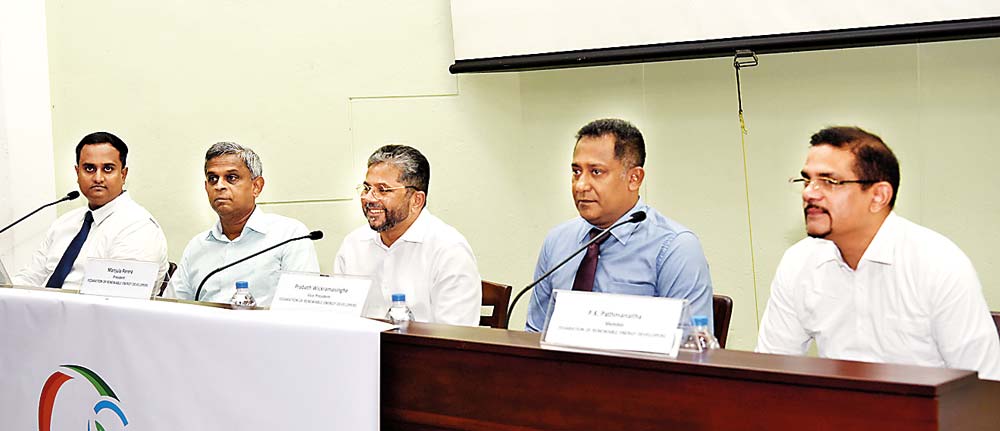
From left: Federation of Renewable Energy Developers Members Afzal Muhammad and Kishan Nanayakkara, President Manjula Perera, Vice President Prabath Wickramasinghe, and Member P.K. Pathmanatha – Pic by Shehan Gunasekara
By Charumini de Silva
The Federation of Renewable Energy Developers (FRED) yesterday demanded urgent intervention from the Finance Ministry and Treasury to release at least 50% of the Rs. 10 billion in unpaid dues owed by the National System Operator Ltd., (NSO) for electricity supplied since December 2025.
Addressing the media, the FRED representatives said the outstanding amount has now escalated to Rs. 10 billion, with an additional Rs. 2.5 billion becoming due every month, placing nearly 400 renewable energy companies, many of them small and medium-scale local enterprises, under severe financial stress.
FRED President Manjula Perera said the crisis began in December last year when shortfalls in coal-fired power generation forced the electricity system to increasingly rely on diesel and heavy fuel generation to cover daily supply gaps of between 100 MW and 150 MW.
“The primary reason for this liquidity drain is the prioritisation of payments for diesel and heavy fuel power generation,” he claimed.
Recalling the country’s economic turmoil in 2022 and 2023, Perera said the renewable energy sector had at least received partial payments during that period, but had not received any payments since December 2025.
He argued that the economics of thermal generation are becoming increasingly unsustainable, noting that a litre of diesel costs around Rs. 500, including taxes, and generates only about four units of electricity.
It was also pointed out that the rising geopolitical tensions involving Iran and the US have pushed thermal generation costs to nearly or above Rs. 100 per kilowatt-hour (KWh).
“It is fundamentally unfair that conventional power generators receive preferential treatment for payments while the renewable energy sector is completely neglected,” he said.
Perera said the country currently spends nearly Rs. 1 billion a day on thermal generation, while equivalent renewable energy generation costs only around 15% of that, or roughly Rs. 150 million.
With 1,100 MW of renewable capacity under pressure, the FRED said the payment deadlock is affecting a substantial share of the non-conventional renewable energy sector, including 134 ground-mounted solar plants with a combined capacity of 314.3 MW, 221 mini-hydro projects generating 434.6 MW, 20 wind farms producing 267.5 MW, and 14 dendro and other renewable plants contributing 57.5 MW, excluding rooftop solar systems.
“If the NSO is unable to secure commercial funding because it is a newly established corporate entity without sufficient collateral, we urge the Finance Ministry and the General Treasury to intervene,” Perera said.
He also alleged that industry engagement with the system operator has effectively broken down. “The officials of the NSO are not willing to even meet us now,” he claimed.
In addition to the delayed payments, Perera said renewable energy developers are also suffering major losses from forced curtailment of generation, claiming the industry is losing between Rs. 2 to 2.5 billion every month due to generation cuts imposed every Sunday and on mercantile holidays between 9 a.m. and 3 p.m., a practice that has continued since February 2025.
FRED Member Kishan Nanayakkara said renewable energy projects operate under legally binding power purchase agreements (PPAs), and both curtailment and non-payment now raise serious contractual concerns. “Non-payment is also a contractual default. Payments are required to be made within either 30 or 45 days, depending on the agreement terms,” he said.
He noted that curtailment under PPAs is typically permitted only under emergency or maintenance-related conditions and ‘not as a routine dispatch practice.’
Nanayakkara described the current situation as a “technical sovereign default.”
“This is not merely a contractual issue. Since the NSO is effectively State-owned, the failure to honour these obligations reflects on the Government itself,” he said.
He added that while legal remedies remain available, arbitration or litigation may come too late to save the sector. “By the time legal proceedings conclude, the industry could already be dead,” Nanayakkara warned.
FRED Member R.K. Pathmanatha questioned why renewable energy developers were not being paid despite their costs already being built into electricity tariffs approved by the Public Utilities Commission of Sri Lanka (PUCSL).
“The cost of renewable energy generation is already built into the tariff structure paid by consumers. So why renewable energy developing companies are not being paid, while others are?” he asked.
Pathmanatha also raised concerns over the financial governance framework following the restructuring and unbundling of the Ceylon Electricity Board (CEB), questioning whether the NSO, which he said lacks substantial assets of its own, has the financial capacity to function independently.
“All consumer payments are collected by the electricity distribution companies, but the NSO is responsible for paying all generation companies, including independent power producers. The concern is whether the current financial governance structure is functioning properly,” he said.
He added that renewable energy currently supports over 70% of daytime electricity demand across industrial, commercial, and domestic segments.
The FRED warned that if renewable developers are forced out of business due to continued payment defaults, the country will become increasingly dependent on expensive imported fossil fuels.
They noted that many developers are still recovering from the impacts of the COVID-19 pandemic, the economic crisis, repeated loan restructurings, and earlier payment delays, while continuing to supply electricity under long-term PPAs signed years ago at tariffs ranging between Rs. 7 and Rs. 9 per unit.
“There has not been a single tariff increase for many renewable energy projects despite rising costs. We continue supplying power under long-term PPAs signed years ago,” they said.
The FRED claimed that the NSO has been unable to secure working capital financing from commercial banks due to weak balance sheets, lack of assets, and unresolved transfer pricing arrangements following sector restructuring.
However, the industry body expressed hope that the NSO will have better working capital flow with a likely electricity tariff hike from tomorrow (9).
It also warned that the payment crisis could jeopardise future investments in battery storage infrastructure, including the first phase of a 160 MW/640 MWh battery energy storage system expected to be operational this year.

