Friday Oct 02, 2026
Friday Oct 02, 2026
Wednesday, 5 August 2026 03:40 - - {{hitsCtrl.values.hits}}
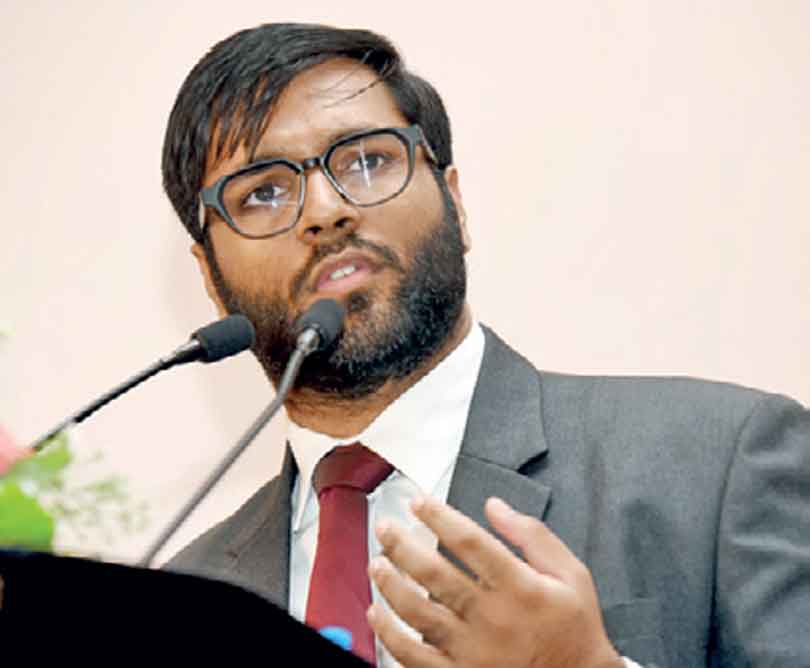
Verité Research Lead Economist Raj Prabu Rajakulendran
– Pic by Shehan Gunasekara
Sri Lanka’s post-crisis fiscal recovery has been achieved at a significant economic and social cost, with the gains in Government revenue and public finances yet to translate into a comparable improvement in employment, poverty and household welfare, according to Verité Research Lead Economist Raj Prabu Rajakulendran.
Addressing a forum titled ‘Navigating the New Tax Landscape Together’ organised by B.R. de Silva and Co. Chartered Accountants, Rajakulendran said Sri Lanka’s recovery had been internationally recognised largely because of improvements in fiscal indicators, particularly Government revenue, but argued that these measures alone did not capture the full impact of stabilisation on the economy and people’s livelihoods.
He said Sri Lanka’s revenue-to-GDP ratio had increased from around 8% before the crisis to about 16%, placing the country among the strongest performers in improving Government revenue following an economic crisis. He also noted that Sri Lanka ranked among the top countries in improving its primary fiscal balance, reflecting substantial progress in restoring public finances.
Recovery’s...
“This is quite a significant achievement for Sri Lanka given that we were in such a bad crisis,” Rajakulendran said.
However, he argued that the recovery narrative had become too narrowly focused on fiscal outcomes while overlooking the broader economic consequences of stabilisation.
Sri Lanka would only regain the level of economic output recorded in 2018 by 2027, meaning recent economic growth largely reflected the recovery of output lost during successive shocks rather than expansion beyond pre-crisis levels.
“So all this growth that you’re seeing is simply to go back to where we were in 2018. It is not to grow the economy again,” he said.
He said the recovery should also be assessed against employment and poverty rather than fiscal indicators alone.
Employment has fallen to its lowest level in two decades, and while businesses could close rapidly during a crisis, rebuilding productive capacity and creating jobs took considerably longer. He added that employment recovery did not form part of the IMF-supported program’s monitored targets despite its significance for households.
He also pointed to the sharp increase in poverty following the crisis, noting that while the last official poverty estimate before the crisis stood at about 11%, updated Government estimates had yet to be published and internal estimates suggested poverty could be around 30%.
“Our recovery is good on the IMF scorecard. But is our recovery good on the human lives aspect?” he said.
Rajakulendran questioned the use of GDP growth as the principal measure of recovery, arguing that economic expansion alone did not necessarily translate into improvements in living standards.
He said economies could record higher growth while inequality widened, employment weakened and households continued to struggle with the cost of living.
Referring to reconstruction following Cyclone Ditwah, he said rebuilding activity contributed positively to GDP even though many affected communities continued to experience economic hardship.
“When there is a crisis, when you are rebuilding the country, you are contributing to the economy, but the rebuilding effort is simply understating the effect on human lives,” he said.
Rajakulendran argued that policymakers should place greater emphasis on employment, wages, poverty and inequality alongside conventional macroeconomic indicators when assessing economic recovery.
Turning to taxation, Rajakulendran said the sustainability of Sri Lanka’s fiscal recovery would depend on strengthening tax administration rather than imposing further tax increases.
He noted that although Sri Lanka ranked second in South Asia by GDP per capita, it ranked only sixth in Government revenue collection, indicating that the country generated income without collecting a corresponding level of tax revenue.
“We don’t have a rate problem. We have a collection problem,” he said.
Rajakulendran said Sri Lanka’s corporate income tax rate of 30% was already among the highest in the region, yet collections remained comparatively weak, demonstrating the need to improve compliance, audits and administration while broadening the tax base.
He said a similar gap existed in personal income taxation, where Sri Lanka continued to collect well below the average for upper-middle-income economies despite recent improvements in taxpayer registration.
According to Rajakulendran, the expansion of the tax base remained essential to reducing the burden on existing taxpayers.
“The burden falls on a small group of people who are paying these high taxes,” he said.
He also argued that weak direct tax collection had resulted in excessive reliance on indirect taxes, with around half of the increase in Government revenue between 2021 and 2024 coming from value added tax.
Rajakulendran said greater dependence on VAT and other consumption taxes disproportionately affected lower-income households because they paid the same tax regardless of income. He called for a gradual shift towards greater reliance on direct taxation of income and wealth, supported by a broader taxpayer base and a more rules-based, predictable tax framework.
Using cigarette taxation as an example, Rajakulendran said the tax component of cigarette prices had declined from about 74% in 2018 to around 66% in 2025, reducing potential Government revenue by an estimated Rs. 17.3 billion.
He said restoring the earlier tax share could generate sufficient revenue to fund the Suwa Seriya ambulance service four times over, illustrating that better tax design could strengthen public finances without increasing the burden on compliant taxpayers.
Rajakulendran said taxation should ultimately support economic development rather than simply maximise Government revenue, arguing that future reforms should place greater emphasis on equity, stronger public services and improvements in living standards.
“The end goal should really be human flourishing and economic development,” he said.
Sri Lanka’s debt sustainability should be judged by the cost of servicing its debt rather than the size of its debt stock, with the country’s relatively high interest burden remaining one of its weakest post-crisis indicators despite completing sovereign debt restructuring.
This is according to Verité Research Lead Economist Raj Prabu Rajakulendran.
Debt sustainability...
Addressing a forum titled ‘Navigating the New Tax Landscape Together’ organised by B.R. de Silva and Co. Chartered Accountants, Rajakulendran said Sri Lanka’s fiscal recovery had been widely recognised for improvements in Government revenue and the primary fiscal balance, but argued that debt sustainability required greater attention to interest costs.
“If we look at interest cost to GDP, which is the most important indicator, we are bottom of the list,” he said, referring to comparisons with countries that had undergone economic crises and sovereign debt restructuring.
Rajakulendran said many countries that restructured their debt were able to reduce their interest burden significantly, whereas Sri Lanka’s restructuring had largely deferred repayments.
“All we did was we pushed repayments in the future. It’s called kicking the can down the road. We said, ‘We have a problem now. If I just push it to 2030, my problem will be solved.’ Not really, but that’s how we did most of our work,” he said.
He noted that Sri Lanka entered the restructuring process with a large debt stock carrying high borrowing costs, causing interest expenditure to rise sharply and making debt servicing a more important measure of sustainability than debt levels alone.
Rajakulendran argued that debt-to-GDP ratios by themselves could present a misleading picture.
Countries such as Japan and Singapore maintained debt ratios of around 200% of GDP while retaining strong sovereign credit ratings because they financed themselves at relatively low interest rates.
“It’s not the stock of debt. If your debt can be huge, but if your interest rate is like 2%, 3%, you can pay that quite easily. The question is, can you service the debt that comes in your way? Interest cost to GDP is an important indicator,” he said.
Rajakulendran also linked debt management to the pace of economic recovery.
Using 2018 as the benchmark for pre-crisis economic output, he said Sri Lanka would only regain that level of production by 2027 despite the current recovery in economic growth.
He contrasted Sri Lanka’s experience with countries including Ghana, Grenada and Mongolia, which he said had restructured their debt earlier, allowing them to avoid deeper economic contractions.
“What we did was, we were too late to restructure debt. The economy suffered a lot more than what other countries did. They pre-emptively restructured debt,” he said.
Rajakulendran said the effectiveness of debt restructuring should therefore be assessed not only by improvements in fiscal accounts but also by whether it reduced debt servicing costs and supported a quicker return to sustainable economic growth.

