Monday Oct 26, 2026
Monday Oct 26, 2026
Monday, 26 October 2026 06:26 - - {{hitsCtrl.values.hits}}
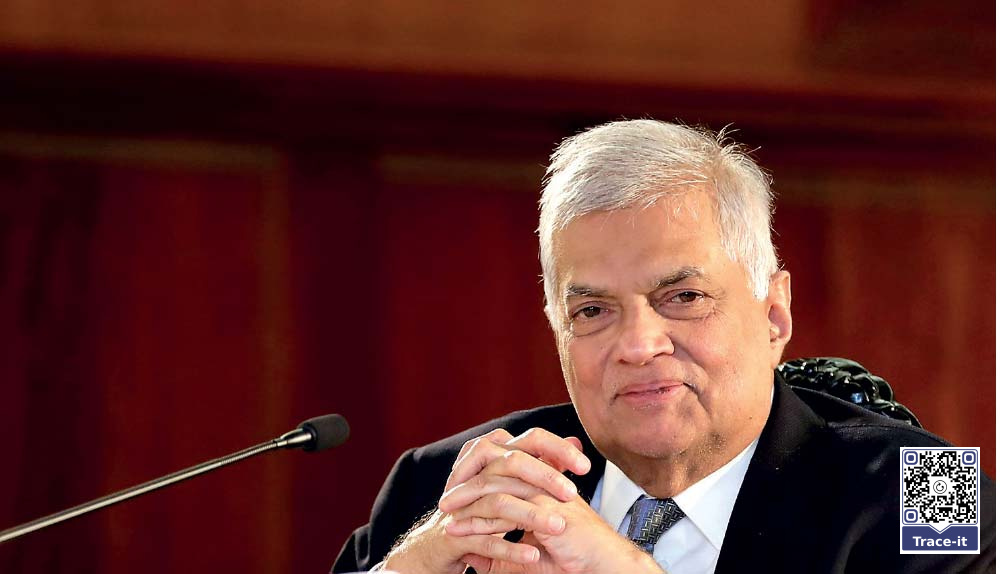
Former President Ranil Wickremesinghe
FORMER President Ranil Wickremesinghe has set out a 10-point plan for Sri Lanka to secure a place in an emerging world order, with rapid technological modernisation, membership of BRICS, and a stronger maritime role at its core.
“If we do not do this, we will have no place in the new world order,” Wickremesinghe said, delivering the keynote at the 50th webinar organised by the Daily FT, Association of Chartered Certified Accountants (ACCA), and the International Chamber of Commerce Sri Lanka, together with Women in Management (WIM), the Sri Lanka Institute of Directors, the MBA Alumni Association of the University of Colombo, and Pioneer Institute of Business and Technology, on Saturday. The webinar was titled “In an Emerging New World Order, What Are Sri Lanka’s Options?”
Among the requirements he set out were rapid technological modernisation resulting in a strong, competitive economy, making Sri Lanka a maritime logistics centre, close economic cooperation with India, and stronger relations with Bay of Bengal and other Southeast Asian countries, leading finally to regional integration. He also urged Sri Lanka to join BRICS, strengthen relations with the US, China, and Russia, as well as Japan, engage in transactional geopolitics, accelerate the work of the Colombo Security Conclave, and build a technologically advanced Navy with small and medium naval ships.
“If you want to survive in this new global order, where technology plays this role and trade will certainly have an importance, either we have to go along this way or fade into insignificance like one of the small Pacific Isles,” he said.
Wickremesinghe framed his proposals around Indian Prime Minister Narendra Modi’s address at the NDTV World Summit, which characterised the present as a world between orders, with one ending and another beginning. Modi had highlighted the weaponising of finance, trade, technology, and shipping as part of the new geopolitics, he noted, adding that post-World War II institutions were unable to intervene as they had not adapted to the changing order. Modi had also invoked Chanakya on the need to prevent Matsya Nyaya, where the strong swallow the weak.
Citing a Goldman Sachs report, Wickremesinghe said Artificial Intelligence (AI) and data ownership, combined with dollar-dominated global financial markets, formed the basis of US dominance, while China, the other AI superpower, was seeking an alternative with BRICS members. “What we are witnessing today is a duopoly of AI and computing superpowers,” he said, adding that China and the US also led in space, ocean, and automation technologies, while India, the UK, France, Germany, Israel, Japan, and South Korea were developing their own. “We have to remember sovereignty today implies technology.”
He said the decline of Western-led alliances was giving way to transactional geopolitics between the leading powers, and that Sri Lanka needed economic and social transformation based on technology-oriented modernisation, or it would be swallowed up.
The Indian Ocean, he said, would be one of the centres of the new order alongside the emerging economies of Asia and Africa, strengthening its role as the main shipping artery between East and West, with immense undersea resources available for exploration. However, the US-Iran war had eroded the Indian Ocean’s status as a zone of peace and its freedom of navigation, he said, making it Sri Lanka’s interest to ensure that its two economic lifelines, the Suez Canal and the Gulf, remained fully operational.
He urged policymakers not to ignore the Bay of Bengal as an economic region. Indonesia, projected to have the fourth or fifth largest GDP by 2050, would extend its influence, and Bangladesh would also emerge as an economic power, he said. Closer economic cooperation between Southeast Asia and Western China was producing the Chengdu-Chongqing corridor extending to Myanmar and Bangladesh, which he said would give China a second access to the Indian Ocean, this time through the Bay of Bengal. He also pointed to an economic region at Sri Lanka’s doorstep, a market of 600 million excluding India.
Emerging technologies, including orbital maritime awareness satellites, hypersonic weapons, unmanned water vehicles, and drones, would play a major role in Indian Ocean security, he said, adding that protecting undersea cables in the region was a priority.
On trade, Wickremesinghe, who said he had worked on agreements with Singapore and Thailand, named Indonesia, Malaysia, and Vietnam as the next targets. While Europe and the US remained important markets, Sri Lanka could not send more goods there and had to find markets elsewhere in Asia, “because that’s where the power is going to be.”
“We are a hundred billion dollar GDP. We are so small. Most American corporations are bigger than that. So is Tata or Adani. We have to realise that and we must grow big,” he said.
On the US midterm elections, he said foreign policy was unlikely to play a big role, and that both Vice President JD Vance and the Democrats appeared inclined to withdraw from global affairs, with the US relying instead on its financial and technological power. How the big powers and India drew their relations would determine “where and how we can play our pieces on the chessboard,” he said. “But to play the pieces on the chessboard, we have to become a strong economy. Otherwise, you are nowhere.”
On AI, he warned of the emergence of trillion-dollar companies on both the US and Chinese sides, its impact on employment in India and Sri Lanka, and rising social tensions in the UK, France, and Germany if wealth concentrated among a handful of trillionaires. “We must know how to harness AI,” he said.


