Tuesday Sep 15, 2026
Tuesday Sep 15, 2026
Friday, 20 February 2026 00:00 - - {{hitsCtrl.values.hits}}

RBI Executive Director Shri Ajay Kumar

CBSL Governor Dr. Nandalal Weerasinghe

APB Sri Lanka President Anton Arumugam
 RBI Executive Director Shri Ajay Kumar delivers keynote at APB Sri Lanka Convention
Says INR can deepen financial integration to drive growth
Potential to narrow trade gap and reduce hedging costs; reduce FDI forex costs
States Indian tourists would “spend double” if INR widely enabled
Highlights scope for Sri Lankan banks and corporates with balances in Indian banks
APB Sri Lanka Convention focuses on regional collaborations for growthBy
Devan Daniel
Reserve Bank of India (RBI) Executive Director Shri Ajay Kumar yesterday made a detailed case for expanding the use of the Indian Rupee (INR) in Indo-Sri Lankan trade and investment, arguing that local currency settlement would narrow trade imbalances, reduce exchange rate risk, and lift tourism receipts.
Delivering the keynote at the Association of Professional Bankers of Sri Lanka (APB) 36th Anniversary Convention 2026, Kumar said Sri Lanka was progressing steadily and was likely to surpass the $ 100 billion GDP mark this year.
“Currently, I am happy to note Sri Lanka has become a $ 100 billion economy. At least in 2026, it will surpass. I am firmly believing that,” he said. “It has also become a current account surplus country. Though there could be headwinds, it is progressing very, very well.”
India remains one of Sri Lanka’s largest trading partners, with bilateral trade at $ 5.8 billion in 2024-25. Merchandise trade in FY2023-24 amounted to $ 5.54 billion, with India exporting $ 4.11 billion and Sri Lanka exporting $ 1.42 billion. Cumulative Indian Foreign Direct Investment (FDI) into Sri Lanka stood at $ 2.25 billion as of 2023, while India accounts for 23% of total tourist arrivals.
Kumar noted that intra-regional trade in South Asia remains limited at around 5% of GDP, compared to 22.5% within ASEAN and significantly higher levels within the EU.
“As neighbours, we expect them to trade more,” he said. “The trade imbalance with India can also be fixed.”
“A powerful tool to do this is by denominating your exports to India in local currency,” he said, adding that Indian importers would be more willing to transact if trade were invoiced and settled in INR.
He argued that the currency dynamics support such a shift. “Since the two economies are more aligned cyclically and the currencies tend to move in tandem, it makes sense to denominate the invoice in INR rather than USD,” Kumar said.
To operationalise this, the RBI has permitted Indian banks to open Special Rupee Vostro Accounts (SRVAs) for Sri Lankan banks to settle trade invoices directly in INR. Nine Indian banks have opened seven such accounts linked to Sri Lanka.
Under the framework, Sri Lankan exporters can invoice Indian buyers directly in INR, while importers can settle trade obligations in INR without routing transactions through US dollars. Authorised dealer banks in India are permitted to extend INR-denominated loans to Sri Lankan banks and individuals for trade-related transactions.
Sri Lankan banks holding INR balances in SRVAs may deploy surplus funds into Indian Government securities, in addition to facilitating INR trade finance. The arrangement reduces reliance on US dollar liquidity and lowers conversion and hedging costs for traders and banks.
Sri Lanka has previously accessed the South Asian Association for Regional Cooperation (SAARC) Finance Swap Facility in USD and could also avail of it in INR, Kumar noted.
On tourism flows, he said payments integration should be expanded rapidly.
“Indians visiting Sri Lanka are now able to pay by scanning QR codes and pay using a Unified Payments Interface (UPI) in select establishments here. The list of such places needs to be expanded massively,” he said.
“I can assure you that Indian tourists will spend double the amount in INR if INR is enabled here compared to when they are forced to spend in US dollars.”
On investment structuring, Kumar observed that several Indian public sector corporations investing in Sri Lanka had financed projects in USD despite not earning foreign exchange revenues.
“If they had invested using INR, which is permitted under Sri Lanka’s foreign exchange regulations, they would not have incurred exchange rate costs,” he said, suggesting that currency choice was imposing avoidable costs on investors.
In recent years, the greenback has been losing ground to other reserve currencies. According to the International Monetary Fund (IMF), its latest Currency Composition of Official Foreign Exchange Reserves (COFER) data show total global foreign exchange reserves rising to $ 12.94 trillion in the second quarter of 2025, up from $ 12.54 trillion in the first quarter. The increase largely reflected the appreciation of reserve currencies against the USD.
The share of USD holdings in allocated reserves declined to 56.32% from 57.79% while the euro’s share of allocated reserves increased to 21.13% from 20.00%. The share of Chinese Renminbi holdings remained unchanged at 2.12%. Other currencies (excluding the USD, euro, and Renminbi) accounted for 20.43%, indicating a shift towards diversification within the broader reserve basket.
Chief Guest Central Bank of Sri Lanka (CBSL) Governor Dr. Nandalal Weerasinghe reinforced the emphasis on regional integration, stating that Sri Lanka’s next phase of growth would depend on stronger economic linkages with major Asian partners, including India and China.
“Sri Lanka stands to gain significantly from regional synergies through deep economic integration with partners,” he said, adding that closer trade, investment, and payments connectivity would expand markets and enhance resilience.
The Governor pointed to the launch of India’s UPI in Sri Lanka in February 2024, enabling Indian tourists and residents to transact digitally. The CBSL is also engaging regional peers on payment system interoperability and financial safety net arrangements.
From a macroeconomic standpoint, Dr. Weerasinghe said the economy is estimated to have grown by around 4.5% in 2025, with 4-5% growth projected this year. Inflation, currently around 2%, is expected to move towards the 5% target in the second half of the year. Private sector credit growth has strengthened, supporting recovery momentum.
Sri Lanka has recorded fiscal and current account surpluses for three consecutive years, while external buffers have been rebuilt even after the resumption of external debt servicing. The sovereign debt restructuring process is nearing completion, strengthening the country’s external position.
APB President Anton Arumugam said the Convention’s theme highlighted the need for banks to translate regional alignment into operational outcomes, including expanded trade finance, local currency settlement mechanisms, and interoperable digital payment systems.
He said Sri Lanka’s recovery has created space for financial institutions to deepen cross-border collaboration and support greater trade and investment integration with regional economies, positioning the banking sector as a conduit in the country’s next phase of growth.
Pix By Upul Abayasekara

Unveiling of the APB E-Journal
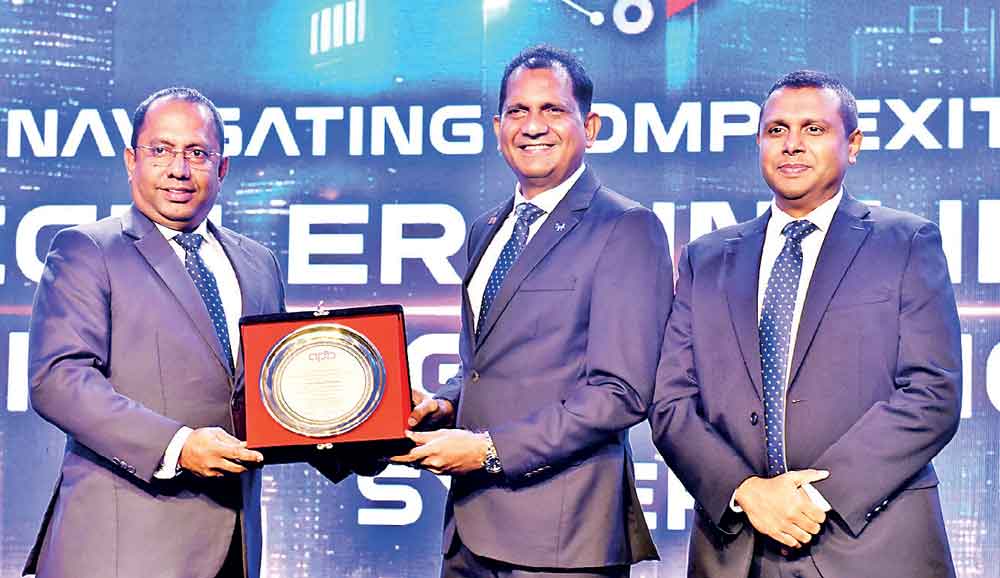
Life Membership Award- APB Past President Halin Hettigoda