Sunday Oct 04, 2026
Sunday Oct 04, 2026
Wednesday, 19 August 2026 05:30 - - {{hitsCtrl.values.hits}}
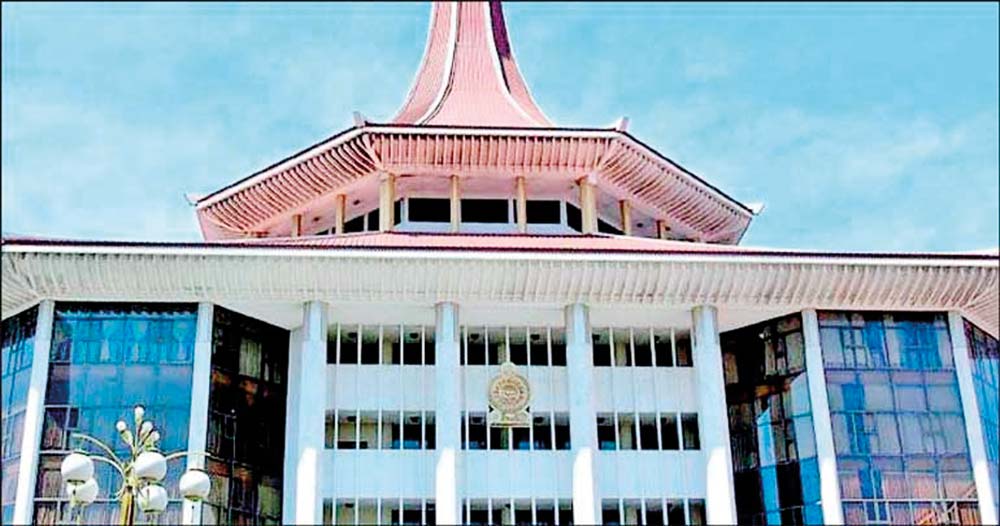
The Government’s proposed 22nd Amendment to the Constitution faces an immediate test before the Supreme Court and further resistance in Parliament, after several petitions were filed within hours of its tabling yesterday challenging the extension of retirement ages of superior court judges, including those currently in office.
The anticipated legal challenges, including petitions by the Samagi Jana Balawegaya (SJB), Bar Association of Sri Lanka (BASL) office-bearers, former Minister and constitutional law academic Prof. G.L. Peiris and Free Lawyers Movement Chairman Maithri Gunaratne, come ahead of the Bill’s Second Reading scheduled for today (19). Petitioners are seeking a determination that the amendment requires both a two-thirds majority in Parliament and approval by the people at a referendum.
Justice and National Integration Minister Harshana Nanayakkara yesterday presented the Twenty-Second Amendment to the Constitution Bill together with the Judicature (Amendment) Bill, prompting protests and several points of order from Opposition MPs led by Opposition Leader Sajith Premadasa.
The proposed 22nd Amendment seeks to raise the retirement age of Supreme Court judges from 65 to 67 years and Court of Appeal judges from 63 to 65 years. The Judicature (Amendment) Bill proposes changes to the retirement age of judges serving in the lower courts.
The Government has said the changes are intended to address shortages of judicial officers and strengthen the judicial system. The constitutional challenges, however, focus particularly on the application of the proposed extension to judges already holding office.
SJB General Secretary and MP Ranjith Madduma Bandara filed the party’s petition, SC/SD/31/2026, naming the Attorney General as respondent.
Madduma Bandara argues that altering the tenure of serving judges affects judicial independence, the separation of powers and the sovereignty of the people. The SJB said constitutional amendments should be considered in terms of their potential impact on the country’s democratic structure, separation of powers and the rights of the people.
Prof. Peiris filed a separate Special Determination petition focusing on the proposed extension being made applicable to incumbent judges, including the incumbent Chief Justice.
He contends that the provision, as drafted, could amount to an inducement under the guise of a constitutional amendment because it would extend the tenure of judges currently holding office, and could therefore be perceived by the public as an inducement offered to holders of judicial office.
Prof. Peiris further argues that Clause 2 is inconsistent with, among others, the Preamble and Articles 3, 4, 12(1), 28, 107, 108, 110, 111C and 83 of the Constitution, and would alienate the inalienable sovereignty of the people, specifically their judicial power.
He also contends that applying the extension to sitting judges would introduce a constitutional amendment with retrospective effect.
The first petition against the Bill was filed by BASL Treasurer T.M.S. Pasindu Silva and its Assistant Secretary. Free Lawyers Movement Chairman Gunaratne subsequently filed another challenge.
The court action follows Opposition protests when the legislation was presented yesterday. Premadasa described the proposed changes as the “death of democracy.”
Under the Constitution, a Bill may be challenged before the Supreme Court within 14 days of being placed on Parliament’s Order Paper.
The Supreme Court proceedings will now determine whether the proposed amendment can proceed through Parliament with the required special majority or must additionally be submitted to the people at a referendum, while the Government must separately contend with Opposition resistance as the Bill moves to its Second Reading today.

