Thursday Oct 15, 2026
Thursday Oct 15, 2026
Wednesday, 3 December 2025 05:38 - - {{hitsCtrl.values.hits}}
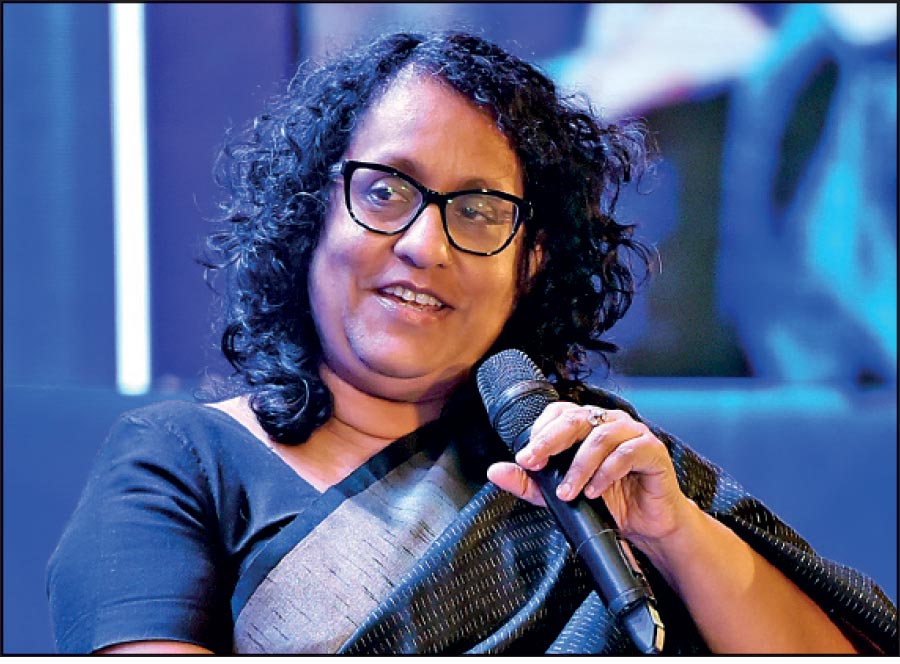
Dr. Harini Amarasuriya
By Charumini de Silva
Prime Minister Dr. Harini Amarasuriya yesterday delivered an unvarnished account of the scale of destruction caused by the recent cyclone and flooding, while assuring the business community that the Government’s reform agenda and economic stabilisation path will not be derailed.
Speaking during a fireside chat at the Sri Lanka Economic Summit organised by the Ceylon Chamber of Commerce, the Premier outlined the immediate humanitarian challenges, the extensive infrastructure damage, and the medium-term strategies to normalise lives, restore livelihoods and accelerate structural reforms.
“This catastrophe cannot push us away from the path we have set. It must strengthen our resolve,” she said.
Dr. Amarasuriya added that despite the shock, the Government remains committed to the growth path outlined in the Budget 2026, anchored on six key pillars driving the medium-term vision which include inclusive growth, export diversification, sustainability in policy, production economy, rural development, and digital transformation.
“The 7% GDP growth target for 2026 remains intact. However, given the circumstances, it will be subjected to adjustments as new data emerges,” she added.
Addressing questions on whether the disaster would delay key structural improvements and legislations such as State-owned enterprises (SOE) reforms, trade facilitation measures, digitalisation and the single-window platform for investment, the Prime Minister was unequivocal.
Pix by Ruwan Walpola
“These are not optional extras. If we are to recover quickly, we need the right policy environment. None of these reforms will be postponed. In fact, some will move faster,” she said.
Responding to concerns from industry leaders, Dr. Amarasuriya insisted that Sri Lanka’s tourism sector will remain central to economic recovery.
She stressed that tourist arrivals during the season should not be hindered, and urged travellers to continue visiting Sri Lanka, noting that the South and East coasts were largely unaffected and many affected areas would recover within weeks.
“This is when we need you the most,” she said, calling on international visitors not to cancel, but to adapt travel plans where necessary.
In one of the strongest moments of the discussion, Dr. Amarasuriya said Sri Lanka must confront the structural causes that repeatedly make the same communities vulnerable to climate catastrophes.
Pointing to heavily inundated Colombo suburbs built on reclaimed marshland, she said: “This is not an accident. These outcomes are the result of decades of bad planning, poor land-use decisions and political expediency.”
She asserted that the Government’s ‘Rebuild Sri Lanka’ vision aims not only to restore what was lost, but to fundamentally reshape how the country plans, builds and manages climate resilience. “This includes ensuring that evidence, not politics, drives land planning, infrastructure decisions and urban development,” she said.
Dr. Amarasuriya also acknowledged the profound human cost of the disaster, noting that while official deaths remained relatively low, the number was still significant for a country of Sri Lanka’s size, with more missing persons being reported every day. “Access to several areas in Matale, Kandy, Nuwara Eliya and Badulla remained limited as many communities were still grappling with the emotional and material shock of losing homes, livelihoods and social infrastructure,” she remarked.
Despite the distress, the Prime Minister praised the “extraordinary resilience” of affected communities and the solidarity shown across the country from public officials and private companies to civil society groups, international partners and diplomatic missions who stepped forward with assistance.
She noted that the biggest challenge now emerging is the scale of physical destruction, with entire villages inundated, roads washed away, bridges collapsed, and significant damage to housing and public utilities.
“Formal assessments are still underway, supported by the World Bank, UN agencies and bilateral partners. We do not yet have final numbers, because even the officials tasked with doing these assessments have themselves been affected,” she explained.
The Government’s immediate priority, Dr. Amarasuriya stressed, is stabilising daily life before addressing broader economic rehabilitation. This includes clearing debris, reopening schools and universities, restoring utilities and ensuring that displaced families can return home.
Electricity has been restored in most parts of the country, though several pockets, especially in the Central Province remain without power due to severe structural damage. “Communication networks are largely back online and water supply disruptions are now being rectified as floodwaters recede,” she added.
She also noted that the Government has already announced cash grants for households to restart essential repairs and replace basic belongings, assuring that additional support schemes will follow once the full assessment of losses is completed.
On supporting businesses, she said the Government is evaluating temporary relief measures, including possible moratoria or rescheduling of debt for affected SMEs, though final decisions will be tied to verified data.
The Premier confirmed that the Maha season harvest cycle has been heavily disrupted, particularly in paddy, vegetables and other short-term crops. She noted that in many districts farmers had only recently restarted cultivation following earlier economic difficulties, making the latest loss even more devastating.
With cultivations destroyed, seed stocks washed away, and irrigation systems damaged, she warned that there may be pressure on food prices in the coming months. The Government is therefore considering temporarily relaxing certain import regulations, including quarantine requirements, to prevent shortages and stabilise prices.
“This is an exceptional situation. Our priority is to ensure food security and prevent scarcity,” she stressed.
The Prime Minister thanked international partners for their rapid support, from emergency equipment to recovery financing, whilst calling on the private sector to remain committed to Sri Lanka’s long-term economic direction despite the setback.
“Maybe it sounds corny, but we must keep faith that our people will recover. We have done so before. What we ask of the private sector is to not lose confidence, to stay the course with us,” she appealed.
Dr. Amarasuriya also urged the public and the global diaspora to support the newly launched ‘Rebuild Sri Lanka Fund’, which she said would be anchored to a clear vision of resilience, inclusivity and sustainable development.
“The very fact that this event is happening, proves that Sri Lanka will go on and we will welcome visitors just as warmly tomorrow as we did yesterday,” she affirmed.


