Thursday Nov 12, 2026
Thursday Nov 12, 2026
Thursday, 12 November 2026 00:00 - - {{hitsCtrl.values.hits}}
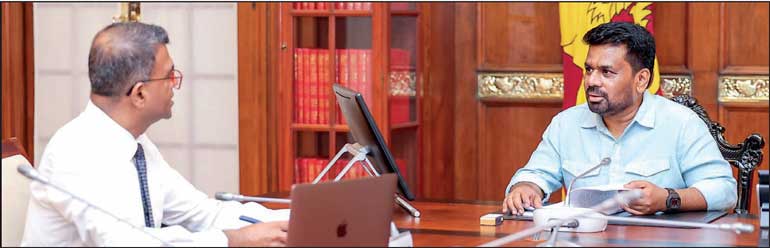
President and Finance Minister Anura Kumara Dissanayake (right) with Treasury Secretary Dr. Harshana Suriyapperuma reviewing the finalised 2027 Budget proposals yesterday
President and Finance Minister Anura Kumara Dissanayake is expected to present an investment-oriented 2027 Budget in Parliament today, with some relief for masses impacted by the tough stabilisation measures of the past two years, climate change and the Middle East conflict.
As hinted by the President and his Ministers in recent weeks, the Pay As You Earn threshold is set to be adjusted upwards again and no new taxes or rate increases are expected, as the Government squares pre-announced relief with International Monetary Fund (IMF) conditions for a $ 345 million tranche and El Niño and the Middle East war that are eroding growth assumptions.
The Budget, the Government’s third, carries Rs. 4.99 trillion in service expenditure and a Rs. 3.8 trillion net borrowing cap.
Relief is to be delivered in stages. The President has told a trade union convention that the PAYE threshold, already raised from Rs. 100,000 to Rs. 150,000, will be adjusted again, and has set out a two to three year VAT reduction alongside a one-year deferral of the IMF-backed property tax. No new taxes or rate increases are expected, with the revenue strategy resting on compliance rather than rate changes.
Revenue mobilisation is running well ahead of targets. The original target was to raise Government revenue to 15.4% of Gross Domestic Product (GDP) by 2030, but the country had already exceeded 16% by end-2025. This year’s target, set under ceilings referenced to the Public Financial Management Act, has been kept at around 15% and is comfortably within reach.
Once that level is secured, space opens to fund much-needed public investment and to consider strategies to reset the present tax structure. Problems in corporate income tax and individual income tax are acknowledged, but rates are unlikely to come down at this stage without delaying revenue mobilisation. A reduction in indirect taxation becomes possible once revenue reaches the required level, with all tax policy changes to be guided by fairness, simplicity and convenience.
The Budget carries Rs. 2 trillion in capital allocations, prioritising roads, railways, rural connectivity and networks, logistics, and some social spending, and is framed as a move beyond the goal of economic stabilisation towards economic expansion and transformative development. The President reviewed the final document at the Presidential Secretariat on 11 November. Existing bureaucratic systems and resources, however, constrain the State’s ability to spend at speed, and discussions on accelerating disbursement are already under way.
Most macroeconomic stabilisation targets have been met ahead of or within the expected timeframe, drawing recognition from local stakeholders, diplomatic missions, international agencies and independent rating agencies. The stated task now is to move past stabilisation into real transformation, with investment needed both local and foreign, Finance Deputy Minister Anil Jayantha Fernando recently said.
Domestic savings are identified as the immediate opportunity, given the gap between savings and investment, with the capital market cast as the channel for pooling scattered savings and directing them into the real economy. To that end, capital market policies are to be far more visible in the 2027 Budget, with an acknowledgement that steps taken over the past two years were not widely seen and led some to conclude little had been done for the market, Fernando said.
Most of the 12 capital market development proposals submitted by the Securities and Exchange Commission of Sri Lanka (SEC) have already been discussed and accepted by the Finance Ministry. Some will be included in the Budget proposals, while the remainder will be discussed further and implemented in consultation with the Colombo Stock Exchange (CSE) and the SEC. Required legal amendments are to be introduced, with new Acts in the pipeline for presentation to Parliament, and the single window project for investment facilitation through technology is nearing completion.
The Appropriation Bill, Gazetted on 18 September, 2026 by order of the President as Finance Minister, sets service expenditure for Ministries and Departments at Rs. 4.99 trillion and statutory expenditure, charged to the Consolidated Fund by other laws, at Rs. 4.92 trillion, for total expenditure of about Rs. 9.92 trillion. Net outstanding Government borrowings are capped at no more than Rs. 3.8 trillion for the year.
The structure shows how far recurrent commitments constrain the Budget. The Department of Pensions alone accounts for Rs. 550.35 billion of the Public Administration Ministry’s Rs. 651 billion. Provincial Councils are budgeted separately at Rs. 574.95 billion recurrent and Rs. 85 billion capital, a combined Rs. 659.95 billion, taking the Ministry’s effective allocation to about Rs. 1.31 trillion, ahead of Finance.
The IMF reached staff-level agreement on the Seventh Review of the $ 3 billion Extended Fund Facility on 8 November, making Executive Board approval contingent on the Budget being presented in line with program parameters and on adequate progress with debt restructuring. The arrangement ends in March 2027, with debt service stepping up in 2028. Revenue must stay above 15.3% and 15.4% of GDP in 2026 and 2027, with primary expenditure capped at 12.9% of GDP. The Government has told the Fund that Budget revenue measures will suffice for targets.
The external backdrop has worsened. The IMF said the economy grew 4.2% in the second quarter, an eleventh consecutive quarter of expansion, with reserves at $ 6.9 billion at end-August, but flagged risks from the war’s duration and intensity, global trade policy and El Niño. “Safeguarding macroeconomic stability in a shock-prone environment requires continuing with prudent policies and bold reforms to protect the hard-won gains of the program,” it said, pressing for fuel prices to track global markets.
Inflation rose to 8.3% year-on-year in October from 8% in September, a three-year high. The current account swung to a $ 128 million deficit in September, taking the nine-month shortfall to $ 420 million against a $ 1.9 billion surplus a year earlier. Equity outflows reached $ 170.2 million over the nine months, against $ 85 million a year before, though direct investment in the balance of payments primary account exceeded $ 1 billion, up from $ 841 million.
Analysts point out that the economy is undergoing its most fundamental change in seven to eight decades. Twin fiscal and current account surpluses were last recorded in the 1950s and the shift will reward capital-intensive, margin-driven businesses while squeezing labour-intensive, volume-based players, as the Government avoids loose fiscal policy in a break from the past. However, the fiscal gains and economic stabilisation have been uneven, not benefiting vulnerable groups.
Other analysts argue that the fiscal responsibility framework must survive the Budget. They want revenue to increase through a widened tax net, and call for a healthy primary surplus, a contained deficit and a shift from recurrent to capital spending through procurement changes, with tax moderated rather than cut. Policy stability mattered more than any single Budget.
Advocate Institute has called for an independent Tax Ombudsman with binding timelines, noting that of Rs. 2.16 trillion in arrears at end-2025, Rs. 1.68 trillion is disputed and interest on disputed balances rose from Rs. 81 billion to Rs. 278 billion in a year. They want Port City residential exemptions of up to 25 years abolished, given apartments there sell at about $ 500 a square foot to roughly 6,000 families, and an end to property tax breaks for the Port City casino.
They also seek an end to lotteries as a revenue tool, parity between online gaming and casinos, and a financially independent Gambling Regulatory Authority. On food, they calculate that taxes make up Rs. 308 of the retail price of chicken and want the Rs. 50 per kilo Special Commodity Levy on imported corn replaced with VAT, import quotas ended and cash transfers used to support about 35,000 registered maize farmers. On paddy, they want Bim Saviya titling accelerated, since freehold deeds for nearly two million families would otherwise take about 100 years, and the Plant Variety Protection Act passed.
The Second Reading vote is set for 6 p.m. on 20 November and the Third Reading for 14 December.