Thursday May 28, 2026
Thursday May 28, 2026
Wednesday, 31 December 2025 00:00 - - {{hitsCtrl.values.hits}}
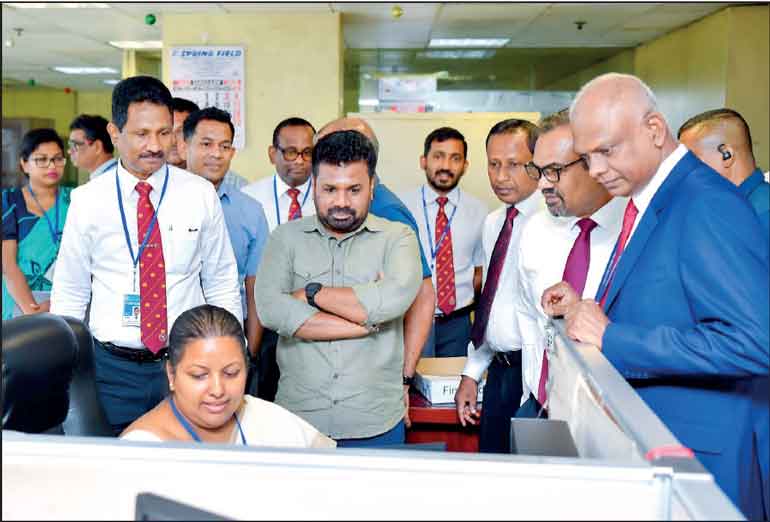
President Anura Kumara Dissanayake at Sri Lanka Customs with Director General Seevali Arukgoda (right)
President and Finance Minister Anura Kumara Dissanayake visited Sri Lanka Customs, the Inland Revenue Department and the Excise Department yesterday to commend record-breaking performances and to deliver a clear message: sustained revenue mobilisation, strict enforcement and institutional integrity are now central to economic stability.
President Dissanayake visited the three main revenue agencies of the Government—Sri Lanka Customs, the Inland Revenue Department, and the Excise Department—to commend their record-breaking performances and discuss their plans for 2026 and beyond.
The year 2025 has been recorded as the highest revenue-earning year in the history of Sri Lanka Customs, according to Sri Lanka Customs Director General S. P. Arukgoda, who noted that the Department surpassed its expected revenue target of Rs. 2,115 billion, enabling it to enter 2026 with an additional surplus of approximately Rs. 300 billion.
During the visit, the President engaged in extensive discussions with the Director General, Directors and senior officials of the Department.
Commending the vital role played by Sri Lanka Customs in generating much-needed State revenue and contributing to economic and social stability, the President expressed his appreciation to all Customs employees for their commitment and service.
Emphasising that Sri Lanka Customs is one of the country’s key revenue-generating institutions, the President highlighted the importance of maintaining operations in an efficient, transparent and accountable manner. He also called upon all officers to work collectively, with renewed plans and strategies, to lead the country towards economic success in 2026.
The President further stressed that the economic collapse in 2022 was largely due to the Government’s inability at the time to generate sufficient rupee revenue and secure adequate foreign exchange. He pointed out that economic stability has since been restored through the achievement of revenue targets, a capability that has also been critical in responding to recent disaster situations.
A comprehensive discussion was also held on Sri Lanka Customs’ overall performance in 2025 and its new strategic plans for 2026, with several new ideas and proposals being presented.
Sri Lanka Customs currently operates under four main pillars—revenue collection, trade facilitation, social protection and institutional development—and the President inquired into the progress achieved under each area.
It was also revealed that the Internal Affairs Unit, established to prevent corruption and promote an ethical institutional culture, is functioning effectively.
The President sought updates on measures taken to address long-standing allegations related to congestion, delays and corruption in Customs operations, as well as plans to modernise cargo inspection systems.
The discussions further covered Sri Lanka Customs’ digitalisation programme planned for 2026, along with issues relating to recruitment, promotions, training, and staff salaries and allowances.
Highlighting the strategic importance of airports in preventing attempts to create instability within the country, the President underscored the need for Sri Lanka Customs to operate with a comprehensive awareness of its duty to uphold the stability of the State, while remaining prepared to face emerging challenges.
At the Inland Revenue Department, President Dissanayake was briefed on how the agency collected Rs. 2,203 billion in revenue in 2025, the highest amount recorded in its 93-year history. This represented a surplus of Rs. 33 billion over the annual revenue target and a 15% increase compared with the previous year, according to Inland Revenue Commissioner – General Rukdevi Fernando.
Marking the first occasion in the Department’s 93-year history that a President has visited it, President Dissanayake attended a meeting with staff to review progress in 2025 and discuss plans for 2026.
He expressed appreciation to all officers and staff for surpassing the Government’s revenue expectations and urged them to continue working towards a common objective to realise the economic transformation required for the country.
Emphasising that no individual is entitled to the privilege of evading taxes, the President stated that the era of a tax culture shaped by personal, familial or political affiliations has come to an end. He stressed that the law will be enforced without hesitation, regardless of status, against those who attempt to evade taxes.
The President also noted that tax collection is neither repression nor coercion but a legitimate right of the State, adding that necessary changes will be made to laws, regulations, designations and staffing to secure this contribution.
He further emphasised that the Government’s objective is to ensure that the benefits of these economic achievements flow to the public. Accordingly, the Government is focusing on improving essential public services, transforming the transport system, and allocating adequate resources for the development of the education and health sectors.
The President also highlighted the need for a targeted program to strengthen tax collection by improving tax literacy, simplifying the tax system and addressing staff shortages.
Fernando stated that the professional competence and dedication of the Department’s officers were the key factors behind the achievement.
She added that a revenue target of Rs. 2,401 billion has been set for 2026 and that the Department expects to achieve this through programs aimed at enhancing tax compliance and broadening the tax base.
In addition, she said plans for 2026 include expanding third-party data sharing, strengthening investigations into domestic and overseas assets, taking over the RAMIS system, reinforcing risk-based auditing, introducing e-invoicing, adopting modern technology for tax administration and enhancing tax ethics.
At the Excise Department, President Dissanayake commended the agency for surpassing its revenue targets after many years, noting that the commitment of officers and a corruption-free operational framework contributed to the achievement.
The Excise Department is on track to exceed its 2025 revenue target of Rs. 227.4 billion, with expected revenue reaching Rs. 231.3 billion. This marks the first time in its history that the Department has achieved 102% of its revenue target.
The President noted that the national economy depends on the level of State revenue generated, stressing that a collapse in State revenue would inevitably lead to an economic collapse. He pointed out that the country faced severe consequences during 2020–2021 due to a sharp decline in State revenue.
The President’s attention was also drawn to challenges faced by the Excise Department, including issues related to vehicles and buildings. He emphasised the need to reach internal consensus and to resolve, without delay, issues arising from vacancies in executive positions and related appointments.
The meeting further reviewed progress on amendments to the Excise Ordinance, as well as the status of illicit liquor and narcotics detection operations carried out in 2025. Commissioner General of Excise M.B.N.A. Premarathna, along with senior officials and members of the Excise Department staff, were present at the meeting.