Tuesday Sep 15, 2026
Tuesday Sep 15, 2026
Wednesday, 4 February 2026 00:00 - - {{hitsCtrl.values.hits}}
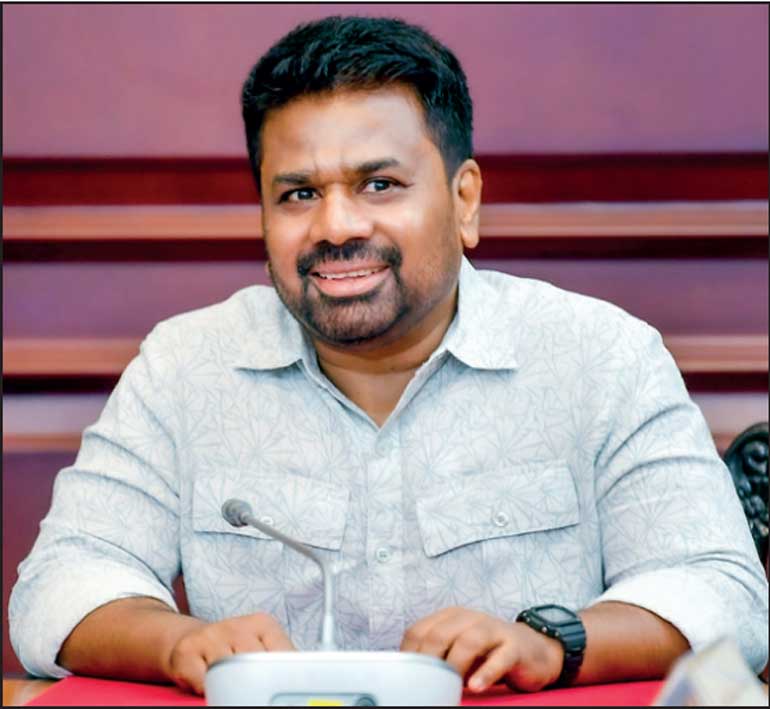
President Anura Kumara Dissanayake
President Anura Kumara Dissanayake yesterday convened a high-level meeting to review Sri Lanka’s preparedness for its Third Mutual Evaluation on Anti-Money Laundering and Combating the Financing of Terrorism (AML/CFT), signalling direct presidential oversight of a process critical to safeguarding the country’s standing in the global financial system, according to the President’s Media Division.
The meeting comes as Sri Lanka prepares to demonstrate technical compliance with the Financial Action Task Force’s (FATF) 40 recommendations and their effective implementation across 11 immediate outcomes. Failure to meet these standards could expose the country to heightened international scrutiny, including the risk of being placed back on the FATF “grey list”, a designation that could deter foreign investment and disrupt international financial transactions.
Addressing officials, President Dissanayake stressed that accountability and good governance must precede efforts to convince external stakeholders. “As a Government, we are first and foremost committed to ensuring good governance,” he said, urging State institutions to take responsibility for timely and effective implementation.
The FATF, the global standard-setter on AML/CFT and countering the financing of the proliferation of weapons of mass destruction, assesses countries through a Mutual Evaluation process that examines legal frameworks, institutional capacity, resource allocation and effectiveness. Sri Lanka’s evaluation is overseen by the Asia/Pacific Group on Money Laundering (APG), with domestic coordination handled by the Financial Intelligence Unit of the Central Bank of Sri Lanka and the involvement of around 25 Government institutions.
An Operational Committee on AML/CFT appointed by the President monitors the implementation of action plans across these agencies. The discussion also reviewed Sri Lanka’s previous evaluations in 2006 and 2014–2015, including shortcomings that led to international grey listing in 2017, underscoring the need for a nationally prioritised and fully resourced effort.
During the meeting, the President questioned officials on legal delays and obstacles to enacting required legislation and instructed that pending technical amendments be expedited. Human resource shortages across several institutions were identified as a key constraint, with the President directing immediate corrective action, including exploring the re-engagement of experienced retired officers on one-year contracts.
He also ordered steps to resolve instances of officers holding multiple positions, directed that promotions and recruitments be accelerated in consultation with the Public Service Commission, and instructed that a circular be issued to retain trained officers in their current posts until the evaluation is completed in November.
The report of the Special Task Force appointed to oversee progress is due to be submitted to the President within the next two weeks.
The meeting was attended by Justice and National Integration Minister Harshana Nanayakkara, Central Bank Governor Dr. Nandalal Weerasinghe, Finance, Planning and Economic Development Ministry Secretary Dr. Harshana Suriyapperuma, Defence Ministry Secretary Air Vice Marshal Sampath Thuyacontha (Retd.), Foreign Affairs Ministry Secretary Aruni Ranaraja, Attorney General Pärinda Ranasinghe, Inspector General of Police Priyantha Weerasuriya, National Intelligence Chief Major General Nalinda Niyangoda, and heads of relevant institutions, including the Commission to Investigate Allegations of Bribery or Corruption and the Legal Draftsman’s Department.


