Tuesday Sep 15, 2026
Tuesday Sep 15, 2026
Thursday, 5 February 2026 05:44 - - {{hitsCtrl.values.hits}}
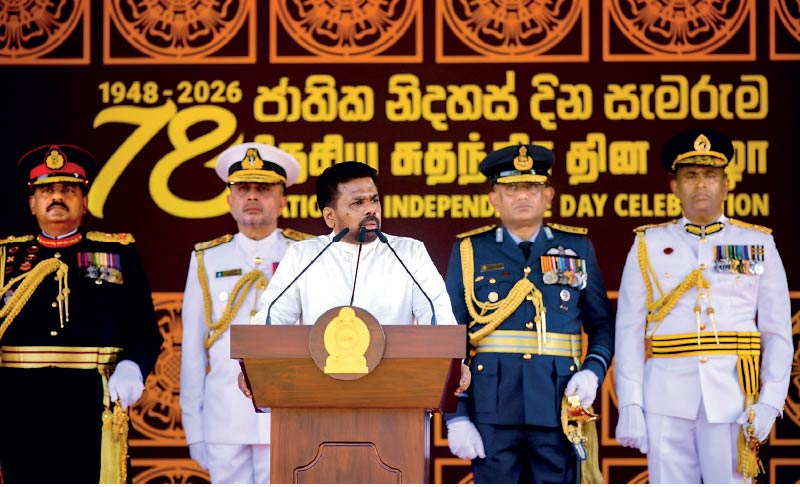
President Anura Kumara Dissanayake
President Anura Kumara Dissanayake yesterday set out a broad economic vision centred on governance, human capital, and equitable growth, arguing that Sri Lanka’s political independence remains incomplete without economic freedom.
Addressing the 78th National Independence Day celebrations, the President said the country was still “engaged in a struggle to complete our independence,” adding that “the true fulfilment of independence lies in the extent to which we are able to achieve economic freedom.”
He said the Government’s rebuilding agenda must rest on sovereignty, self-determination, and freedom while drawing selectively from Sri Lanka’s past. “We are a nation with a proud and ancient history,” he said, noting that rebuilding would require the country to “discard what is harmful” while embracing what strengthens long-term development.
Economic growth, he said, must be rooted in national realities rather than imported models.
“This is not a development model that severs our roots or erodes our national character, but one that builds a new Sri Lanka upon them,” the President said, signalling a shift away from growth paths that weaken institutions or social cohesion.
Human capital was identified as the economy’s primary constraint and opportunity. “Above all these, our most valuable asset is our human resources,” he said, adding that Sri Lanka must create a workforce that “prioritises knowledge over ignorance, progress over outdated prejudices, and unity over division.”
Education reform, the President said, would be central to productivity and competitiveness.
“We must initiate the most transformative era in our education sector,” he said, adding that the Government was prepared to confront entrenched thinking and embrace modern knowledge and technology to create a well-rounded, skilled population.
He linked economic performance directly to social cohesion, warning that division undermines national strength. “When we are divided, our strength weakens,” the President said. “Racism and extremism only lead to the self-destruction of our own strengths.” He said national unity would be treated as a core economic asset in rebuilding the country.
For investors and businesses, the clearest signal came on governance. Dissanayake placed the supremacy of the rule of law at the centre of the rebuilding program. “The foundation for building Sri Lanka lies in ensuring that the supremacy of the law is properly upheld,” he said, arguing that confidence in institutions was essential for a strong and just economy.
Environmental limits were framed as binding constraints on future growth. “A path of development that completely destroys the ecosystem is not our aspiration,” the President said, pointing to environmental degradation and recent climate-related disasters as evidence of the costs of unsustainable growth. He said rebuilding must preserve forests, water systems, and biodiversity for future generations.
On the external front, the President said Sri Lanka would pursue “international relations of a new dimension” in an increasingly competitive global economy. The objective, he said, was to strengthen national security, improve citizens’ lives, and build recognition for Sri Lanka “on a new level” in the international community.
Turning to recent economic performance, he said 2025 had recorded progress across key indicators, including “the lowest budget deficit since 1977,” “record-high Government revenue after 2006,” historically large current account balances, and record tax revenue collected by the Inland Revenue Department.
However, he cautioned against treating macro data as an end in itself. “An economy’s success is not measured by data alone,” he said. “If the lives of citizens are not improved, if livelihoods are not made easier, then even the strongest economic data becomes meaningless.” The central task of rebuilding, he said, was to ensure that economic gains reached disadvantaged segments of society.
Economic strength, he added, was inseparable from sovereignty. “True freedom is measured by the strength of an economy,” Dissanayake said, noting that dialogue was already under way with industrialists, entrepreneurs, public officials, and the public to shape a sustainable and inclusive growth path.
Calling for collective effort, the President urged all stakeholders to commit to rebuilding the country together. “If you want to go fast, go alone. But if you want to go far, go together,” he said, adding that Sri Lanka’s economic, institutional, and environmental challenges could only be addressed through shared effort.


