Thursday Oct 15, 2026
Thursday Oct 15, 2026
Saturday, 21 March 2026 00:00 - - {{hitsCtrl.values.hits}}
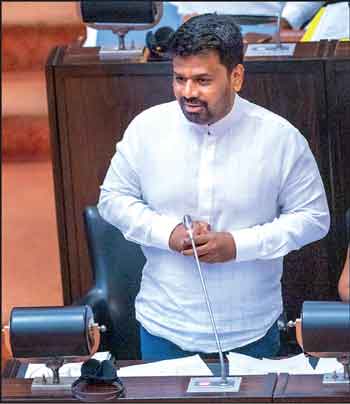 |
| President Anura Kumara Dissanayake in Parliament yesterday |
President Anura Kumara Dissanayake yesterday told Parliament that the Government will move quickly to revise fuel pricing, review taxation and expand procurement measures to manage the impact of the Middle East crisis, warning that delays could affect supply.
“We must carefully assess how it may impact us and respond accordingly,” he said, describing the situation as an external shock affecting both energy supply chains and foreign exchange inflows.
He said the Government now faces an immediate pricing decision as private sector suppliers withdraw due to losses.
“Private companies state that unless they receive market prices, they will not import fuel. This is reasonable, as their losses per shipment could reach $ 55 million,” he said, noting that private players account for 43% of the domestic fuel market.
“Therefore, I think we need to make a decision on the fuel prices very soon,” he said, adding that price distortions could lead to supply issues. “If there is a price difference of Rs. 100–150 between the Corporation and private companies, consumers will avoid private suppliers, and will instead queue at CPC stations for hours.”
The President said global price movements and rising supplier premiums had increased costs. “Crude oil prices have increased from $ 81 to $ 114,” he said, while premiums on long-term tenders had risen “from around $ 2.5 to around $ 40.”
“Consequently, countries worldwide have decided to increase fuel prices. In our country, the increase has been around 8% on average,” he said.
On taxation, he said the Government was examining possible relief, but cautioned against broad-based reductions.
“Monthly tax revenue from fuel is about Rs. 20 billion,” he said, adding that diesel alone generated Rs. 240 billion last year, while the Ceylon Petroleum Corporation (CPC) carries significant debt.
“We are considering providing relief through taxes. However, both IMF policy and our own policy emphasise targeted subsidies rather than general ones,” he said.
He said implementation would be difficult given the scale of the informal economy. “The informal economy is large and complex. Therefore, we are considering both aspects,” he said.
On supply, the President said the Government had shifted away from ad hoc procurement towards long-term tenders.
“In the past, ad hoc or spot purchases led to serious issues of corruption. Therefore, we have consistently sought to secure energy supplies through long-term tenders,” he said.
He said refined fuel imports from suppliers in Singapore and India remained stable, but crude oil supply had become a concern.
“A shipment of 90,000 tons has been postponed,” he said, adding that another shipment “has not been fulfilled as expected.”
To address this, the Government called for tenders on 5 March covering diesel, petrol, furnace oil, aviation fuel and crude oil.
“As a result, a tender for diesel was awarded—petrol, furnace oil, Jet-A1 fuel,” he said, with shipments scheduled through April. However, “no company submitted a proposal to supply crude oil in April,” with only a June shipment secured so far.
A Cabinet-appointed committee is reviewing additional proposals. “Our foremost priority is to ensure the uninterrupted supply of energy. A shortage would be far more detrimental than an excess,” he said.
He said fuel imports must be carefully managed due to port constraints. “It takes around eight days to unload a fuel shipment,” he said.
The Government has also allowed private operators to supply fuel to exporters.
“We have issued licences and they have commenced supplying fuel required by exporters,” he said.
The President said discussions were underway on Government-to-Government arrangements (G2G), including with Russia.
“From that point, we began discussions and we will be able to present reports on that progress very soon,” he said.
He said the Government was reviewing legal inconsistencies in pricing, where agreements allow private firms to set prices while statutory authority rests with CPC.
“We are closely examining this issue,” he said.
Regarding LP gas, he said supply remained stable. “There is currently no issue regarding gas supply. We have secured the gas required for the month of March,” with April shipments also scheduled.
He said steps were also being taken to diversify supply sources and reduce reliance on single suppliers.
“If fuel prices are fully aligned with global market prices, the other side of our economy will contract. We are reviewing the matter and will arrive at a final decision very soon,” he added.


