Tuesday Oct 13, 2026
Tuesday Oct 13, 2026
Thursday, 21 May 2026 06:07 - - {{hitsCtrl.values.hits}}
|
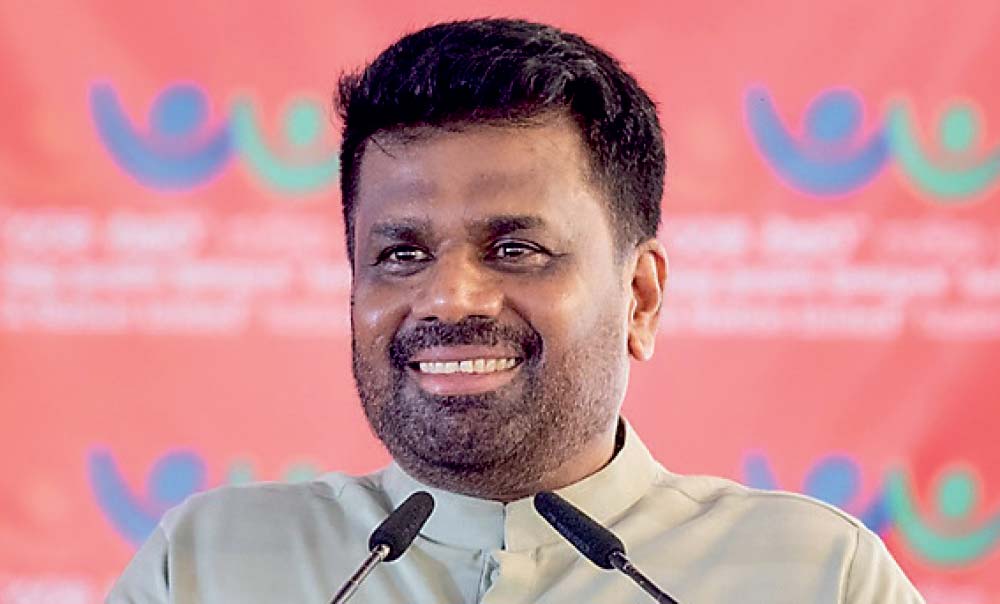
President Anura Kumara Dissanayake
|
President Anura Kumara Dissanayake yesterday assured that the Government would take measures to prevent a repeat of the economic collapse experienced in 2022, as Sri Lanka faces renewed pressure on the rupee and foreign exchange reserves amid a strengthening US dollar and the economic fallout from the Middle East crisis.
Addressing public events in Batticaloa, the President made his first public remarks since the recent depreciation of the rupee and said the Government was continuing discussions with the International Monetary Fund (IMF) on measures required to stabilise the economy under Sri Lanka’s Extended Fund Facility (EFF) program while responding to emerging global economic pressures.
He said the Government had already submitted proposals to the IMF and was discussing measures to manage the prevailing pressure on the dollar, including steps aimed at reducing fuel consumption, curbing imports, and lowering overall import expenditure.
The President said the strengthening of the US dollar against global currencies had intensified pressure on the Sri Lankan rupee, while tourism earnings, exports, and workers’ remittances had also weakened.
He noted that tourist arrivals in April had declined by 29% compared to the corresponding period last year, affecting foreign exchange earnings, while export demand and remittance inflows had also slowed amid global economic uncertainty.
Dissanayake also highlighted the sharp increase in fuel import expenditure in recent months, which has added further pressure on dollar demand and the rupee. Fuel imports had risen from $ 98 million in February to $ 216 million in March, $ 368 million in April, and $ 522 million in May.
He said the country’s economy continues to be managed under the IMF-backed EFF program and stressed that the Government was engaged in ongoing discussions with the IMF on proposals aimed at stabilising the economy and mitigating prevailing financial pressures.
The President called on citizens to reduce fuel consumption, exercise caution in the use of imported goods, and act responsibly to minimise the outflow of dollars from the country.
He said the country had only a limited window to contain the pressure on the dollar and urged the public to face the situation collectively and with restraint.
He warned that the difficult external environment would persist for some time longer, but maintained that the Government would not allow another destabilising economic crisis to emerge in the country.
President Dissanayake made these remarks yesterday while attending the ‘A Nation United’ Batticaloa District Program.
The President said: “Today, we have gathered with the objective of overcoming one of the most serious challenges facing our country. As a Government, we are focusing on several key challenges and are working with a firm determination to rebuild the nation.
Our first challenge is the task and journey of building a strong economy. Over the recent past, we have faced several challenges affecting our economy. Certain tax policies imposed by various countries had placed pressure on our economy.
Cyclone Ditwah became the disaster with the greatest economic impact in Sri Lanka’s recent history. Since it was an internal challenge, we were able to confront it with strength.
More recently, a war situation centred in the Middle East region has emerged. This has created economic challenges for all countries, regardless of whether they are considered developed nations or countries with weaker economies.
The economic challenges we are facing can mainly be divided into two categories. The first is earning sufficient revenue for the Treasury. We have managed this successfully. We now possess a Treasury account with the highest surplus in Sri Lanka’s history.
As a result, we were able to allocate Rs. 500 billion to face the impact of Cyclone Ditwah. Likewise, because funds were available in the Treasury, we were able to intervene to mitigate the rise in fuel prices and electricity tariffs caused by the conflict in the Middle East. We have allocated a further Rs. 100 billion for that purpose.
Last April, Rs. 20 billion was allocated for a fuel subsidy, and another Rs. 20 billion each will be provided for the next two months. Even today, the Government is providing a subsidy of Rs. 100 for every litre of fuel used by the public. This has been possible because the Treasury has sufficient funds.
Similarly, the increase in fuel prices compelled us to increase electricity tariffs to some extent. However, 95% of electricity consumers will not experience an increase in their electricity bills because the Government has decided to provide a subsidy. Therefore, during the most recent tariff revision, only around 5% of consumers experienced an increase.
We will continue this subsidy until September. The Government is bearing an expenditure of Rs. 15 billion for this purpose. As a result of sound economic management, our Treasury possesses the financial strength necessary to face such disasters.
However, we are currently facing a crisis relating to the US dollar. In particular, the dollar has strengthened against other currencies, which has affected our rupee. One of our main sources of income is the tourism industry, which earns dollars.
Compared to last April, tourist arrivals have declined by 29%, affecting our dollar inflow. Due to the global economic crisis, demand for our exports has also declined, leading to a shortage of export earnings in dollars. On the other hand, remittances sent by Sri Lankans working overseas have also declined this month.
At the same time, the increase in the value of the dollar has significantly raised the monthly cost of fuel imports. In February, fuel imports cost us $ 98 million. In March, this increased to $ 216 million, in April to $ 368 million, and in May to $ 522 million. The monthly fuel import bill has now exceeded $ 500 million. This has placed pressure on the rupee and increased demand for dollars. Therefore, a number of measures are being prepared to address this crisis.
At present, we are managing the economy within the framework of the EFF program linked to the IMF.
Therefore, we are discussing with them the decisions that need to be taken, while also presenting our own proposals. We must control this short-term pressure on the dollar. To achieve this, we must reduce fuel consumption.
We must also pay greater attention to the use of imported goods and reduce import expenditure. I urge all citizens to think about how each of us can individually contribute towards reducing the outflow of dollars from the country.
Let us face this short-term crisis with strength. I assure you that we will never allow the country to return to the destructive economic conditions of the past. That is the economic journey before us.”