Thursday Oct 15, 2026
Thursday Oct 15, 2026
Wednesday, 8 April 2026 04:33 - - {{hitsCtrl.values.hits}}
|
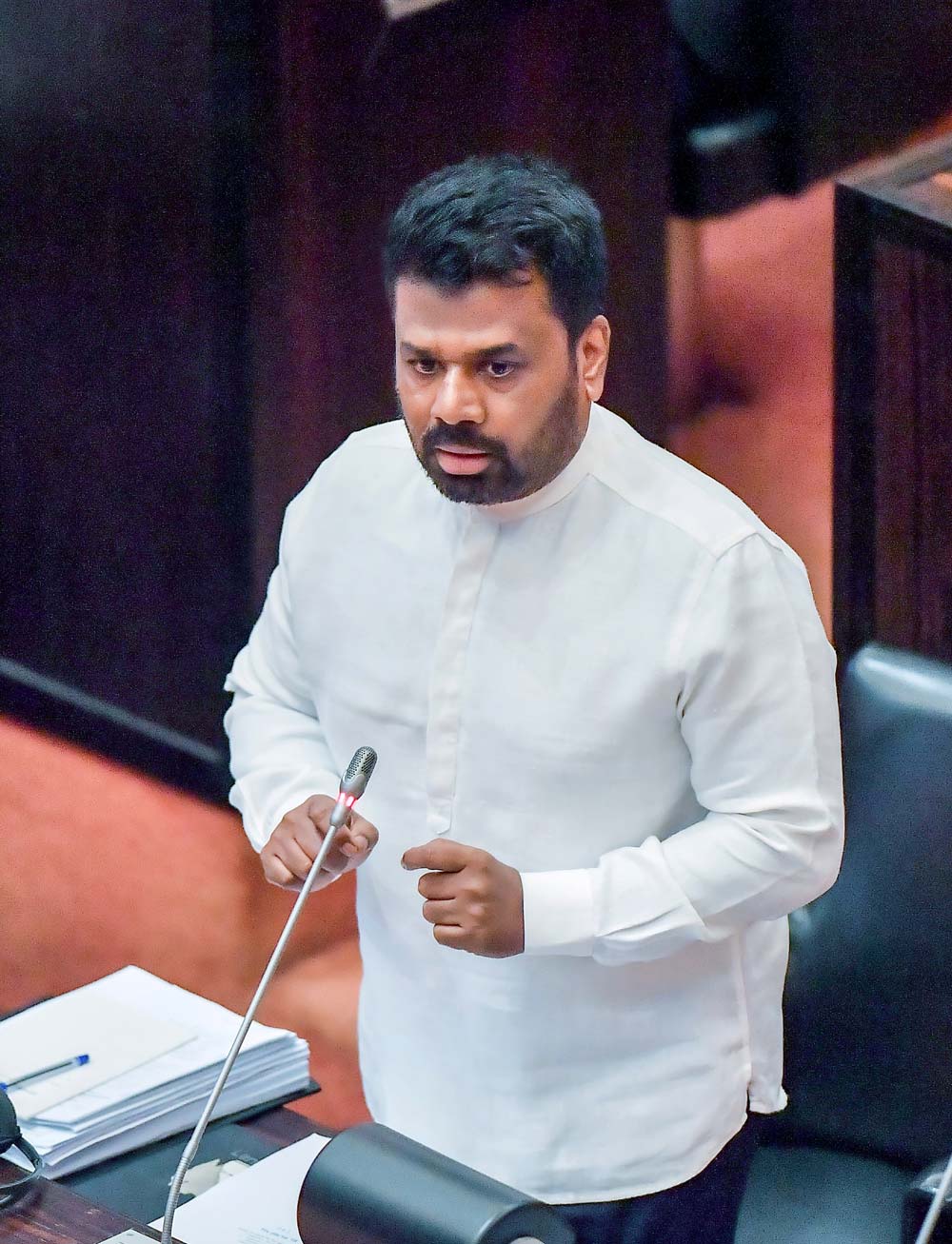
President and Finance Minister Anura Kumara Dissanayake
|
In a special Parliamentary address yesterday, President and Finance Minister Anura Kumara Dissanayake announced a Rs. 100 billion relief package to help contain the impact of the Middle East war on the domestic economy.
“You may recall that, in addition to addressing the destruction caused by the Ditwah catastrophe, we allocated Rs. 50 billion to meet public needs. That is what governance entails. Likewise, in response to the current crisis, the relief package I have presented amounts to Rs. 100 billion,” Dissanayake said.
“I believe we must provide relief to the people and safeguard their welfare. Accordingly, we have proposed an expenditure of Rs. 100 billion over three months within what we can afford. However, if the situation deteriorates further, we will return to this House with additional proposals and seek your support in approving them,” he said.
Dissanayake said the Government is ‘striving to maintain bank interest rates below 10% and inflation below 5%’. “Any appreciation of the US dollar will have adverse effects on us. The relief measures we have introduced are aligned with the current circumstances. We will ensure an uninterrupted supply of energy and fuel until the end of May, supported by the fuel subsidy measures,” he said.
The President said the increase in fuel prices has imposed an additional burden of around $ 1.5 billion, urging reduced consumption to limit import demand and ease pressure on the rupee. He also noted higher risk premiums on gas, although supply would be maintained, with possible disruptions confined to the private sector.
Pricing for super diesel and super petrol has been liberalised for private distributors, reflecting market rates. He noted that three other companies are involved in fuel distribution and have already adjusted prices accordingly. The Government currently controls 57% of the fuel distribution market and is assessing risks if the pricing gap with private players widens.
A three-month plan covering fuel, fertiliser and gas has been formulated, with a reassessment to follow. “We invite your ideas, proposals, and criticisms and we are prepared to consider them carefully,” the President said.
Sri Lanka is also seeking external support to secure fuel supplies. India, China and Russia have indicated willingness to assist. He noted that discussions with Indian Prime Minister Narendra Modi resulted in an agreement on fuel supply, while China has also committed to provide diesel and petrol. Russia has similarly agreed to supply fuel, with recent visits by its Energy Minister and Deputy Foreign Minister. The President said approval has been granted to continue transactions with Russia until 11 April, although an extension remains uncertain. He added that such purchases require the concurrence of international banks and that diplomatic efforts are ongoing to ensure continuity.
The President said the rupee has depreciated to some extent, although remittances remain resilient, with March inflows exceeding previous March levels. However, tourism earnings have fallen short, with around 150,000 arrivals compared to an expected 300,000, reducing foreign exchange inflows.
He said the crisis is concentrated in fuel and energy, with policy options limited to either full cost-reflective pricing or subsidisation. While cost-reflective pricing would protect the Treasury, the Ceylon Petroleum Corporation and the Ceylon Electricity Board, it would impose a significant burden on businesses and households, requiring a balanced approach.
At current market levels, diesel prices would exceed Rs. 600 per litre, including a Rs. 50 tax. The Government has opted to retain the tax and instead provide a subsidy of up to Rs. 100 per litre of diesel. The fuel pricing formula will be reintroduced around 1 May, based on actual monthly data, alongside a subsidy of up to Rs. 20 per litre of petrol. This will cost approximately Rs. 20 billion per month, amounting to Rs. 60 billion over three months.
Given the absence of a sufficiently accurate system to target subsidies, super diesel and super petrol prices have been aligned with market rates, while broader subsidies are maintained.
Additional targeted support will be provided to the fisheries sector. Standard fishing vessels will receive an extra Rs. 50 per litre subsidy on top of the Rs. 100 diesel subsidy, for up to 625 litres per month, with the additional subsidy credited directly to bank accounts. This translates to Rs. 31,250 per vessel per month over three months. Multi-day vessels will receive a fuel allowance of Rs. 150,000 per voyage within the same period.
On fertiliser, around 14,000 metric tonnes of urea procured at earlier prices are currently held by State agencies, with suppliers initially agreeing to release 65% of stocks and later the full quantity, sufficient for two cultivation rounds. However, future imports are priced between $ 600 and $ 850 per metric tonne, raising risks for subsequent cultivation cycles.
The Government will maintain the fertiliser price at Rs. 10,200 despite a market price of around Rs. 13,500, absorbing approximately Rs. 3,000 per bag at a total cost of about Rs. 1.7 billion. Fertiliser subsidies will be increased from Rs. 25,000 to Rs. 30,000, while subsidies for other crops will rise from Rs. 15,000 to Rs. 18,000. Tea smallholders will receive an additional Rs. 5,000 per bag on top of the existing Rs. 4,000 subsidy, at a cost of around Rs. 6.5 billion.
Aswesuma remains the primary mechanism to identify low-income households. Payments for April will be increased from Rs. 17,500 to Rs. 25,000, from Rs. 10,000 to Rs. 15,000, and from Rs. 5,000 to Rs. 7,500, at an additional cost of Rs. 8.5 billion.
On electricity, the President outlined cost pressures from increased thermal generation due to low reservoir levels, higher fuel prices, reduced coal quality and substitution of diesel for furnace oil and naphtha. Crude oil shipments from the Middle East have been delayed, including expected supplies from Fujairah, with one shipment delayed and another pending, while the next is expected by mid-April.
He said refinery operations may be halted for several days, requiring separate imports of furnace oil, expected between 13 and 15 April, at higher cost. If refinery output is disrupted, diesel will need to be used for power generation, further increasing costs.
Coal quality issues have also affected output. Although installed capacity is 900 megawatts, actual generation is around 810 megawatts due to internal consumption and inconsistent performance. While plants are expected to generate 270 units, output has fallen to as low as 244 units in some cases.
Coal shipments undergo laboratory testing, with 80% of payments made upfront and the remaining 20% after verification at an Indian laboratory. Despite passing tests, some shipments have failed to deliver expected performance. Payments have been withheld and penalties imposed, including reductions of up to $ 64 per metric tonne from a base price of $ 98.
Any additional costs arising from poor-quality coal and increased reliance on diesel will be recovered from suppliers and not passed on to consumers.
The President said the electricity tariff revision implemented on 1 April was based on earlier projections and not linked to the current crisis, with increases ranging from Rs. 15 per month for low consumption to about Rs. 1.50 per day for higher tiers.
A shared burden approach has been adopted between the Government, consumers and suppliers. A subsidy will be provided to households consuming below 90 units, with Rs. 5 billion allocated per month, totalling Rs. 15 billion over three months. Total losses over the period are estimated at Rs. 32 billion, with Rs. 15 billion borne by the Government and around Rs. 7 billion to be recovered from coal-related inefficiencies.