Saturday Oct 24, 2026
Saturday Oct 24, 2026
Saturday, 24 October 2026 00:00 - - {{hitsCtrl.values.hits}}
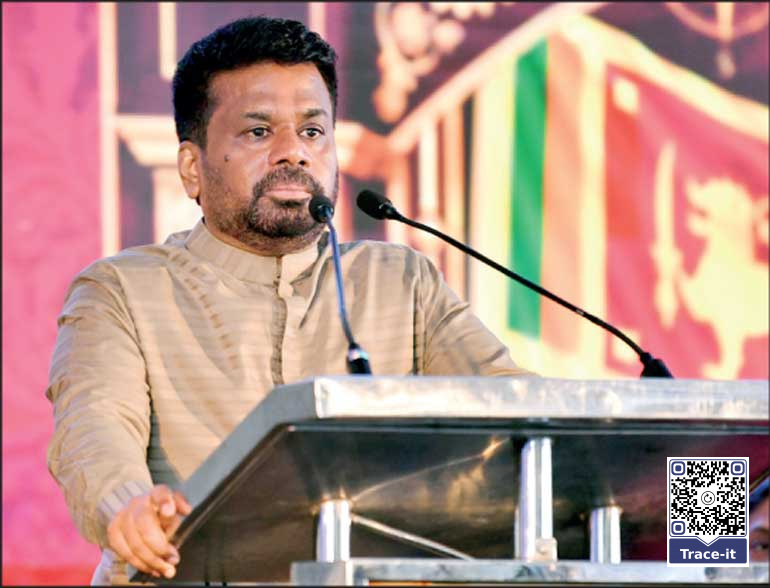
President Anura Kumara Dissanayake
The Treasury account now holds a surplus approaching Rs. 1 trillion, compared with a deficit of about Rs. 700 billion in 2022, while a Finance Ministry committee is considering closing or amalgamating 34 State-owned enterprises (SOEs) deemed unnecessary or inefficient, President Anura Kumara Dissanayake said yesterday.
Addressing the 100th Annual Conference of the Government Surveyors’ Association at the Waters Edge Hotel in Battaramulla, President Dissanayake said the Government had been constantly compelled to print money or borrow from the banking system due to a lack of funds, and the turnaround in the Treasury’s position had helped considerably in resolving the rupee crisis.
He said political appointments made in the past had resulted in excessive staffing at lower levels of the public service, creating a substantial financial burden. “Our aim is to build an attractive public service comprising capable and highly qualified professionals,” he said.
The President said revenue collection in 2025 reached 110% of the projected target, the first time in Sri Lanka’s history, noting that no previous Budget had achieved its projected revenue targets. He said the Government expected to achieve a healthy level of revenue in 2026 by meeting the targets set for the Department of Inland Revenue, the Sri Lanka Customs Department and the Department of Excise.
Sri Lanka recorded a current account surplus of $ 1.8 billion in 2025, he said. Since independence, the country had recorded a current account surplus on only about three occasions, each of about $ 300 million.
However, President Dissanayake said the Middle East conflict had exposed Sri Lanka to an unexpected impact. The country spent $ 4 billion on oil imports last year and had already spent $ 4 billion by the end of August this year, meaning the total could exceed $ 6 billion by year-end. Managing pressure on foreign exchange reserves was therefore one of the main challenges, he said.
The Government plans to increase capital expenditure from Rs. 1,330 billion this year to Rs. 2 trillion next year. The President said a large number of major projects had been launched using domestic Treasury funds alone without borrowing in dollars, including the Kurunegala-Galewela, Rambukkana-Galagedara and Kahathuduwa-Ingiriya Expressways. The Government also plans to begin the estimated Rs. 600 billion Kelani Valley railway line electrification project next year using Treasury funds.
He said that even when expenditure is in rupees, dollars are needed to import machinery, steel and other materials, making earning dollars and minimising dollar outflows the principal economic strategies. While the country now has sufficient rupee resources to withstand domestic shocks, the economy is not yet strong enough to withstand external shocks arising from tourism, foreign workers’ remittances and fuel prices, he said.
On public sector pay, the President said the inability to retain professionals had made it difficult to recruit engineers, IT professionals and managers. The 2025 Budget provided for a basic salary increase in three phases in 2025, 2026 and 2027, each costing Rs. 110 billion, adding Rs. 330 billion to the salary bill by 2027 compared with 2024. As no further basic salary increase is planned in the 2028 Budget, greater consideration could be given to allowances at that stage, he said.
On the surveying service, President Dissanayake said the Government was prepared to allocate the necessary funds in the Budget for modern technological equipment if an assessment study identifying the requirements is submitted. He said the Government would also consider a study to amend the service minute, as requirements differ from those of 20 years ago.


