Tuesday Oct 13, 2026
Tuesday Oct 13, 2026
Tuesday, 13 October 2026 03:04 - - {{hitsCtrl.values.hits}}
By Charumini de Silva
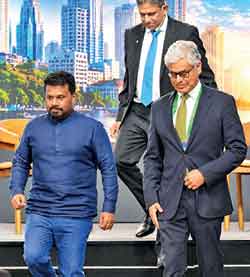 |
| President Anura Kumara Dissanayake with The Ceylon Chamber of Commerce Chairperson Krishan Balendra at the Sri Lanka Economic and Investment Summit yesterday. Vice Chairperson Bingumal Thewarathanthri is in the background – Pic by Lasantha Kumara |
President Anura Kumara Dissanayake yesterday pledged stronger safeguards for investors and greater private-sector participation in infrastructure and economic development.
He made this pledge outlining a series of proposed changes spanning ports, logistics, energy, taxation, and technology at the inauguration of the Sri Lanka Economic and Investment Summit 2026 organised by The Ceylon Chamber of Commerce.
Addressing a packed business audience during a Fireside Chat moderated by Standard Chartered Bank Sri Lanka CEO and Ceylon Chamber Vice Chairperson Bingumal Thewarathanthri, the President stressed that investment protection, transparency, predictable rules, and infrastructure development must be matched by stronger domestic businesses capable of partnering with foreign investors.
“If there are not strong local entrepreneurs and businesses, with whom can the foreign investors do businesses or joint ventures?” he asked, urging the private sector to play a more active role in expanding the economy.
He said the Government would consider extending tax concessions to businesses investing in rural areas to create new economic opportunities, while also signalling a review of existing fuel-sector agreements and a shift towards competitive procurement and pricing mechanisms in selected areas.
Among the most significant announcements was the Government’s intention to offer management and operating rights of the East Container Terminal (ECT) at Port of Colombo to a private-sector partner while retaining State ownership. The terminal is currently operated by the Sri Lanka Ports Authority (SLPA).
The President said the Terminal’s current throughput was approximately 500,000 twenty-foot equivalent units (TEUs), compared with a potential annual capacity of 3.2 million TEUs once fully developed and optimised.
He argued that delays in port operations meant the country was not making the best use of its existing assets, highlighting the opportunity for international terminal operators and shipping lines to improve efficiency and expand capacity.
Industry reports indicate that five to six international shipping lines have expressed interest, although the Government has yet to formally identify a preferred operator or announce the terms and timeline of the proposed arrangement.
The move could reshape competition among Colombo’s container terminals and influence the Port’s transshipment business, provided the eventual operating structure delivers the anticipated capacity and efficiency gains.
The Government is also pursuing a substantial expansion of port infrastructure. The President said approximately $ 1.4 billion would be required for breakwater infrastructure supporting the proposed West Container Terminal II (WCT II).
Financing is expected to be sought from multilateral development institutions. Preliminary design-related work has progressed with support from the Asian Development Bank (ADB), with the final report expected by April 2027, according to the President.
WCT II is expected to add around 3.2 million TEUs in annual capacity upon completion, creating further opportunities for terminal operators, maritime service providers, and other port-related investors.
The SLPA also intends to call a fresh tender for a logistics centre within Port of Colombo after a dispute involving land previously allocated to other parties was resolved, the President said. Compensation is to be paid to the previous parties, after which the land is expected to be released for the new tender.
The proposed development could attract investment into bonded warehousing, container freight stations, distribution, cargo consolidation, and value-added logistics services.
Separately, the Government plans to establish a container examination facility in Kerawalapitiya through a public-private partnership (PPP). The President referred to a facility capable of examining approximately 150 containers, although further details on its operational capacity and implementation timeline were not provided.
The project, which has received Cabinet approval for a PPP-based approach, is intended to ease congestion, improve Customs clearance, and increase cargo-handling efficiency.
The Government is considering reducing the existing 2.5% tax or levy affecting bunkering through the Budget 2027, following representations from the Bunkering Committee, the President said.
He said the objective was to strengthen Sri Lanka’s competitiveness as a regional bunkering centre, with the Government also considering a partnership between the Ceylon Petroleum Corporation (CPC) and private-sector operators to expand bunker-fuel storage at the JCT Oil Bank.
The President also announced plans to establish 75 additional CPC filling stations, while confirming that existing agreements with Lanka IOC, Sinopec, and other private fuel suppliers would be reviewed with the involvement of the Attorney General.
He expressed concern that current arrangements could constrain the Government’s ability to respond to international oil-price volatility and supply disruptions, particularly where private operators limit distribution despite having stocks.
“Although in urban areas both public and private fuel stations are available, in outstations only one player is available and mostly private sheds. Limiting distribution by private players due to price while having stocks is not correct and fair,” he said.
The Government wants to strengthen its capacity to ensure uninterrupted domestic fuel availability, while expecting private operators to balance commercial returns with their wider responsibilities.
“Be a competitive player. Profit and social responsibility is something that the private sector must consider,” the President said.
The proposed review follows broader concerns about the flexibility of existing fuel-market arrangements and the State’s ability to maintain supplies during periods of disruption.
The President said renewable energy development would continue in collaboration with the private sector, with four grid lines expected to be opened for private-sector participation.
He questioned the reliance on fixed feed-in tariffs, noting that rates are determined by the Public Utilities Commission of Sri Lanka (PUCSL), and argued that competitive tendering would help bring down costs.
He also identified land scarcity as a constraint on solar development, suggesting that greater emphasis would be placed on floating solar parks, citing the recent Ibbankatuwa project as an example.
The proposed approach would seek to expand renewable energy capacity while addressing land limitations and improving cost competitiveness.
The President said the Government had managed to secure uninterrupted supplies of oil, gas, and fuel amid escalating tensions in the Middle East, but cautioned that the future course of the conflict remained uncertain.
He said the Government had allocated Rs. 60 billion in fuel concessions to cushion the economy against another shock following the economic crisis and Cyclone Ditwah, and had extended relief through a further Rs. 41 billion allocation for targeted communities.
Identifying eligible beneficiaries remains a challenge because of gaps in available data, he said, adding that Mobitel and Dialog were discussing possible solutions.
The President identified workforce skills and productivity as critical to Sri Lanka’s ability to attract investment, particularly in information and communications technology (ICT), where industry requirements have evolved rapidly.
He said the Government planned to sign an agreement with Singapore next week to establish a training centre on Wijerama Mawatha, aimed at strengthening capacity in ICT and artificial intelligence (AI). The proposal is also expected to be submitted for Cabinet approval next week.
Sri Lanka needed to develop its IT skills beyond current levels to match the requirements of a changing global market, he said, while pointing to the need to improve salary structures in the public sector and specialised fields to attract and retain expertise.


