Saturday Oct 17, 2026
Saturday Oct 17, 2026
Saturday, 17 October 2026 00:00 - - {{hitsCtrl.values.hits}}
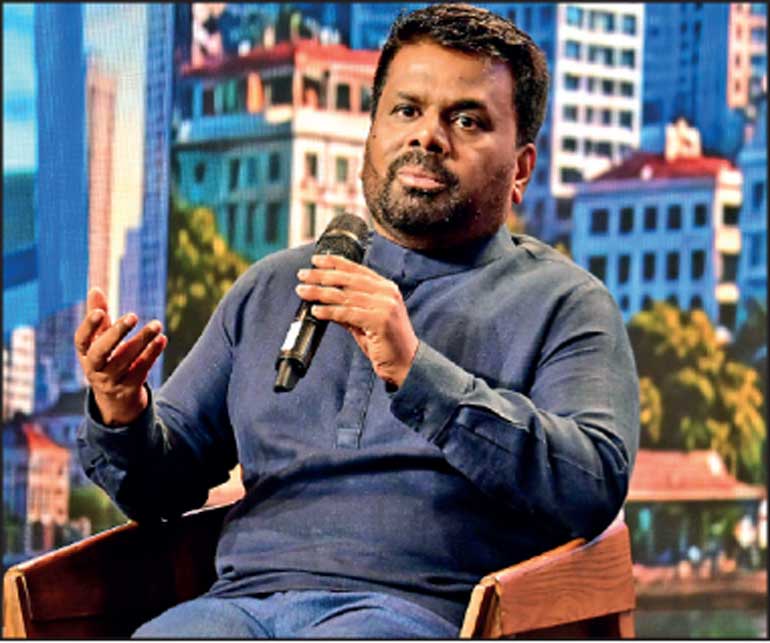
President Anura Kumara Dissanayake
- Pic by Lasantha Kumara
By Charumini de Silva
Sri Lanka’s long-awaited global tourism promotion campaign remains stalled by shortcomings in the Government’s procurement framework, with President Anura Kumara Dissanayake acknowledging that existing procedures are ill-suited to purchasing creative ideas and marketing expertise.
Speaking at the inauguration of the Sri Lanka Economic and Investment Summit 2026 on Monetary (12), he said the Sri Lanka Tourism Promotion Bureau (SLTPB) had been attempting to advance the promotional initiative for around 18 months, but the process had yet to move forward, highlighting how administrative bottlenecks continue to impede a critical investment in the country’s tourism competitiveness.
“How do we purchase a promotional plan? According to our procurement methodology, a desk can be purchased. However, what is a promotional publicity program? It is an idea and how do we buy an idea?” he asked.
Dissanayake pointed out that procurement procedures developed primarily for purchasing physical goods were inadequate for evaluating creative services, where selecting the best proposal requires different assessment criteria.
The delay comes as Sri Lanka seeks to strengthen international visibility and attract more visitors amid intensifying competition among regional destinations. A sustained global campaign has been viewed by industry stakeholders as critical, particularly as the country has gone for over 15 years without a sustained global tourism promotion campaign, despite having funds available for destination marketing to improving awareness, diversifying source markets and supporting higher tourism earnings.
The President said the SLTPB is expected to call tenders in January, while a smaller-scale promotional project had already commenced in five countries.
In August, SLTPB officials unveiled a detailed promotional blueprint envisaging an immediate Rs. 1.5 billion interim digital and public relations campaign from August 2026 to April 2027 across six key source markets. That plan was to be followed by the much larger Rs. 5 billion global branding campaign, scheduled to commence in March 2027 and continue through February 2029 (https://www.ft.lk/top-story/Rs--1-5-b-interim-tourism-campaign-kicks-off-ahead-of-global-brand-push/26-796239).
On 31 August, just days after Sri Lanka Tourism unveiled a roadmap envisaging the launch of its global branding campaign, Tourism Deputy Minister Prof. Ruwan Ranasinghe said the long-awaited global destination marketing campaign is set to face a further delay of nearly one year, as the Government was prioritising another consultancy exercise before the final campaign can be awarded https://www.ft.lk/front-page/Another-year-s-wait-for-Sri-Lanka-s-global-tourism-campaign/44-796622#)
Dissanayake linked the tourism marketing delay to a broader problem in public-sector administration, arguing that rules introduced over time to prevent corruption had created procedures that could obstruct the timely execution of projects.
“There was a mindset in our country that the State machinery is always engaged in corruption,” he said, adding that successive laws and procedures intended to address the problem had reached a point where tasks could not be carried out swiftly.
He said the traditional procurement system was designed largely around purchasing goods, whereas modern public-sector requirements increasingly involved software, services and solutions that could not be assessed through conventional purchasing methods.
“We have identified several specialised and emerging fields requiring new procurement procedures,” he added.
The President also pointed to delays caused by the sequencing of procurement and Budget approvals. “Previously, procurement processes generally began only after the Budget was passed and funds were formally allocated, often pushing the completion of procurement activities to August or September. Now, the Government has addressed this constraint by allowing the Treasury Secretary to certify the availability of funds, enabling procurement preparations to move forward earlier,” he disclosed.
He also said the Government was considering a proposal from tourism industry businesses to reward performance through payments linked to incremental visitor arrivals.
Under the proposed arrangement, funds would be allocated in the next Budget for the Sri Lanka Tourism Development Authority (SLTDA) to pay participating businesses if they brought in a higher number of tourists than the target or benchmark for the current year.
The proposal signals a possible shift towards results-based tourism marketing, but details of the baseline, verification mechanism and payment structure were not outlined.


