Friday Jun 26, 2026
Friday Jun 26, 2026
Friday, 26 June 2026 05:16 - - {{hitsCtrl.values.hits}}
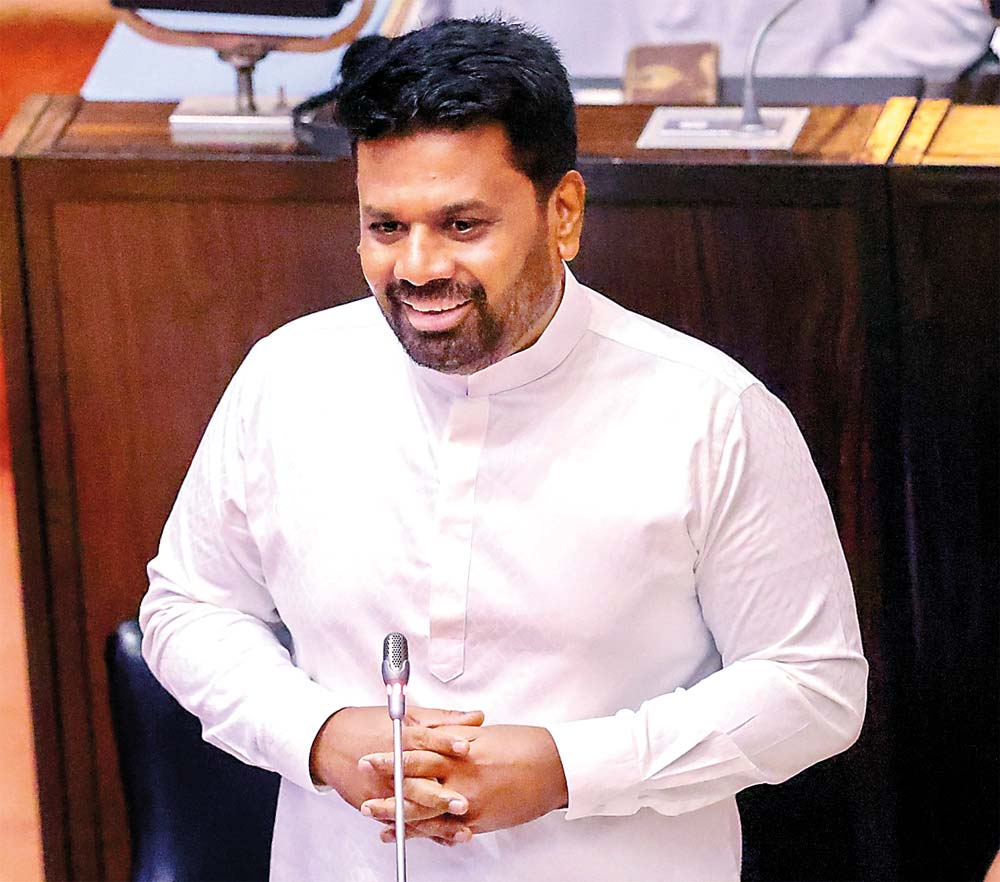
President Anura Kumara Dissanayake
President Anura Kumara Dissanayake yesterday launched a scathing attack on what he described as Sri Lanka’s entrenched nexus of corruption, organised crime, and political patronage, alleging that recent investigations revealed that nearly $ 1 billion had been transferred overseas through advance-payment transactions since 2023 without any corresponding imports.
Speaking during the adjournment debate on combatting the drug menace in Parliament, the President pledged to dismantle the networks he said had fuelled both the country’s economic decline and the expansion of organised crime.
Dissanayake argued that drug trafficking, corruption, and organised crime were not isolated challenges but components of a deeply embedded ecosystem that had infiltrated State institutions, political structures, and sections of the law enforcement apparatus, enabling illicit financial flows and undermining governance.
Earlier this month, Public Security Minister Ananda Wijepala told Parliament that authorities had uncovered several bogus import payments totalling $ 85 million. President Dissanayake said further investigations revealed much more.
“Since 2023, advance payments amounting to nearly $ 1 billion have been made through Telegraphic Transfer (TT) transfers, yet no goods have been received. Such sums cannot be moved by ordinary individuals,” he said, claiming investigations had uncovered links to drug money, corruption proceeds, and criminal activity, as well as involvement by certain bank branches.
Dissanayake framed the crackdown as a fulfilment of a public mandate rather than a political witch hunt.
“If our intention had been revenge, it would have been carried out the moment we assumed office,” he said, insisting the Government’s objective was to ensure that “those who stole public property are brought to justice” through strengthened anti-corruption laws, expanded investigative capacity, and faster court processes.
The President sought to present the anti-corruption drive and anti-drug campaign as two fronts of the same battle, noting that organised crime had thrived because of political protection and corruption within the State machinery.
He disclosed that authorities had identified trafficking routes through airports, ports, and postal services, while also stepping up action against underworld figures and their associates.
According to Dissanayake, 23 individuals wanted under Interpol Red Notices have been returned to Sri Lanka, while another 35 suspects linked to drug trafficking have been arrested and repatriated.
He said the Government had established a high-security prison facility at Welisara to isolate major criminal figures and cut off their ability to communicate with networks outside prison.
“We have significantly curtailed the ability of organised criminal gangs to direct their operations from prison,” he said.
However, the speech moved beyond crime and narcotics to target what the President portrayed as a decades-long culture of impunity. Naming senior officials including Criminal Investigation Department (CID) Director Shani Abeysekara, Commission to Investigate Allegations of Bribery or Corruption (CIABOC) Director General Ranga Dissanayake, and Public Security Ministry Secretary Ravi Seneviratne, the President alleged the Opposition of attacking investigators, prosecutors, and the judiciary because they were exposing wrongdoing.
“The establishment of justice, fairness, and a civilised society has become intolerable to certain sections of the Opposition,” he charged.
The President also revisited some of Sri Lanka’s most controversial unresolved cases, including the killing of Lasantha Wickrematunge, the abduction and assault of Keith Noyahr, attacks on journalists and media institutions, the death of Wasim Thajudeen, and the 2019 Easter Sunday attacks.
“These were not ordinary civil disputes,” he said, alleging that elements within a small section of the State apparatus had been used for political purposes to commit crimes and protect political power.
Dissanayake also alleged that past political actors had profited both from facilitating extrajudicial killings and from protecting criminals.
“Money was taken both to have people killed without being brought before the courts and, conversely, to spare them from death,” he said.
He claimed that a political leader had spoken to imprisoned drug traffickers on 92 occasions, though he stopped short of naming the individual.
The President said that Sri Lanka’s fight against drugs cannot succeed without dismantling the wider network that sustains it.
“We do not believe that drug trafficking and organised criminal gangs emerged in isolation. We must address the entire ecosystem surrounding them,” Dissanayake said.
Positioning the campaign as a broader effort to restore governance and public trust, the President declared that the Government’s mission was not merely to arrest traffickers, but to “transform the State into a civilised one” by uprooting the political, financial, and institutional structures that enabled crime to flourish.

