Thursday Oct 22, 2026
Thursday Oct 22, 2026
Monday, 16 March 2026 05:37 - - {{hitsCtrl.values.hits}}
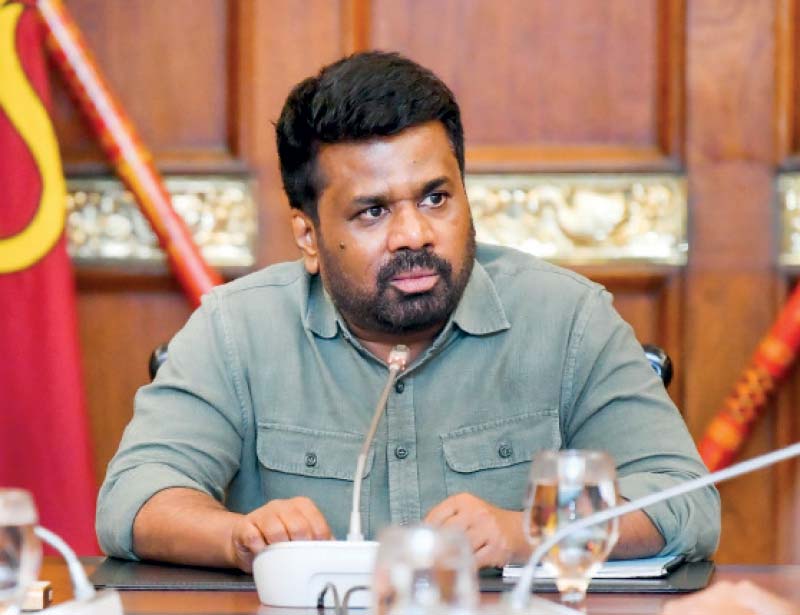
President Anura Kumara Dissanayake
President Anura Kumara Dissanayake yesterday instructed senior Government officials to strengthen contingency planning to ensure the uninterrupted delivery of essential services as geopolitical tensions in the Middle East raise concerns over potential economic and supply disruptions.
The high-level meeting between the President, Ministry Secretaries, and Heads of key institutions held at the Presidential Secretariat reviewed preparedness measures in light of the evolving international situation.
Officials discussed the potential implications of the conflict on critical sectors including health, education, industry, agriculture, and fisheries, with Ministry Secretaries presenting updated assessments on fuel requirements and operational needs across their respective sectors.
Following the discussions, the President directed officials to explore the feasibility of maintaining regional fuel reserves to safeguard essential services, particularly within the health sector, where uninterrupted operations are critical.
He also instructed Ministry Secretaries to examine the possibility of expanding remote working arrangements within the public sector and submit detailed reports on how official duties could be carried out from home if circumstances require.
Acknowledging the uncertainty surrounding future developments, the President stressed the need for proactive preparation rather than reactive measures. He said authorities must be ready to respond to a range of possible scenarios given the unpredictable nature of the current global situation.
Dissanayake also called for improvements to the digital QR code system already introduced to manage fuel distribution during periods of supply constraints. He instructed officials to identify and rectify existing shortcomings in the system and ensure that it is updated and streamlined to respond effectively if needed.
The President stressed that authorities should remain under continuous monitoring and maintain close attention to international developments that could affect the country’s economy and supply chains.
Rather than addressing challenges sector by sector, the President urged officials to adopt a coordinated national approach, identifying alternative mechanisms that could mitigate potential disruptions and implementing them with speed and efficiency.
He further emphasised the importance of close cooperation between institutions, calling on officials to act swiftly with mutual understanding and coordination when responding to emerging challenges.
The meeting was attended by Foreign Affairs, Foreign Employment and Tourism Minister Vijitha Herath and Industry and Entrepreneurship Development Deputy Minister Chathuranga Abeysinghe, Secretary to the President Dr. Nandika Sanath Kumanayake, Presidential Adviser on Digital Economy Dr. Hans Wijayasuriya, Presidential Chief of Staff Prabath Chandrakeerthi, Industry and Entrepreneurship Development Ministry Secretary Thilaka Jayasundara, Education Ministry Secretary Nalaka Kaluwewa, Public Administration Ministry Secretary Aloka Bandara, Health and Mass Media Ministry Secretary Dr. Anil Jasinghe, Digital Economy Ministry Secretary Varuna Dhanapala, and Fisheries Ministry Secretary Kolitha Kamal, among other heads of institutions.


