Thursday Oct 15, 2026
Thursday Oct 15, 2026
Wednesday, 4 March 2026 00:00 - - {{hitsCtrl.values.hits}}
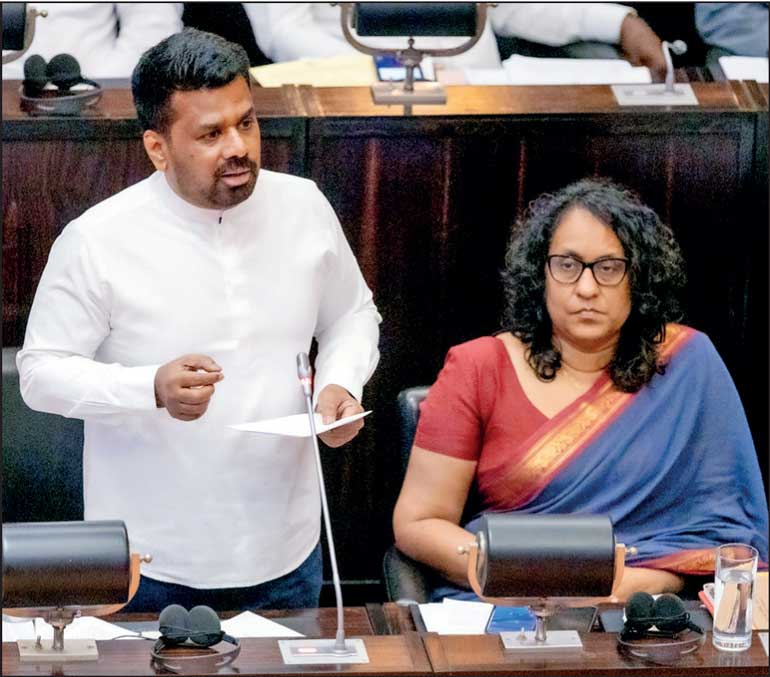
President Anura Kumara Dissanayake addressing Parliament
President Anura Kumara Dissanayake yesterday assured Parliament that Sri Lanka has sufficient fuel stocks at present, despite the escalating conflict in the Middle East, and outlined a schedule of incoming shipments to ensure uninterrupted supply.
Addressing the House, the President said diesel stocks are adequate for 33 days under prevailing consumption levels, while petrol inventories are sufficient for 28 days. A tanker carrying 35,000 metric tonnes of petrol is expected to arrive on 7 or 8 March, which he said would extend petrol availability to around 40 days.
He further detailed confirmed cargoes scheduled from RM Parks on 14 March, Sinopec on 17 March, and the Indian Oil Company (IOC) on 21 March and 28 March, noting that all relevant confirmation agreements for these shipments have been secured and the necessary operational mechanism has been put in place. Shipments, he said, are planned in line with tank capacity and drawdown rates.
Explaining operational constraints, the President said the principal limitation is storage capacity.
Excluding IOC-operated tanks in Trincomalee, combined storage capacity at Kolonnawa and Muthurajawela is approximately 150,000 metric tonnes. However, facilities cannot maintain full capacity at all times and are managed in line with scheduled shipments. At the time the crisis arose, approximately 103,000 metric tonnes were in storage. The refinery supplies around 1,080 metric tonnes daily, with total daily fuel requirements, including aviation fuel, amounting to approximately 1,800 metric tonnes.
Petrol storage capacity stands at 161,087 metric tonnes. At the onset of the current crisis, 136,270 metric tonnes were available in storage. No separate strategic reserve is maintained, and operational and reserve stocks are held within the same facilities, requiring careful management.
Daily aviation fuel demand is included within the overall requirement of approximately 1,800 metric tonnes, of which 1,080 metric tonnes are produced by the refinery and the balance imported. Existing aviation fuel stocks are sufficient for 49 days.
Crude oil inventories are adequate for 26 days, with a further shipment currently at sea expected to provide an additional 18 days of refinery operations, enabling refinery activity for a total of 44 days even under a worst-case scenario in which no additional vessels arrive.
The President then detailed the infrastructure developments needed to improve fuel storage capacity.
In Trincomalee, 24 tanks are available, of which three are allocated to Prima under agreement, leaving 21 tanks under Government control, each with a capacity of 10,000 metric tonnes, amounting to 210,000 metric tonnes in total.
Under the first phase of refurbishment in Trincomalee, four tanks have been selected, with two already renovated and work continuing on the remaining two. A pipeline system from the sea to the storage facilities is to be installed at an estimated cost of Rs. 7.37 billion, enabling operational capacity of 40,000 metric tonnes.
The President said a new 86,000-metric-tonne storage complex is under construction in Kolonnawa. Six new tanks are being constructed at a cost of Rs. 2.32 billion, while two additional tanks will cost Rs. 1.45 billion. The project is scheduled for completion in January 2028 and will increase capacity by a volume sufficient to cover an additional 10 days of supply.
Capacity at Muthurajawela is to be increased by a further 40,000 metric tonnes, with an estimated investment of Rs. 3.5 billion. In addition, 63,000 metric tonnes of additional aviation fuel storage is planned with an estimated investment of Rs. 16 billion. A pipeline from Muthurajawela to Katunayake is also to be constructed.
The 90-year-old pipeline from Kolonnawa to the Port is to be replaced with new 14-inch and 18-inch lines at an estimated cost of Rs. 12.8 billion, while the naphtha pipeline from Kolonnawa to Kelanitissa is to be replaced at a cost of Rs. 1.5 billion.
Overall, approximately Rs. 30 billion has been allocated for critical energy infrastructure development.
The refinery, originally constructed in 1969 with a capacity of 38,000 metric tonnes and expanded in 1979 by 12,000 metric tonnes to 50,000 metric tonnes, has not seen further capacity expansion since. Plans are now in place to increase refining capacity to 100,000 metric tonnes, with 15 bids already received and a further five expected.
On gas supplies, the President stated that total storage capacity is 8,000 metric tonnes against a daily requirement of between 1,000 and 1,200 metric tonnes. A 30,000-metric-tonne privately owned storage terminal is under discussion for temporary utilisation of 15,000 metric tonnes to meet urgent domestic needs. He added that 100,000 new Litro gas cylinders have been ordered and are scheduled to arrive on the 12th.
While reiterating that there is no immediate supply crisis, the President said that as long as the situation remains at its current level, the necessary solutions are in place. However, he acknowledged that if the conflict were to escalate further, the Government would have to respond accordingly. He added that the Central Bank of Sri Lanka is reviewing the current conditions and will present a report on the potential impact on the economy, particularly in the financial sector, while the Finance Ministry is preparing an assessment of the impact on livelihoods and the economy along with response measures.
President Dissanayake stated that Sri Lanka expects all parties involved in the war to commit themselves at the earliest opportunity to building a peaceful world. He noted that the situation poses a significant threat to the global economy and to people’s livelihoods and said Sri Lanka cannot escape its effects in isolation.
The President further stated that approximately one million Sri Lankans are registered with the Foreign Employment Bureau and that a 24-hour emergency telephone service has been established at all embassies to assist Sri Lankans overseas.
He said the Government is also examining the impact on tourism, exports, maritime services and aviation, with particular focus on safeguarding foreign currency reserves and maintaining exchange rate stability.


