Friday Oct 16, 2026
Friday Oct 16, 2026
Thursday, 7 May 2026 06:40 - - {{hitsCtrl.values.hits}}
|
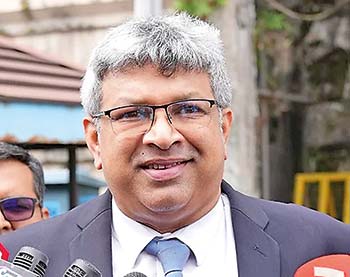
Justice Minister Harshana Nanayakkara
|
|
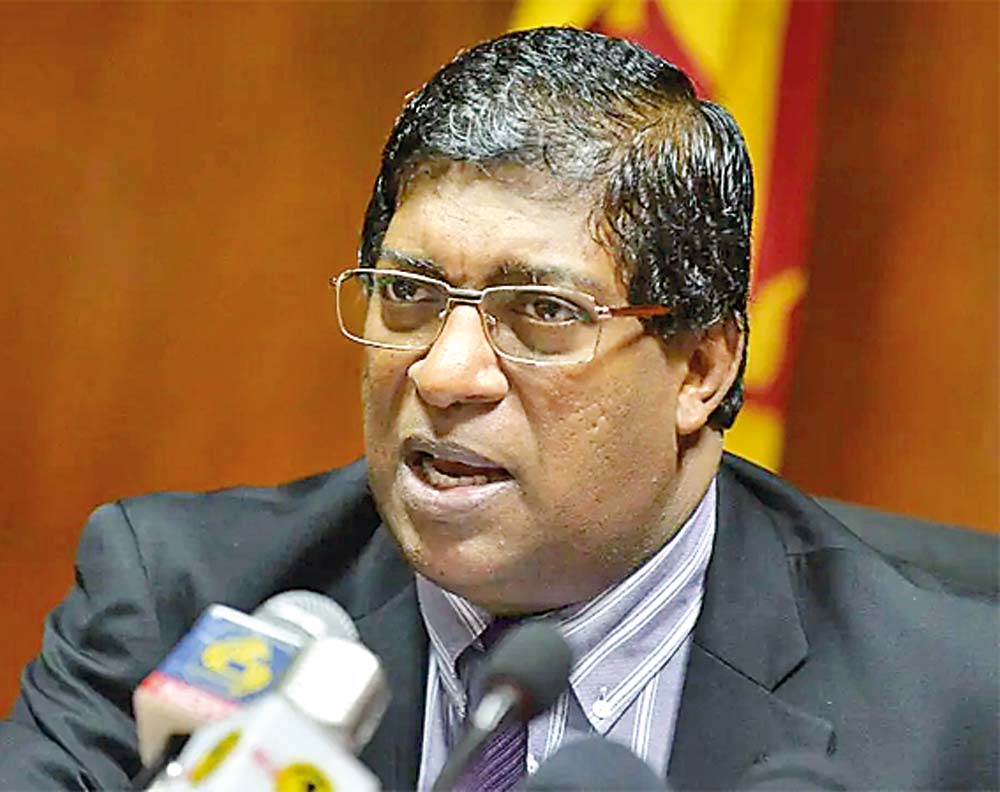
Opposition MP Ravi Karunanayake
|
Parliament yesterday commenced the Second Reading debate on the proposed Rescue, Rehabilitation and Insolvency (Corporate and Personal) Bill, a landmark legislative overhaul aimed at replacing Sri Lanka’s century-old insolvency framework.
Recommended by the International Monetary Fund (IMF) and developed with technical assistance from the World Bank, the new law focuses on business rehabilitation, debt restructuring, and financial recovery, though concerns were raised over whether existing Parate powers and court delays could undermine implementation.
The Government yesterday said the proposed law will, for the first time, allow financially distressed companies and individuals to seek court-supervised protection from creditor action while restructuring debt and attempting business recovery, though concerns were raised in Parliament over whether Sri Lanka’s existing Parate framework could undermine the effectiveness of the new regime.
The legislation marks the country’s most significant overhaul of insolvency and debt recovery laws in more than a century.
The Bill seeks to repeal the Insolvency Ordinance of 1853 and amend provisions in the Companies Act and Inland Revenue Act, replacing a framework successive governments and business chambers have long argued is outdated and ill-suited for modern commercial activity.
Opening the Second Reading debate in Parliament yesterday, Justice Minister Harshana Nanayakkara said the legislation had been years in the making and developed with technical assistance from the World Bank, alongside the Attorney General’s Department, the Legal Draftsman’s Department, and the Law Commission.
Sri Lanka’s existing legal regime, he said, remained heavily weighted towards winding up distressed businesses rather than preserving economic value.
“Our laws are structured towards closing down financially distressed entities. The current legal regime is strong on liquidation, weak on rescue and rehabilitation. It is that last bit that this law is trying to address,” Nanayakkara told Parliament.
The Minister said the absence of a modern insolvency framework had contributed to disorderly recoveries, informal settlements, and erosion of confidence in the financial system during periods of economic stress.
“In the absence of a robust legal regime for regulation of financial distress and insolvency situations, there will be disorder in dealing with situations of financial distress. There will be a race to grab assets. It can lead to favouritism and side deals. Some people will get their monies advanced while others will not,” he said.
The proposed law establishes a unified insolvency framework covering corporates, partnerships, and individuals, while introducing structured rescue and rehabilitation procedures, creditor participation mechanisms, moratoriums on legal action during restructuring, and supervised liquidation processes where recovery is not possible.
It also provides for the creation of a regulatory authority overseeing insolvency proceedings and insolvency professionals.
A key component of the Bill is the introduction of targeted protections for low-income debtors and micro, small and medium enterprises (MSMEs), which successive policymakers have identified as among the sectors most vulnerable to prolonged economic shocks and tight credit conditions.
Under the proposed framework, debtors with liabilities below Rs. 2 million and monthly surplus income of Rs. 100,000 or less may qualify for debt rehabilitation orders that temporarily prevent creditor enforcement action and provide a path towards discharge from debt obligations.
MSMEs with liabilities below Rs. 50 million would also be eligible for court-approved restructuring arrangements binding on creditors.
“This would be of major help to low-income people and MSMEs burdening under the weight of debt. What is important is that when discharged from the debt rehabilitation order, the debtor’s included debt shall be cancelled,” Nanayakkara said.
The Government positioned the Bill as part of broader efforts to strengthen financial sector stability and improve recoveries within the banking system.
Citing India’s Insolvency and Bankruptcy Code introduced in 2016, Nanayakkara said insolvency reforms there had improved recovery rates, reduced resolution timelines, strengthened financial discipline, and lowered Non-Performing Loan (NPL) ratios within the banking sector.
He told Parliament India’s gross Non-Performing Asset (NPA) ratio had declined to 2% by December 2025, while recoveries under insolvency resolution proceedings had generated values significantly above liquidation outcomes.
Opposition MP Ravi Karunanayake broadly supported the legislation, describing it as a necessary reform to support viable businesses facing temporary financial distress or weak capital structures.
“Insolvency is different from bankruptcy where liquidation is there. The laws are there for liquidation but there isn’t anything to resuscitate a good business proposition that is ill-capitalised or not solvent enough,” Karunanayake said.
However, he warned that the success of the framework would depend heavily on implementation and judicial efficiency.
Karunanayake argued that the proposed 60-day framework for insolvency proceedings was unrealistic given delays within Sri Lanka’s court system and proposed extending the period to 180 days.
“My feeling has got to be looked at is that the 60-day time framework that is given is hardly sufficient because the decision-making process in Sri Lanka is not as competent as it would be. We should look at at least a 180-day period,” he said.
He also called for specialised commercial courts or fast-track judicial mechanisms to handle insolvency proceedings and urged greater focus on SMEs, which he said accounted for 60-65% of businesses in the country.
A substantial part of Karunanayake’s speech focused on the Parate law, which permits banks to auction assets of defaulting borrowers without court intervention.
“Parate is a law that is there only in one country in the region, and that is Sri Lanka. This gives preferential treatment to the banks. Today, they are using this to the detriment of the business sector. The small and medium enterprises (SMEs) are disproportionately affected and that is not healthy in the business environment,” he said.
He argued that insolvency reforms would have limited impact unless accompanied by broader changes to the recovery environment, particularly for businesses weakened by high interest rates, external shocks, and prolonged economic instability.