Monday Sep 28, 2026
Monday Sep 28, 2026
Monday, 28 September 2026 05:03 - - {{hitsCtrl.values.hits}}
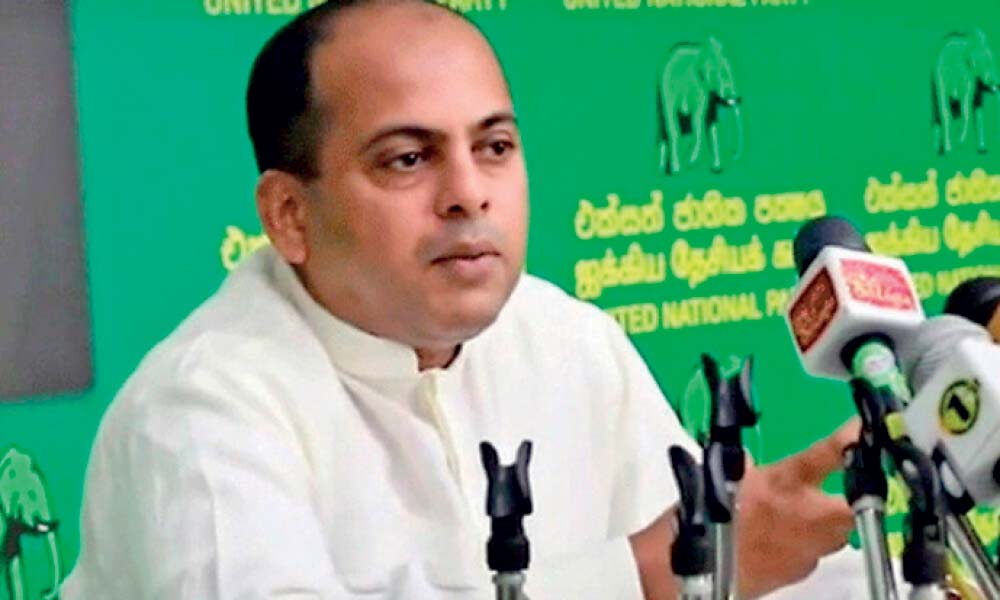
SOC on Infrastructure and Strategic Development Chair MP S.M. Marikkar

CoPF Chair MP Dr. Harsha de Silva
New grid batteries will help Sri Lanka absorb surplus solar power nationally, but will not open up rooftop connections where neighbourhood transformers are already full, two Parliamentary Committees heard on 22 and 23 September. Households that can still connect now face either a far less favourable tariff or a battery bill of over Rs. 1 million.
The Public Utilities Commission of Sri Lanka (PUCSL) challenged the premise behind the curbs on rooftop solar. “If there is no alternative below the marginal cost, prices cannot be reduced,” it told the Committee on Public Finance (CoPF) last week.
Marginal cost is the cost of the most expensive power the system must buy, typically from oil-fired plants, which CoPF members said still supply about 40% of generation. The PUCSL rejected the argument that surplus solar has little value, saying daytime power is cheap only because of rooftop solar.
A rooftop system feeds into the neighbourhood transformer serving its street. When too many roofs export power at midday, that transformer overloads and the utility refuses new connections.
Separately, officials told the Sectoral Oversight Committee (SOC) on Infrastructure and Strategic Development chaired by MP S.M. Marikkar last week that this is the bottleneck in congested urban areas. Yet the National System Operator (NSO) is placing its batteries at grid substations, several steps up the network. Its tender covers 16 substation batteries of 10 MW and 40 MWh each, a total of 160 MW, of which two have been commissioned.
These can absorb surplus power for the national system, but they cannot relieve an overloaded transformer on a street in Kotte. The tendered sites also appear to lie largely outside the Western Province, where congestion is worst.
Marikkar said the battery build-out would benefit ground-mounted solar farms in the regions where the batteries are being installed, while doing nothing for rooftop households in Colombo. He noted that large-scale producers already enjoy concessions, including duty-free import of megawatt-scale batteries, which household buyers do not receive.
He said adding or upgrading a rooftop system in areas such as Kotte and Kolonnawa was now effectively impossible. He urged that Western Province rooftop users be given priority for battery capacity, and that the Government take responsibility for storage.
Batteries at the neighbourhood level, which could ease the bottleneck, have not yet started. The PUCSL said it approved a Lanka Electricity Company (LECO) proposal for such batteries about three months ago, while one from Electricity Distribution Lanka (EDL) has been delayed.
Households that can still connect will pay more for the same panels. Net metering and net accounting, which let owners offset each unit of solar power against a unit bought from the grid, are closed to new connections.
New users must go on ‘Net Plus,’ selling all their output at a feed-in tariff (FiT) of about Rs. 23 per unit for small systems while buying all their power at the retail rate, which is around Rs. 100 per unit above 180 units a month. Contracts are capped at 12 years. A CoPF member warned that new users could end up paying more rather than saving. Existing agreements are unaffected until they expire.
The NSO told the CoPF last week that daytime solar output of over 2,000 MW now matches daytime peak demand of 2,500 to 2,600 MW, so any new solar must come with storage. For a household, that means a battery. Marikkar said a 5 kW household battery with an inverter costs at least Rs. 1 million.
The duty exemption for megawatt-scale batteries was granted around the close of the NSO tender, but household batteries still attract duty. CoPF Chairman MP Dr. Harsha de Silva said the Government had put ‘the cart before the horse’ by ending net metering before storage became affordable.
A PUCSL guideline allows ‘zero-export’ systems, which use solar power on site without feeding it into the grid, and consumers may also go fully off-grid. The PUCSL said solar with a battery pays off at current tariffs, but that upfront capital is the barrier.
The rules themselves are contested. A Cabinet-approved tariff policy restricts new connections to ‘Net Plus,’ while the PUCSL, which now holds the power to set FiTs under the new Electricity Act, determined its own tariffs in August.
The Energy Ministry directed that the Cabinet policy prevail and referred the PUCSL tariffs to the Cabinet, where they await approval. The NSO argued that net accounting gave supernormal returns and that pressure to keep it came from solar companies.
The PUCSL warned that consumption from January to 21 September rose to 14,062 GWh from 11,637 GWh in the same period of 2023. It said that without prompt action, the reserve margin could be breached, bringing shortages or higher prices.
Dr. de Silva said the authorities must come up with a plan.
Separately, the CoPF approved Rs. 17.2 billion for the NSO to cover a deficit from the first quarter, when the Ceylon Electricity Board (CEB) failed to submit its tariff proposal on time. A targeted subsidy that shielded low-usage households from an 18% tariff increase has ended.


