Friday Sep 25, 2026
Friday Sep 25, 2026
Friday, 25 September 2026 00:00 - - {{hitsCtrl.values.hits}}

President and Finance Minister Anura Kumara Dissanayake
The National Chamber of Commerce of Sri Lanka (NCCSL) has urged President Anura Kumara Dissanayake to withdraw or reconsider an Energy Ministry directive that scraps net metering and net accounting for rooftop solar.
The Chamber warned that the shift to a ‘Net Plus’ scheme, which it described as financially nonviable, threatens a sector that saves the country an estimated Rs. 20.4 billion a month in fuel imports, just as a power shortfall looms in 2027.
In a letter dated 23 September, signed by NCCSL President Anura Warnakulasuriya and Deputy President and Renewable Energy Sector Committee Chairman Dr. Lakmal Fernando, the Chamber sought the President’s urgent intervention. It cited official forecasts, including statements by the Public Utilities Commission of Sri Lanka (PUCSL) and the National System Operator (NSO), pointing to an energy shortfall of up to 450 MWh by early 2027.
The Chamber argued that rapidly deploying rooftop solar photovoltaic (RTSPV) systems and battery energy storage systems (BESS) is one of the most practical ways to mitigate the situation.
It warned that recent policy decisions instead threaten the very sector that currently contributes about 2,600 MW of capacity to the national grid. At Rs. 20.4 billion a month, the sector’s estimated fuel import savings amount to about Rs. 245 billion a year.
The directive, issued by the Energy Ministry Secretary on 11 September under reference PE/DEV/03/01-RT, requires all new RTSPV agreements and extensions to be made only under the ‘Net Plus’ scheme, and caps agreement periods at 12 years.
Under net metering, electricity a household or business exports to the grid offsets the units it consumes. Net accounting pays the consumer for surplus exports. ‘Net Plus,’ by contrast, requires consumers to sell all the power they generate to the utility at a fixed tariff and buy what they consume at the normal tariff.
The Chamber said the gap between the two tariffs is likely to widen, given that domestic electricity tariffs have historically risen by 5% to 7.5% a year.
“This deprives citizens of the right to generate electricity to meet their own consumption, and in practice amounts to imposing a tax on their energy self-sufficiency,” the letter said, describing the change as a violation of fundamental rights.
Net metering and net accounting, it noted, had been the only solutions available to households and businesses to manage continuously rising electricity costs. Without them, the Chamber warned, future investment in rooftop solar could decline significantly, leaving the country more reliant on expensive electricity generated from imported fossil fuels.
The higher costs would ultimately be borne by consumers, raising the cost of living, while higher energy costs would push up production and operating expenses for businesses, weakening their competitiveness in domestic and international markets.
The Chamber took issue with the utility’s argument that, since there is already too much solar electricity in the national grid, future solar integration should be restricted to ‘Net Plus.’ It called the reasoning logically inconsistent and potentially misleading, since ‘Net Plus’ itself continues to allow solar power to be fed into the grid.
“If ‘Net Plus’ continues to allow additional solar generation to enter the grid, the argument of ‘excess solar power’ alone does not appear to provide an adequate justification for removing net metering and net accounting,” the letter said.
It also said the proper regulatory process should be followed before electricity sector decisions are implemented, with the independent regulator, the PUCSL, involved in evaluating significant policy changes that affect consumers, prosumers, meaning consumers who also generate electricity, and private sector participants. Unilateral changes to established commercial arrangements without an appropriate regulatory and consultative process could harm investor confidence and regulatory certainty, it said.
More than 800 companies operate in the rooftop solar industry, providing direct and indirect employment to over 20,000 people, according to the Chamber, which warned that a significant share of these jobs could be at risk if the new scheme is implemented and the market contracts substantially.
It cautioned that if service providers become financially distressed, go bankrupt or are forced to exit the industry, the maintenance, repairs, technical support and after-sales services needed for the approximately 2,600 MW already installed would be at risk. That could threaten the continued operation of existing capacity and increase reliance on imported fossil fuel-based generation, with negative consequences for energy security and foreign exchange expenditure.
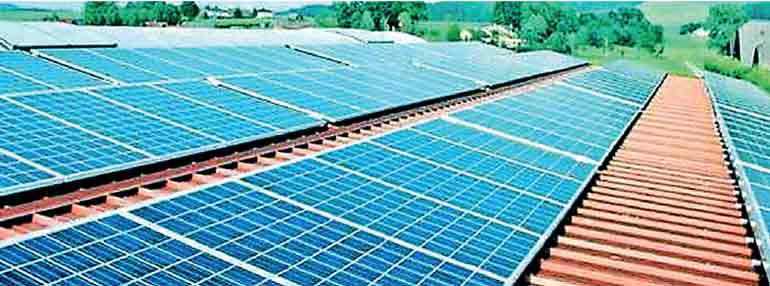
The Chamber also contrasted rooftop solar with large ground-mounted solar plants. Rooftop systems use existing buildings and do not need large areas of additional land, helping protect agricultural and environmentally sensitive areas, it said. They also spread economic activity across small and medium enterprises (SMEs), local installers, and individual consumers, whereas large ground-mounted or floating solar projects tend to concentrate investment and economic benefits among a smaller number of large-scale developers.
The Chamber asked the President to withdraw or reconsider the 11 September directive and restore net metering and net accounting for existing and future RTSPV prosumers. It also called for future changes affecting electricity tariffs and commercial arrangements to be independently evaluated and approved through the PUCSL regulatory process.
Copies of the letter were sent to the Prime Minister, the Speaker, the Deputy Speaker, all Cabinet and Deputy Ministers, the Opposition Leader, all MPs, and the Secretary General of Parliament.


