Tuesday Jul 21, 2026
Tuesday Jul 21, 2026
Tuesday, 21 July 2026 05:36 - - {{hitsCtrl.values.hits}}

CME President and Crystalstone Director/CEO and CeyQuartz MBI COO A.F.M. Farook

CME Secretary and Damsila Resources and Krishna Mining Co., Director Dr. Sandun Dalpatadu
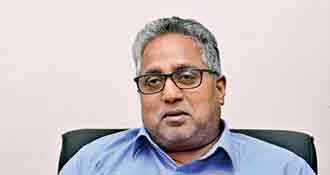
CME Vice President and Bogala Graphite Lanka MD/CEO Amila Jayasinghe

CME Treasurer and Mirama Quartz Industries Director/CEO Yaasir Nizam
 Chamber of Mineral Exporters backs single-window approvals and transfer of GSMB to Industries Ministry, but says implementation will determine success
Says regulatory uncertainty, stalled licences and weak industry engagement eroding investor confidence despite new mineral policy
Calls for GSMB to focus on regulation rather than directing industrial strategy, while reinvesting royalty revenue into exploration and research
Warns unrealistic value-addition targets risk sidelining commercially viable opportunities as global competition for strategic minerals intensifies
The Chamber of Mineral Exporters (CME), representing exporters and explorers of quartz, graphite, mineral sands, and mica, said the recently unveiled National Mineral Policy is a welcome first step but argued that policy announcements alone will not unlock investment.
Instead, it said the real test lies in how the Geological Survey and Mines Bureau (GSMB) and the Industry and Entrepreneurship Development Ministry implement the policy through regulations, licencing reforms, and institutional change.
Sri Lanka’s mineral exporters have launched to set out a detailed set of reform proposals governing the country’s minerals sector, highlighting that unless the GSMB evolves into a more commercially aware and responsive regulator, the country’s ambitions to become a competitive supplier of strategic minerals will remain largely aspirational.
The Chamber estimates its members currently generate directly and indirectly around $ 100 million in annual exports and believes the industry could comfortably double that if longstanding regulatory constraints are removed. Yet it argues the sector’s biggest challenge today is not a lack of mineral resources but an investment climate characterised by delays, administrative uncertainty, and inconsistent regulatory execution.
Industry representatives said their frustration extends well beyond the pace of policymaking. While acknowledging that the Government has held consultations with the private sector, they contend that engagement has largely become a box-ticking exercise, with industry views rarely reflected in policy implementation. They noted that although exporters had actively participated in developing earlier drafts of the Mineral Policy over several years, they were excluded from subsequent revisions and from the preparation of the standard operating procedures (SOPs) that will ultimately determine how the new framework functions.
The Chamber also questioned whether technical advice informing policymaking adequately reflects commercial realities. It argued that regulatory thinking often leaps directly to high-profile products such as graphene, semiconductors, and electric vehicle (EV) battery materials while overlooking the commercial, technical, and scale constraints that determine whether such investments are economically viable. Exporters said each mineral follows a distinct value chain and that commercially successful industries are built progressively rather than by attempting to leap immediately to the highest-value end products.
According to the Chamber, this disconnect has at times resulted in policy decisions that favour ambitious proposals over commercially proven businesses. It cited previous mineral allocation exercises where companies with established processing facilities and export operations lost access to deposits to proposals promising sophisticated downstream manufacturing that ultimately failed to materialise. The Chamber argued that such experiences have weakened confidence in the credibility of regulatory decision-making.
Exporters also expressed concern over what they described as the slow pace at which strategically important deposits are being brought into production. They pointed to major quartz deposits that have remained largely idle for years despite repeated policy announcements and changing administrations, even as existing processors struggle to secure sufficient raw material to expand operations. While welcoming recent Ministerial attention to the sector, they said businesses continue to await concrete action rather than further policy statements.
Licencing uncertainty emerged as another major concern. The Chamber said exploration and mining companies have invested millions of dollars, recruited staff, and completed geological work only to find projects effectively frozen while the Government finalises new procedures. Companies with exploration licences, mining licences, or renewal applications remain uncertain about when approvals will resume, while investors have received no clear timelines for projects placed on hold pending implementation of the new policy. Exporters warned that prolonged regulatory pauses risk damaging Sri Lanka’s reputation among international investors, particularly when companies have already committed capital in good faith.
The Chamber further argued that the existing licencing regime itself discourages long-term investment. Mining projects require substantial upfront expenditure and often take years before generating returns, yet investors continue to face relatively short licence periods and uncertainty over renewals. Such conditions, it said, inevitably increase project risk and reduce Sri Lanka’s attractiveness relative to competing jurisdictions.
Another issue highlighted was the fragmented approval process, where companies may obtain mining licences from the GSMB but remain unable to commence operations because approvals from other Government institutions remain pending. Exporters said projects have in some cases been delayed for years due to land administration issues or approvals outside the regulator’s control, only for companies to later face questions over why production has not commenced.
The Chamber therefore welcomed proposals to establish a single-window approval mechanism through the GSMB, describing it as one of the strongest features of the new Policy if implemented effectively.
The Chamber also challenged the way mineral royalties are administered. It argued that royalties are effectively calculated on the final export value, capturing costs associated with processing, electricity, labour, and logistics rather than simply the value of the mineral extracted from the ground. Exporters further questioned the practice of requiring royalty payments before export proceeds have been received, despite provisions in existing legislation permitting periodic payments. They also called for greater transparency over how royalty revenue is utilised, arguing that a meaningful share should be reinvested into geological exploration, resource mapping, accredited laboratories, and applied research instead of flowing almost entirely into the Treasury.
Research and testing infrastructure was identified as another structural weakness. The Chamber said Sri Lanka still lacks internationally accredited laboratories capable of testing many industrial minerals for higher-value applications, forcing companies to incur significant costs sending samples overseas. It also argued that while universities and public institutions possess considerable scientific expertise and equipment, research funding should be directed more deliberately towards solving commercial processing challenges in partnership with industry rather than remaining largely academic.
Despite its criticism, the Chamber acknowledged several positive developments under the new Policy.
It welcomed the transfer of the GSMB from the Environment Ministry to the Industry and Entrepreneurship Development Ministry, arguing that mining should be managed as an industrial sector while remaining subject to robust environmental regulation.
It also endorsed the Policy’s recognition of the distinction between mineral rights and land rights, describing it as an important step towards resolving one of the industry’s longest-standing legal and administrative obstacles.
The Chamber was equally emphatic that stronger industry participation should not come at the expense of environmental stewardship. It accepted that not every mineral deposit should be developed and argued that the Government must make transparent, science-based decisions on where conservation should prevail and where extraction can proceed under strict environmental safeguards and mandatory rehabilitation. International experience, it noted, demonstrates that properly regulated mining can coexist with environmental restoration and subsequent agricultural, tourism, or commercial development when supported by long-term planning and effective enforcement.
Ultimately, the Chamber agreed that the State should focus on creating a stable regulatory environment rather than attempting to direct commercial outcomes. In its view, the Government’s role is to establish clear rules, uphold environmental standards, and provide investment and policy certainty, while allowing businesses to determine where commercially viable value addition can occur.
As global supply chains increasingly diversify away from traditional sources of strategic minerals, it warned that Sri Lanka risks missing a narrowing window of opportunity if regulatory reform continues to lag behind policy ambition.
– Pix by Sameera Wijesinghe

