Thursday Oct 22, 2026
Thursday Oct 22, 2026
Friday, 13 March 2026 00:00 - - {{hitsCtrl.values.hits}}
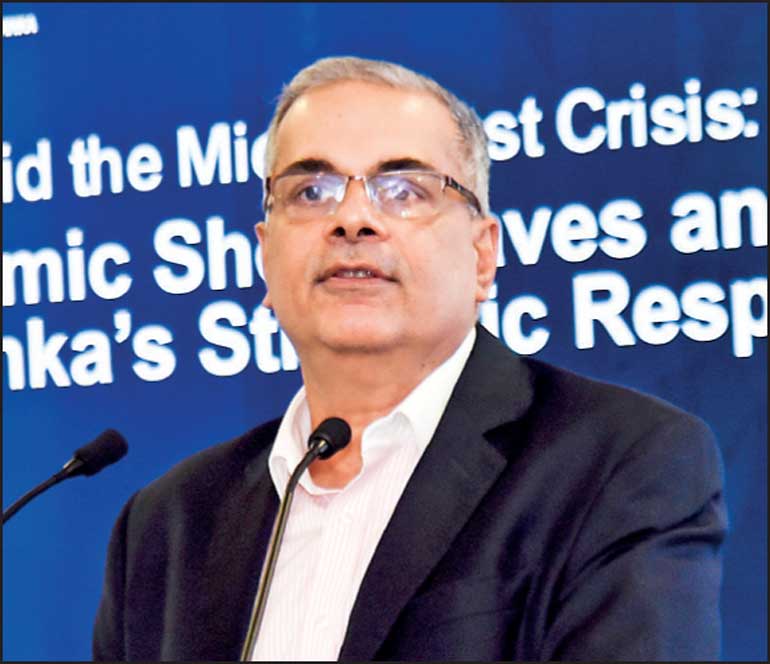
Advocata Institute Chairman Murtaza Jafferjee
– Pic by Upul Abayasekara
Advocata Institute Chairman Murtaza Jafferjee said Sri Lanka’s ability to withstand the economic shock from the escalating Middle East conflict will depend not only on immediate policy responses, such as fuel price adjustments, but also on addressing deeper structural problems of State capture and weak capacity.
Speaking at a CA Sri Lanka forum on ‘Risk amid the Middle East Crisis: Economic Shockwaves and Sri Lanka’s Strategic Response,’ Jafferjee said the Government’s decision to raise fuel prices soon after global crude prices crossed $ 100 a barrel was the correct response in the circumstances.
“For once, the Government is doing the right thing increasing the price,” he said, noting that delaying the adjustment could have led to panic buying and supply shortages at fuel stations.
The Government increased the price of Petrol Octane 92 by Rs. 24 to Rs. 317 per litre and Petrol Octane 95 by Rs. 25 to Rs. 365. Auto Diesel rose by Rs. 22 to Rs. 303, while Super Diesel increased by Rs. 24 to Rs. 353. The price of kerosene was raised by Rs. 13 to Rs. 195 per litre. Lanka IOC matched the Ceylon Petroleum Corporation (CPC) price revision.
However, Jafferjee said the price increase remains far below levels required to reflect prevailing global market conditions.
“Based on spot market prices, petrol should have been increased by nearly Rs. 100 per litre while diesel by Rs. 200 per litre to fully reflect international costs,” he said.
“This is not only about Brent crude prices. The bigger problem is diesel,” he said, pointing to the sharp increase in diesel refining margins, known as crack spreads, which have widened significantly in recent weeks.
The gap between domestic fuel prices and global market costs illustrates the scale of adjustment Sri Lanka could face if the Middle East conflict persists and energy supply disruptions intensify.
Jafferjee noted that Sri Lanka’s macroeconomic position is stronger today than during the period leading to the 2022 economic crisis. “Foreign reserves now exceed $ 7 billion, while remittances last year surpassed $ 8 billion,” he added.
Despite that improvement, he warned that a prolonged conflict could place several pillars of the recovery under pressure.
Remittances, tourism flows, and key export sectors such as tea remain closely linked to Middle Eastern markets. At the same time, disruptions to global shipping routes and energy supply chains could transmit additional shocks to the economy.
The Middle East remains central to global maritime trade, with the Strait of Hormuz serving as one of the most critical corridors for oil and chemical shipments worldwide.
Jafferjee said that if the economy is allowed to adjust through cost-reflective pricing and exchange rate flexibility, the shock can be absorbed.
However, he argued that Sri Lanka’s longer-term growth challenge lies elsewhere. “What I call the 2SC problem, the problem of State Capture and State Capacity,” he said.
He said Sri Lanka’s policy environment has often been shaped by narrow interest groups rather than the broader national interest. “I will say that Sri Lanka is run for the benefit of a thousand people,” he said, adding that accelerating growth will require running the country for the benefit of all its citizens.
According to Jafferjee, introducing greater competition across sectors will be essential if Sri Lanka is to accelerate growth. “It’s not that Sri Lankans are incapable, but you have to run the economy for the benefit of all the people,” he said.
He noted that trade liberalisation is fundamentally about competition and that concerns about open trade are often misplaced.
“People get this completely confused that if you have an open trade economy, you will run out of dollars. You run out of dollars because you have a closed economy, where you are trying to reach prices,” he said.
Jafferjee added that resistance to competition remains one of the country’s structural constraints. “Everybody in Sri Lanka says I like competition, but don’t come and impact my sector,” he said.
He said that while crises often force policymakers to focus on humanitarian priorities and ensuring that people have access to basic necessities, long-term growth will depend on improving institutional capacity and reducing the influence of entrenched interests.
In that context, Jafferjee said the recent fuel price increase represents the correct immediate response to rising global energy costs.
However, he stressed that safeguarding Sri Lanka’s fiscal stability and economic recovery will require the Government to continue with structural reforms in trade policy, State-owned enterprises, labour markets, and productivity if external shocks from the Middle East crisis persist.


