Thursday Oct 15, 2026
Thursday Oct 15, 2026
Thursday, 26 March 2026 00:00 - - {{hitsCtrl.values.hits}}
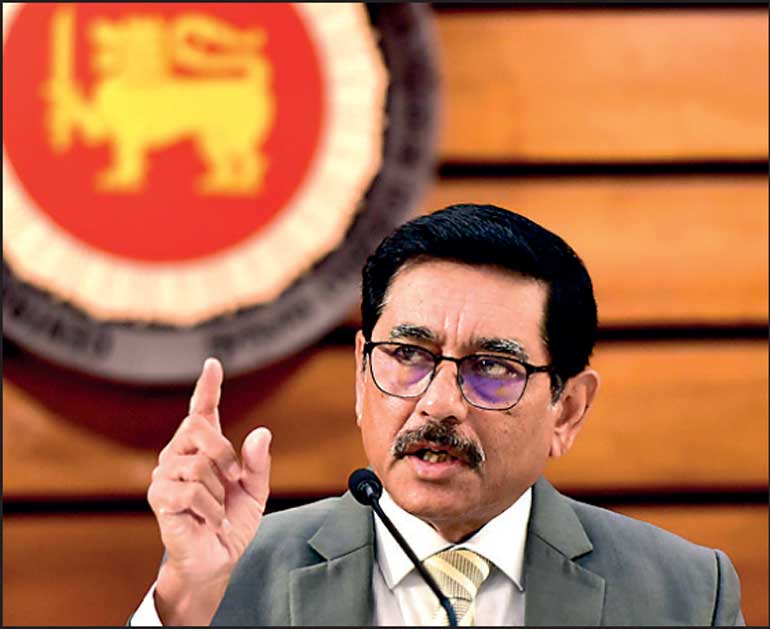
Central Bank Governor
Dr. Nandalal Weerasinghe
– Pic by Upul Abayasekara
By Charumini de Silva
Central Bank of Sri Lanka (CBSL) Governor Dr. Nandalal Weerasinghe yesterday rejected the need for immediate import controls or capital flow restrictions to contain the economic challenges from the Middle East war.
Striking a cautiously optimistic tone, he expressed confidence that Sri Lanka’s resilience and improved macroeconomic buffers will help the country navigate the ongoing geopolitical tensions in the Middle East and their spillover effects on global markets.
Addressing concerns over rising energy prices and global uncertainty, the Governor said Sri Lanka is in a relatively stronger position today to absorb external shocks compared to previous crises.
He noted that while the evolving Middle East conflict is beyond the control of any single country, Sri Lanka will continue to respond prudently based on how global conditions unfold.
“The impact of the current crisis is being felt across countries, including advanced economies. Our position is broadly comparable to many other economies facing similar pressures,” he said.
Recalling past disruptions, Dr. Weerasinghe pointed to the 2019 Easter Sunday attacks, the COVID-19 pandemic in 2020, the 2022 economic crisis, and more recent internal shocks such as Cyclone Ditwah, noting Sri Lankans have ‘repeatedly demonstrated resilience.’
“In all these situations, Sri Lankans have shown an unparalleled resilience to bounce back, and with necessary adjustments in place, we can manage this situation too,” he expressed optimism.
Despite concerns over external balances, the Governor firmly dismissed calls for immediate import controls or capital flow restrictions.
“At this point, we don’t see any requirement, nor do we make any suggestions to restrict capital flows, imports, remittances, or even outflows,” he said.
Responding to questions on the impact of the Middle East crisis on remittances, exports, and tourism, the Governor said data does not indicate a broad-based decline in foreign inflows.
“Actual data we have show the obvious decline in tourism,” he acknowledged, noting that tourist arrivals have fallen by around 17% so far.
Despite record arrivals in the first two months of the year, cumulative tourism earnings declined 4.9% year-on-year (YoY) to $ 730.3 million.
In contrast, Dr. Weerasinghe said workers’ remittances, Sri Lanka’s largest source of foreign inflows, have remained robust. February inflows surged 33% YoY to $ 729 million, marking the second consecutive month of record performance. Cumulative remittances for the first two months of 2026 exceeded $ 1.48 billion, up 32% YoY and the strongest performance for that period on record.
“When you look at these remittances, we have not seen any decline so far,” the Governor said, suggesting that overseas workers may even increase transfers during times of uncertainty to support families back home.
He also noted that there are no signs of large-scale returns of Sri Lankan workers from the Middle East, nor any diplomatic advisories urging them to come back.
The Governor stressed that Sri Lanka continues to operate under a flexible exchange rate regime within an inflation-targeting framework, where the currency is determined by demand and supply conditions and broader macroeconomic fundamentals. “Exchange rate intervention would only occur in the event of excessive volatility,” he said.
He noted that Sri Lanka had previously endured inflation as high as 70% in September 2022, suggesting that inflation returning to around 5% by the second quarter from its initial projection of the third quarter would not pose a severe threat to economic stability.
“The 2% inflation prediction for this month is including the energy price hike and other spillovers from the ongoing situation,” he added.
Dr. Weerasinghe also drew parallels with the 2008 global financial crisis, when Brent crude prices surged above $ 145 per barrel and domestic inflation rose to 28%, noting that the economy managed to withstand that period as well.
Although global oil prices recently surged amid geopolitical tensions, he pointed to early signs of easing in petroleum markets, though volatility still remains elevated.
“If global volatility proves short-lived, Sri Lanka should be able to manage the shock without major disruption. However, if the crisis persists, adjustments to inflation forecasts, fiscal space, and policy paths may become necessary,” Dr. Weerasinghe said.
Noting that the CBSL is closely monitoring developments, he added that the Government has already taken steps to moderate energy demand, which could help cushion inflationary pressures.
“I’m sure authorities will take steps to protect the economy against shocks, and that is all we can do as this situation is beyond our control,” he stressed.
While immediate crisis management is important, Dr. Weerasinghe stressed that structural reforms, including labour, land, banking, fiscal, and anti-corruption reforms, must proceed irrespective of external shocks.
“These are reforms that should be implemented as planned, whether there is a crisis or not,” he said, adding that building buffers in advance is the best way to mitigate risks from future shocks.
Reiterating that no one can predict how long global uncertainties will persist, the Governor said that Sri Lanka’s current policy stance remains appropriate.


