Tuesday Sep 15, 2026
Tuesday Sep 15, 2026
Friday, 16 January 2026 00:00 - - {{hitsCtrl.values.hits}}
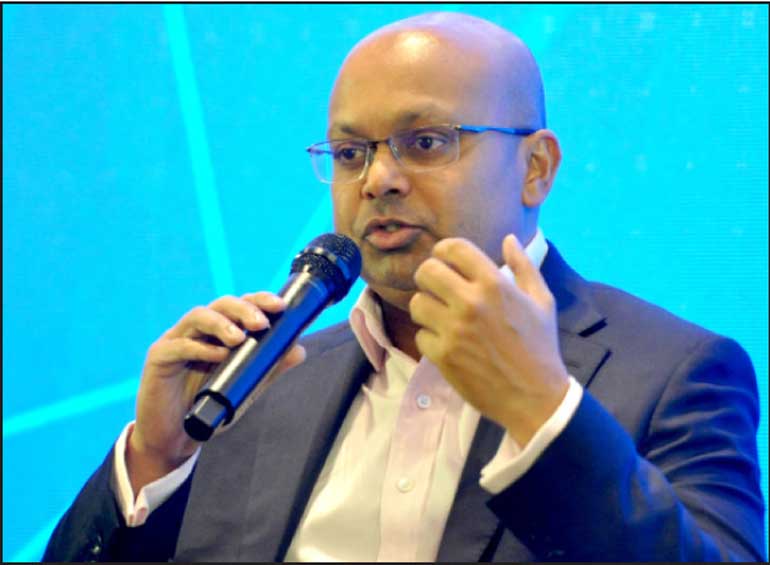
Managing Director
Naveen Gunawardane
– Pic by Lasantha Kumara
Sri Lanka’s post-International Monetary Fund (IMF) period, when external debt servicing, including International Sovereign Bond (ISB) repayments, begins to rise, is unlikely to pose a major macroeconomic risk in 2026 if current fiscal and external surpluses are maintained, according to Lynear Wealth Managing Director Naveen Gunawardane.
Speaking at the HNB Investment Bank (HNBIB) Investor Forum titled ‘Recovery to Resilience’ this week, Gunawardane said Sri Lanka is entering the later stages of the IMF program with a macroeconomic structure that is materially stronger than in past cycles, reducing vulnerability as debt repayments increase.
“When we come to 2028, Sri Lanka will be out of the IMF program and our external debt servicing picks up a little bit,” he said. “However, as long as we can allow these surpluses to continue, I am not too worried about 2028.”
In November 2025, Central Bank of Sri Lanka (CBSL) Governor Dr. Nandalal Weerasinghe said the country’s annual external debt servicing would average $ 2.75 billion up to 2027, and then average $ 3.5-$ 4 billion over the next decade.
At this week’s HNBIB Investor Forum, Gunawardane said the foundation for his outlook was the sustained combination of a primary surplus and a current account surplus, a position Sri Lanka has rarely maintained historically.
“If I look at the macro position, Sri Lanka’s macro is probably the strongest that I have personally seen over the last 10 to 20 years,” he said. “For most of our history, we were a two-digit deficit country. We had a deficit on the current account side and a deficit on the primary balance side. Over the last three years, we have been running primary surpluses and we have also been running a current account surplus.”
He explained that a primary surplus indicates that Government revenues are sufficient to meet non-interest expenditure, fundamentally changing the nature of public borrowing.
“So when you say the Government is running a primary surplus, what it basically means is that the Government is generating sufficient revenue to cover its expenditure excluding interest. Borrowing is then largely for rolling over existing debt and meeting interest payments, not for day-to-day spending.”
Gunawardane said this fiscal position has already proved its value during recent shocks, allowing the Treasury to respond using cash buffers rather than additional borrowing. “When the shock hit, we went into it with surpluses on the primary side. The Treasury had about Rs. 1.1 trillion in the bank account. That is very different to what happened when we went into COVID.”
On the external front, he noted that the current account surplus recorded in 2025 was structurally stronger than in previous years, as it was achieved without import controls and despite a rebound in vehicle imports.
“In 2025, we had a surplus with all import restrictions removed, including about $ 1.3 billion of vehicle imports. What really helped us was workers’ remittances,” he said, estimating inflows at around $ 7.8-7.9 billion for the year.
Looking ahead, Gunawardane said remittances may normalise in 2026, but easing vehicle imports and continued inflows should help sustain a current account surplus and support currency stability.
“When I look at 2026 and 2027, I see a macro picture where we continue to have a primary surplus and a current account surplus. That tells me interest rates should be relatively stable and the currency should also be relatively stable,” he said. “I think we are likely to avoid a 3% depreciation in 2026.”
He added that this backdrop reduces the risk of sharp interest rate increases or currency pressure during the post-IMF transition, provided fiscal discipline is maintained as external debt servicing obligations resume.


