Sunday Oct 25, 2026
Sunday Oct 25, 2026
Wednesday, 9 September 2026 00:00 - - {{hitsCtrl.values.hits}}
 |
| CBSL Governor Dr. Nandalal Weerasinghe |
 |
| BASL President Rajeev Amarasuriya |
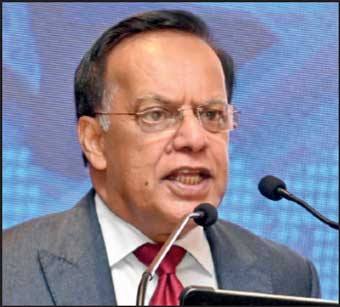 |
| Former Supreme Court Justice Buwaneka Aluwihare |
The country’s legal profession filed only two Suspicious Transaction Reports (STRs) with the Financial Intelligence Unit (FIU) between 2020 and 2026, Central Bank of Sri Lanka Governor Dr. Nandalal Weerasinghe said yesterday.
Speaking at a symposium where regulators pressed the profession to lift its compliance standards and the Bar Association of Sri Lanka (BASL) conceded the shortfall and pledged reform.
Addressing the inaugural National Anti-Money Laundering Symposium organised by BASL, Dr. Weerasinghe said lawyers, notaries and other independent legal professionals are designated non-financial businesses and professions (DNFBPs) under the Financial Transactions Reporting Act, obliged to report suspicious transactions to the FIU within two working days of forming a suspicion.
“Between 2020 and 2026 we saw only two STRs. This is alarming and well below the expectation, and the effectiveness of your profession, the effectiveness of the implementation, we are not doing it properly,” Dr. Weerasinghe said.
The obligation applies whenever lawyers act for clients on real estate transactions, management of client money or securities, or the formation and management of companies, trusts and other legal arrangements.
Sri Lanka was downgraded in its previous two mutual evaluations under the Financial Action Task Force (FATF) framework, and Dr. Weerasinghe said the country intends to avoid a repeat.
Three amendments to the AML/CFT legal framework, updating the Prevention of Money Laundering Act, the Financial Transactions Reporting Act and legislation on the financing of terrorism, were passed by Parliament this year. The reforms were driven by the need to align with evolving FATF standards, address deficiencies flagged in earlier assessments, incorporate recommendations from a 2023 IMF governance diagnostic, and prepare Sri Lanka for its forthcoming mutual evaluation.
The FIU, housed under the Central Bank, will continue as the national centre for receiving, analysing and disseminating financial intelligence, and has also been tasked with coordinating implementation of national AML/CFT policy across reporting institutions.
Reporting entities, including DNFBPs, are required to maintain agency-wide risk assessments, retain transaction and correspondence records for a minimum of six years, and train staff to identify and report suspicious activity. STRs may be submitted in writing, electronically or by telephone, with a written follow-up required within 24 hours where a report is made by phone.
Dr. Weerasinghe thanked BASL for convening the symposium and bringing lawyers and legal professionals into the compliance conversation, describing the initiative as timely given the on-site assessment by the Asia-Pacific Group on Money Laundering (APG), scheduled between 26 October and 6 November.
He called on all reporting agencies, the legal profession included, to exercise heightened vigilance and demonstrate compliance in practice rather than on paper. “It is essential that all stakeholders recognise their responsibilities. Financial institutions and non-financial institutions serve as the first line of defence against financial crime,” he said, adding that beneficial ownership transparency legislation is also in the pipeline.
The evaluation, he noted, would assess the entire national AML/CFT ecosystem, not the Central Bank alone, and would require closer cooperation between public and private actors, including banks and the gaming sector.
BASL President Rajeev Amarasuriya conceded the shortfall in his welcome address. “I think there have been only two STRs, three STRs, which came last year,” he said, telling the gathering the numbers needed to improve, and warning that a second symposium may be required if they do not.
Amarasuriya described lawyers as “gatekeepers,” vulnerable to misuse by those seeking to conceal the ownership, movement or origin of illicit funds through property purchases, company incorporations, trust formation and the management of client assets, activities he called legitimate but exploitable.
The Financial Transactions Reporting Act brings lawyers, notaries and other independent legal professionals into the AML/CFT framework when undertaking such specified activities, he said, adding that compliance was “no longer an issue taking place somewhere outside the legal profession” but one with direct bearing “in the lawyers’ office.”
He said the profession should be proactive rather than reactive. “We should build awareness before gaps in knowledge become gaps in compliance,” Amarasuriya said, adding that the Bar had a duty to address such gaps before they resulted in lapses.
He framed the symposium as an expression of BASL’s own sense of responsibility, not a response to external pressure. “If important legal obligations are imposed upon our members, then the bar itself has a responsibility to ensure that those obligations are properly understood,” he said.
The framework covers customer due diligence, beneficial ownership identification, risk management, compliance procedures and, where appropriate, suspicious transaction reporting, with sanctions attached to non-compliance.
Money laundering, Amarasuriya argued, is “not merely a criminal law problem” but “an economic governance problem,” a distinction he said mattered given Sri Lanka’s efforts to recover from a difficult economic period.
Attracting investment, improving trade, widening access to capital and restoring international confidence all depend on trust, he said; money laundering lets illicit funds enter the legitimate economy, distorts markets, allows criminally funded businesses to compete unfairly with legitimate ones, facilitates corruption, and weakens confidence in the institutions an economy depends on.
Compliance with international AML/CFT standards, and the reputation of the legal profession itself, are economic assets Sri Lanka cannot afford to squander, he said.
Most significant economic transactions, he noted, pass through a lawyer’s hands at some stage, whether incorporating a company, transferring property, structuring an investment, establishing a trust or transferring a business. The profession’s role is to facilitate legitimate business, he said, but “there is a line which cannot be crossed,” drawing a comparison between lawful tax avoidance and unlawful tax evasion.
Lawyers should not confine themselves to asking whether a transaction can be legally structured, he said, but should ask why it is being done in a particular way, who the real party behind it is, what the source of funds is, and why particular corporate structures or jurisdictions are involved, a line of questioning he said underpins a risk-based approach to compliance.
Amarasuriya acknowledged the tension between AML/CFT obligations and the confidentiality, trust and independence at the heart of the lawyer-client relationship, but said the profession needed to understand precisely what the law does and does not require, and how these obligations sit alongside the Supreme Court rules on professional conduct.
The fight against money laundering, he said, cannot belong to one institution, and requires collective effort across regulators, financial institutions, accountants, lawyers, businesses and government. A strong economy, he concluded, requires trusted institutions, trusted institutions require transparency, accountability and integrity, and the rule of law requires the legal profession to help protect all three.
Former Supreme Court Justice Buwaneka Aluwihare, who chairs the AML/CFT Taskforce, said the extension of AML/CFT obligations to lawyers reflects the position they occupy in transactions involving property, companies and trusts, which can be misused to disguise the ownership or origin of criminal proceeds.
Legal professional privilege remains protected, he said, distinguishing between privileged lawyer-client communication and a lawyer’s participation in specified financial or transactional activity. “The privilege belongs to the administration of justice. But that privilege cannot properly be converted into a mechanism to facilitate crime or concealing criminal property,” he said.
The forthcoming mutual evaluation, Aluwihare said, will test not only whether Sri Lanka has enacted laws and established institutions, but whether those systems are demonstrably effective, and whether professions such as the legal sector understand their obligations, identify beneficial ownership and recognise suspicious activity in practice.
“If sectors identified to others as presenting particular vulnerabilities remain unaware, disengaged or inadequately compliant, that weakness becomes the weakness of the national system,” he said, calling for a sustainable culture of compliance built on awareness, practical guidance and clarity on the boundary between reporting obligations and privilege.


