Tuesday Oct 27, 2026
Tuesday Oct 27, 2026
Saturday, 22 August 2026 01:23 - - {{hitsCtrl.values.hits}}
|
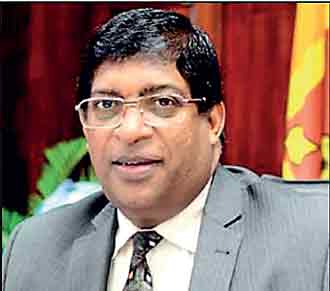
Opposition MP Ravi Karunanayake |
THE New Democratic Front (NDF) MP and former Finance Minister Ravi Karunanayake yesterday said that the National People’s Power (NPP) Government is set to face next month’s IMF evaluation trapped in a risky paradox as the country’s macroeconomic survival has been bought at the price of its people’s standard of living.
He said to secure the next tranche of financing, the state must strictly enforce fiscal discipline and meet its 15% GDP revenue mandate.
However, he claimed that pushing further austerity risks fracturing the absolute limit of public endurance, turning technical economic stability into a catalyst for deeper social discontent.
For the average Sri Lankan, the economy is stable but unlivable. The queues for fuel and gas are gone, but the financial ability to purchase those goods has been strictly rationed by the wallet.
While Sri Lanka has successfully executed 94% of its public external debt restructuring the horizon beyond the mid-2027 IMF program conclusion remains perilous, he emphasised.
Hitting the end-2026 gross reserve target of $ 8 billion is mechanically achievable through continuous exporter conversion mandates and high tariff surcharges (such as the extended 50% vehicle import surcharge).
However, scaling to the Government’s projected target of $ 15.1 billion by 2028 will be a steep uphill battle; as restructured debt servicing actively resumes, opined Karunanayake.
Sri Lanka faces an impending balance-of-payments cliff that will almost certainly necessitate the immediate negotiation of an 18th IMF successor program to avert a secondary default, he pointed out.
While Headline Gross Official Reserves of $ 6.59 billion look robust, they are artificially padded by a non-usable $ 1.4 billion (10 billion RMB) swap with the People’s Bank of China (PBOC) and short-term domestic commercial bank swaps.
But unencumbered Net International Reserves (NIR) languish in negative territory at minus $ 1.268 billion.
The central bank steps in to purchase these excess dollars from commercial banks using newly created Sri Lankan Rupees (LKR).
It has actually beaten the IMF’s review-period floor threshold of negative $ 2.035 billion by nearly $ 700 million reducing the structural deficit via aggressive domestic market dollar purchases (net buying $ 348.6 million in July alone), he explained.
The bank‘s surprise 100-basis-point policy rate hike to 8.75% in May 2026 successfully anchored inflation expectations against volatile Middle Eastern energy shocks and stabilised the rupee at 332.75–332.95 per US$.
But it did so by intentionally choking off credit expansion and suppressing margins for domestic small and medium enterprises (SMEs), Karunanayake claimed.
While inflation has slowed to 6.8%, prices did not drop; they simply stabilised at a historically high apex. Real wages have failed to catch up with the cumulative over 100% inflation peak of recent years.
The mandated 18% VAT on essential goods and aggressive personal income tax brackets have severely eroded disposable income.
Families that were comfortably middle-class in 2021 are now forced into survival mode, cutting down on nutrition, healthcare, and private education.