Tuesday Oct 13, 2026
Tuesday Oct 13, 2026
Friday, 3 April 2026 00:00 - - {{hitsCtrl.values.hits}}
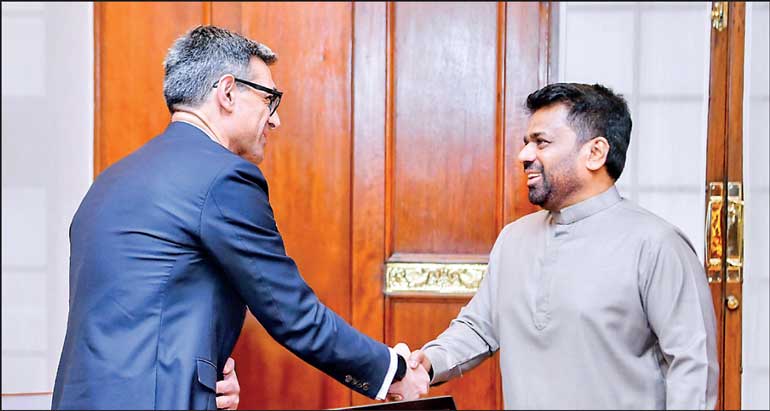
IMF Mission Chief Evan Papageorgiou (left) with President Anura Kumara Dissanayake at the Presidential Secretariat yesterday
Discussions yesterday between President Anura Kumara Dissanayake and the visiting International Monetary Fund (IMF) delegation centred on how Sri Lanka can continue to advance within the Extended Fund Facility (EFF) program without undermining the economic stability achieved so far, amid fresh external pressures from the Middle East conflict.
The visiting delegation, led by Mission Chief Evan Papageorgiou, is here to conduct the Fifth and Sixth Reviews under the EFF program, which could release around $ 700 million in a few months.
The Fifth Review was expected to be completed around December 2025 after the IMF evaluated the 2026 Budget that was announced in November 2025. However, Cyclone Ditwah and the devastation in its wake compelled the Government to seek emergency funding under the IMF’s Rapid Financing Instrument (RFI) instead, amounting to $ 206 million, and the Fifth Review for a $ 347 million tranche was postponed.
According a statement from the President’s office, the IMF delegation commended the economic progress achieved by Sri Lanka under the present Government, particularly noting that the country has transitioned towards a more resilient economic footing through the achievement of growth targets, improved revenue management, and the strengthening of foreign reserves.
Discussions also focused on how Sri Lanka could continue to advance within the IMF program without undermining the economic stability that has been established thus far.
It was further noted that the ongoing conflict situation in the Middle East poses an external challenge–the impact of which Sri Lanka cannot entirely avoid.
However, the Government has been managing the situation prudently, taking measured decisions to address pressures on fuel prices and the energy sector, while ensuring that targeted relief is provided to vulnerable groups, the statement said.
In the face of these external challenges, the IMF delegation also appreciated the Government’s program aimed at safeguarding economic progress while effectively managing both the economy and the livelihoods of the people.
Responding to the IMF’s observations, President Dissanayake stated that Sri Lanka has met all targets set under the EFF program and has reached a position of relative stability. He highlighted the need to take all necessary measures to minimise the impact on the public.
The IMF delegation led by Papageorgiou comprised Sri Lanka Resident Representative Martha Woldemichael, Enrique Flores Curial, Dinar Prihardini, Ursula Wiriadinata, Ozlem Aydin, Yorbol Yakhshilikov, Klakow Akepanidtaworn, and Manavee Abeyawickrama.
The discussion was attended by Central Bank of Sri Lanka (CBSL) Governor Dr. Nandalal Weerasinghe, Treasury Secretary Dr. Harshana Suriyapperuma, Deputy Secretary A.K. Seneviratne, and Director General – Fiscal Policy M.K.C. Senanayake. Finance and Planning Deputy Minister Dr. Anil Jayantha Fernando also participated in the meeting.
Separately, the IMF team received a guided tour of the Parliament, where they met with Speaker Dr. Jagath Wickramaratne and party leaders.
The Speaker reaffirmed Sri Lanka’s full commitment to the IMF’s EFF program and maintaining sound monetary and fiscal policies. He highlighted key legislative measures, such as the Public Financial Management Act and the Anti-Corruption Act, noting that these frameworks are central to ensuring fiscal discipline and good governance.
During the meeting with party leaders, views were exchanged on the current economic landscape, including post-cyclone recovery challenges and global economic uncertainties. Discussions focused on key issues such as tariff adjustments, inflation management, external sector pressures, and the need for sustained structural reforms to ensure macroeconomic stability.
The IMF EFF program ends in March 2027, with the Government making commendable progress but unlikely to meet all key targets, especially around governance and enhancing social security that would ensure continuity of critical structural reforms.


