Friday Oct 16, 2026
Friday Oct 16, 2026
Friday, 16 October 2026 00:00 - - {{hitsCtrl.values.hits}}
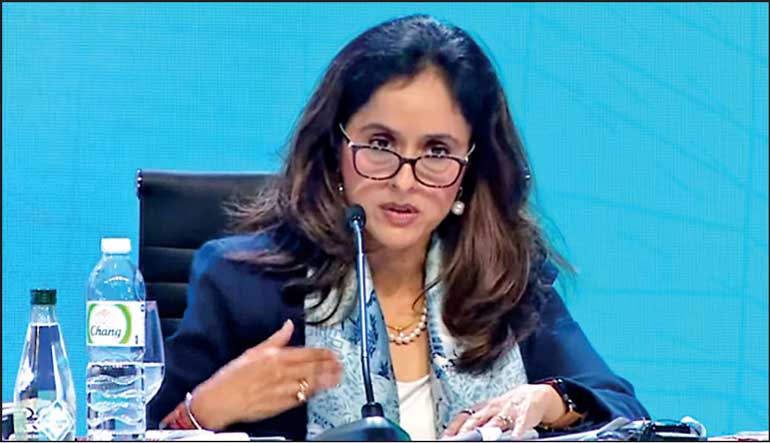
IMF Asia and Pacific Department Deputy Division Chief Sonali Jain-Chandra
The International Monetary Fund (IMF) yesterday urged Sri Lanka to stay focused on completing the ongoing Extended Fund Facility (EFF) program, which has two reviews still to run.
The comments come amid persistent debate over Sri Lanka’s IMF engagement beyond March 2027, when the EFF program ends. The Fund said Sri Lanka’s fiscal performance had outshone that of its peers, and left the decision on any follow-on arrangement to the Government.
“Let me step back for a second just to acknowledge first the important achievements that have been garnered in the context of the [EFF] program, which still has some months left. The program has been delivering very strongly. The macroeconomic situation has much improved, and in contrast to other countries, the fiscal performance is actually very strong,” IMF Asia and Pacific Department Deputy Division Chief Sonali Jain-Chandra told a press briefing at the Annual Meetings in Thailand yesterday.
She said the revenue ratio had doubled, the debt restructuring was largely complete, and growth had been positive for 11 consecutive quarters since the crisis. She also cited structural gains, particularly on governance, which she described as a core part of the program.
Jain-Chandra cautioned, however, that the program was not yet complete. IMF staff reached a staff-level agreement on the Seventh Review in early October, and the IMF Executive Board will consider it in the coming weeks. A further review mission will follow before the program expires in March 2027.
“There are still two reviews left, so important work remains in the current program. It is very important to keep focused on the macroeconomic stabilisation that is happening and to consolidate the reform gains,” she said.
She was responding to a Sri Lankan journalist who asked whether the IMF saw a need for a new arrangement, given that major debt repayments resume in 2028 and the country remains exposed to climate and oil shocks. Jain-Chandra said that decision rested with the authorities.
“There are many ways in which the Fund can support Sri Lanka, whether it is a new financing arrangement, granular policy advice in the context of surveillance, or capacity development, of which Sri Lanka is a very significant beneficiary. We stand ready to support Sri Lanka in any way the authorities desire, and the Fund will remain a very committed partner,” she said.
Elsewhere in South Asia, the IMF raised India’s growth forecast to 7% for this year and next, after a stronger-than-expected first quarter of its fiscal year. Bangladesh, by contrast, faces inflation of 8% and a revenue-to-GDP ratio of just 7%, among the lowest in the world. Jain-Chandra said Bangladesh needs tight monetary conditions and a credible plan to repair a very weak financial sector. Bangladesh requested a new IMF program in May.
For Asia and the Pacific as a whole, the IMF expects growth to ease from 5% in 2025 to 4.8% in 2026 and 4.4% in 2027. That is stronger than projected in April, and implies the region will account for more than two-thirds of global growth. IMF Asia and Pacific Department Director Krishna Srinivasan said the region had absorbed an energy shock that began in February, as well as the 2025 tariff increases, helped by a boom in artificial intelligence (AI)-related technology. He added that the benefits had been uneven.
“Asia’s growth is projected to slow, but continue to outpace the world. But resilience is not unlimited,” Srinivasan said. He pointed to limits on drawing down energy inventories and the mounting fiscal cost of relief measures.
He said risks were tilted to the downside. They include renewed escalation in the Middle East, a reassessment of AI-related profitability, higher sovereign borrowing costs, and a potentially exceptional El Niño cycle. Srinivasan urged central banks to safeguard price stability and their independence, and called on governments to rebuild fiscal buffers while shielding the vulnerable through targeted support.
“The idea is to protect people, not prices,” he said.


