Tuesday Oct 06, 2026
Tuesday Oct 06, 2026
Tuesday, 6 October 2026 04:38 - - {{hitsCtrl.values.hits}}
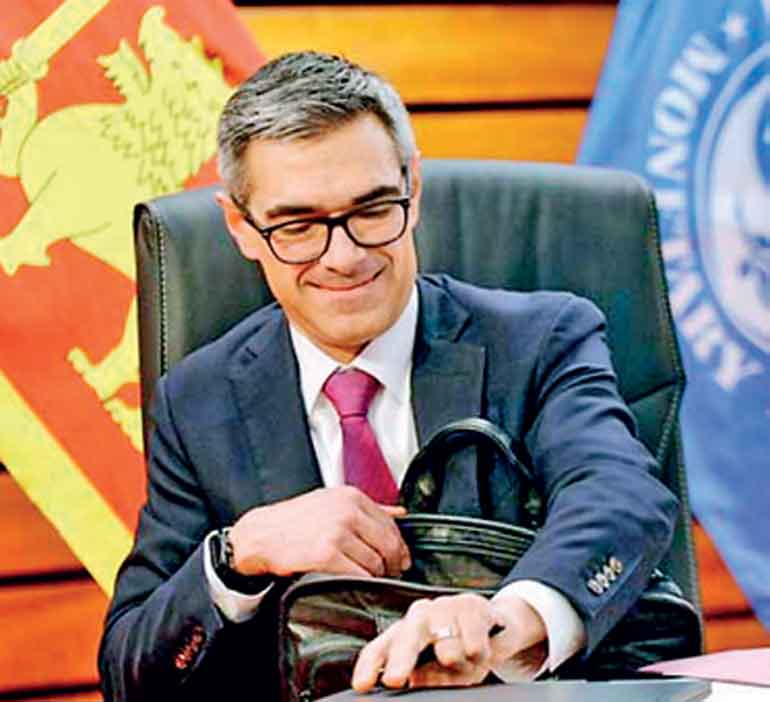
IMF Mission Chief for Sri Lanka Evan Papageorgiou
The International Monetary Fund (IMF) on Sunday reached a staff-level agreement with Sri Lanka on the Seventh Review of its $ 3 billion Extended Fund Facility (EFF), but made Board approval of the next tranche of about $ 345 million contingent on the Government presenting a 2027 Budget in line with program parameters and on adequate progress with debt restructuring, as it pressed for fuel prices to move with global markets amid a protracted Middle East war.
After what the Fund called constructive discussions, IMF Mission Chief for Sri Lanka Evan Papageorgiou issued the following statement:
“IMF staff and the Sri Lankan authorities have reached staff-level agreement on the Seventh Review under the four-year EFF arrangement and concluded the 2026 Article IV Consultation discussions. The EFF arrangement was approved by the IMF Executive Board for a total amount of SDR 2.3 billion ($ 3 billion) on March 20 2023.
“The staff-level agreement is subject to IMF Executive Board approval, contingent on: (i) the presentation by the Minister of Finance to Parliament of the 2027 Budget, in line with program parameters and (ii) the completion of the financing assurances review to confirm multilateral partners’ financing contributions and assess adequate progress with debt restructuring.
“Upon completion of the Executive Board review, Sri Lanka would have access to SDR 254 million (about $ 345 million), bringing the total IMF financial support disbursed under this arrangement to SDR 2.032 billion (about $ 2.7 billion).
“Sri Lanka’s economy has proved remarkably resilient to successive shocks. Economic activity expanded by 4.2% in 2Q 2026, marking eleven consecutive quarters of strong growth. At 8% year-on-year (YoY) in September, headline inflation remains in single digits. Gross official reserves have increased, reaching $ 6.9 billion at end-August 2026. Banks remain well capitalised and profitable. Fiscal outturn in 1H 2026 was strong and debt restructuring is largely completed.
“However, Sri Lanka continues to face downside risks from uncertainty over the duration and intensity of the Middle East war, global trade policy, and the impact of El Niño. Safeguarding macroeconomic stability in a shock-prone environment requires continuing with prudent policies and bold reforms to protect the hard-won gains of the program.
“In response to a protracted Middle East war, the Government should allow domestic fuel prices to adjust in line with international fuel price movements and preserve cost-recovery energy pricing, while protecting the vulnerable. Support should be well-targeted, on budget, carefully costed, and time-bound to avoid jeopardising fiscal and debt sustainability, eroding confidence, and reversing the recovery.
“Poverty-targeted cash transfers should be leveraged to shield the most vulnerable. Successive shocks highlight the need to intensify efforts to improve the coverage, targeting, and responsiveness of social safety nets. In the event of stronger second-round inflationary effects from the Middle East war, monetary policy should stand ready to tighten to mitigate the risk of expectations becoming de-anchored.
“Staying the course on the broader reform agenda is critical to entrench stability and sustainably lift growth. Developing and implementing a medium-term revenue strategy would support the authorities’ efforts to sustain revenue mobilisation, while also enhancing the efficiency and fairness of the tax system, and providing policy certainty to investors. Efforts to strengthen public investment management should continue to address bottlenecks to capital spending execution, including to accelerate Cyclone Ditwah-related recovery and reconstruction.
“Greater exchange rate flexibility remains key to absorbing shocks and supporting reserve accumulation. Preserving the integrity of the anti-corruption legislative framework is critical to enhance public trust. Delivering strong and inclusive growth requires creating an enabling environment by liberalising trade, modernising business and labour regulations, broadening access to finance, advancing digital public infrastructure, and closing infrastructure gaps.
“Following the visit to Sri Lanka during 10-23 September, the IMF team held virtual meetings with Central Bank of Sri Lanka Governor Dr. P. Nandalal Weerasinghe, Secretary to the Treasury Dr. Harshana Suriyapperuma, Senior Economic Adviser to the President Duminda Hulangamuwa and other senior officials to finalise the staff-level agreement. We would like to thank the authorities for the excellent discussions and strong collaboration.”

