Thursday Oct 15, 2026
Thursday Oct 15, 2026
Friday, 10 April 2026 00:00 - - {{hitsCtrl.values.hits}}
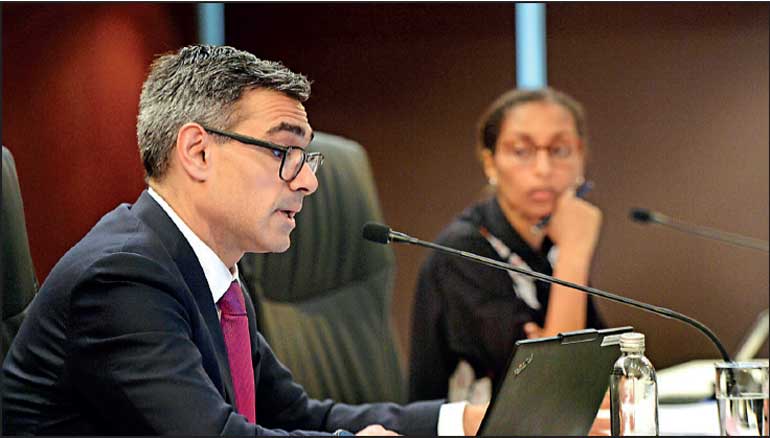
IMF Sri Lanka Mission Chief Evan Papageorgiou (left) at the media briefing yesterday in Colombo along with Resident Representative Martha Woldemichael – Pic by Lasantha Kumara
In a major boost for the country, Sri Lanka has reached a staff-level agreement with the International Monetary Fund (IMF) on the combined Fifth and Sixth Reviews under its $ 3 billion Extended Fund Facility (EFF), positioning the country to access around $ 700 million in fresh financing, subject to key reform conditions.
The IMF said yesterday the agreement remains contingent on the restoration of cost-recovery electricity and fuel pricing, alongside the completion of financing assurances and progress in debt restructuring.
Upon approval by the IMF Executive Board, total disbursements under the program would rise to about $ 2.4 billion.
IMF Sri Lanka Mission Chief Evan Papageorgiou told journalists yesterday that Executive Board meeting could take up Sri Lanka review either in May or June by which time Sri Lanka is expected to complete the prior actions.
The Fund noted that Sri Lanka’s reform program has delivered measurable outcomes, with the economy expanding by 5% in 2025, inflation returning to positive territory at 2.2% year-on-year in March, and gross official reserves reaching $ 7 billion by end-March 2026. Fiscal performance was also supported by higher tax revenues, particularly from motor vehicle imports.
However, the IMF warned that external and domestic risks remain elevated. The ongoing Middle East conflict has driven up energy prices, disrupted tourism flows, and affected remittance inflows, while reconstruction needs following Cyclone Ditwah are placing additional strain on public finances.
Against this backdrop, the IMF emphasised the need to sustain fiscal consolidation through improved tax compliance, broader revenue measures, and disciplined spending. It also called for maintaining cost-reflective energy pricing while protecting vulnerable groups through targeted support.
The Fund further underscored the importance of safeguarding central bank independence, rebuilding reserves with exchange rate flexibility, and addressing financial sector risks, including non-performing loans and vulnerabilities in smaller finance companies.
Advancing governance reforms, strengthening anti-corruption frameworks, and accelerating structural reforms in trade, digitalisation, and labour markets were also identified as critical to sustaining long-term growth and resilience.
IMF also said:
“Sri Lanka’s ambitious reform agenda continues to deliver commendable outcomes. The economy grew by 5% in 2025. Inflation has returned to positive territory and rebounded to 2.2% YoY in March, and gross official reserves reached $ 7 billion in end-March 2026. Fiscal performance in 2025 was strong, primarily supported by taxes on motor vehicle imports. Debt restructuring is nearing completion, with the successful completion of Sri Lankan Airlines’ debt exchange and further progress in finalising remaining bilateral agreements.
“Sri Lanka is significantly exposed to the Middle East conflict, which has heightened energy prices, disrupted a key air hub for tourists, and affected Sri Lankans working in the region. Authorities have ameliorated disruptions to economic activity by securing sufficient fuel supplies for households and industries.
“At the same time, the country needs to address the infrastructure and spending needs caused by Cyclone Ditwah. Heightened downside risks to the economy from disaster risks, persistent trade policy uncertainty and the conflict in the Middle East emphasise the urgency to accelerate the reform momentum to safeguard macroeconomic stability, enhance Sri Lanka’s resilience to shocks, and maintain the economy on a path toward recovery and inclusive growth.
“On this front, it is important to continue building fiscal space through strong revenue measures and prudent spending execution. This requires sustained efforts to improve tax compliance, broaden the tax base, address revenue leakages, and enhance public financial management. It is instrumental to restore and maintain cost-recovery fuel and electricity pricing while assisting the most vulnerable. Continued vigilance is needed to minimise fiscal risks and safeguard fiscal discipline.
“As Sri Lanka starts building back better, projects should be prioritised judiciously and spending executed transparently and in compliance with the Public Financial Management Act. Any fiscal support in response to exogenous shocks should be well-targeted, carefully costed, and time-bound. Protecting the poor and vulnerable, who are disproportionately affected, should remain a priority, and this calls for the steadfast strengthening of social safety nets by improving their targeting, adequacy, coverage, and shock-responsiveness.
“It is important for monetary policy to remain data-dependent and agile to safeguard price stability in the face of shocks. Central bank independence should continue to be upheld, including by continuing to prohibit monetary financing of the budget. Rebuilding foreign reserves while allowing for exchange rate flexibility is a necessity amid global uncertainty. Resolving non-performing loans, promoting sound credit growth, and addressing vulnerabilities in some small licensed finance companies will help safeguard financial stability.
“The publication of the 2026 Government action plan on governance reforms is welcome; effective implementation will help advance the anti-corruption agenda and support growth. It will be key to uphold the independence of Sri Lanka’s anti-corruption body (CIABOC), support the reliability of the beneficial ownership registry, and strengthen fiscal governance through sound legislation on public-private partnerships, state-owned enterprises, public procurement, and public asset management. Unlocking strong and durable growth for all Sri Lankans requires staying the course on reforms, including by sustaining trade liberalisation efforts, accelerating digitalisation initiatives, streamlining business regulations, and modernising labour legislation to reduce rigidities
“We would like to thank the authorities for the excellent collaboration during the mission, including during our visit to Galle in the Southern Province. We reaffirm our commitment to support Sri Lanka at this uncertain time.”
During the review, the IMF team held meetings with President and Finance Minister Anura Kumara Dissanayake, Labour Minister and Deputy Minister of Finance and Planning Prof. Anil Jayantha Fernando, Deputy Minister of Economic Development Nishantha Jayaweera, Central Bank of Sri Lanka Governor Dr. P. Nandalal Weerasinghe, Secretary to the Treasury Dr. Harshana Suriyapperuma, Senior Economic Advisor to the President Duminda Hulangamuwa, Chief Advisor to the President on Digital Economy Dr. Hans Wijayasuriya, Governor of Southern Province Prof. Susiripala Manawadu, and other senior Government and CBSL officials. The IMF team also met with parliamentarians, representatives from the private sector, civil society organisations, and development partners.


