Friday Oct 02, 2026
Friday Oct 02, 2026
Monday, 26 January 2026 05:32 - - {{hitsCtrl.values.hits}}
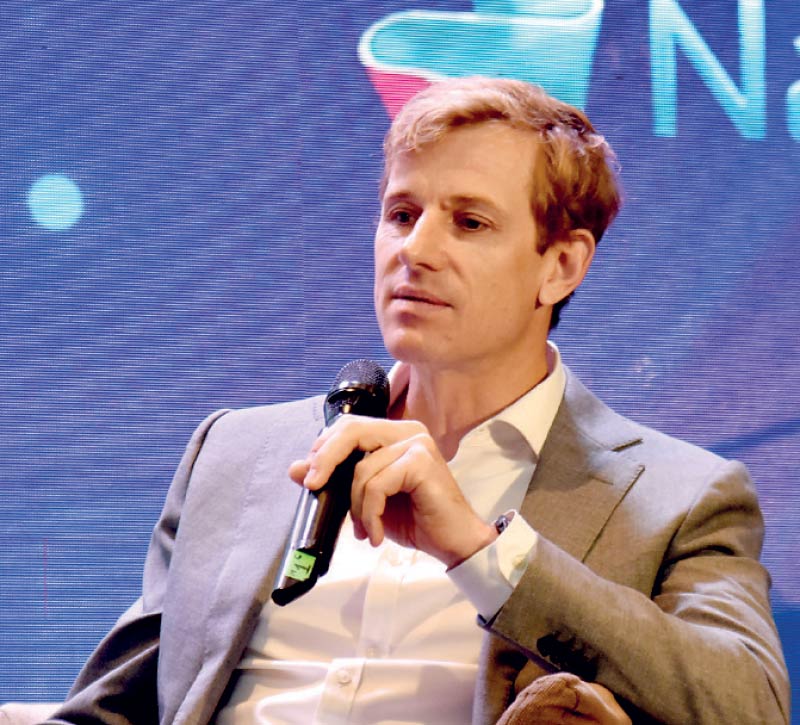
IFC South Asia Manager – Country Advisory and Economics Gregory Smith – Pic by Upul Abayasekara
Cautioning that complacency was setting in and reforms were slipping to the backburner, World Bank Group’s private sector arm International Finance Corporation (IFC) South Asia Manager – Country Advisory and Economics Gregory Smith has urged Sri Lankans not to forget the country’s worst economic crisis triggered in 2022 after defaulting its debts.
Sri Lanka’s post-crisis economic recovery has been “remarkable” but remains fragile, requiring sustained policy discipline and public pushback against bad decisions, Smith said.
Delivering the keynote address at Nations Trust Bank’s investor forum titled ‘Investing in Growth – Sri Lanka 2026’ last week, Smith said the country’s recovery over the past two years marked a sharp reversal from the depths of the 2022 crisis, but warned that the gains could quickly unravel without continued adherence to macroeconomic stability.
“If we were sitting here in January 2024, inflation had only just come down from 60-70% and the crisis was still front and centre,” he said, recalling the period when debt restructuring was incomplete and political uncertainty dominated investor sentiment.
He said GDP per capita, which had fallen to around $ 3,800 by end-2023, back to 2014 levels, had since recovered to about $ 4,800, reflecting what he described as a remarkable stabilisation and turnaround.
“Sri Lanka has now recorded 10 consecutive quarters of positive growth, mostly in the 4-5% range, a performance few would have assumed as a base case two years ago,” Smith said, adding that despite the economic damage caused by Cyclone Ditwah late last year, he projected growth of about 4.85% in 2025 and around 4.5% in 2026.
The recovery, he said, had been driven primarily by tourism and remittances. Tourist arrivals, which collapsed to about 500,000 in 2021, rebounded to around 2.3 million this year, while remittances recovered to $ 6 billion in 2023 and about $ 8 billion last year.
“These flows have been huge to the recovery,” Smith said, noting that Sri Lanka posted its first current account surplus in 2023. However, he cautioned that recent current account deficits reflected a return of growth and demand, rather than weakness.
Foreign Direct Investment (FDI), however, remained a concern. “FDI is probably the most disappointing number for me. It’s still less than 1% of GDP, and that hasn’t changed in the last two years,” he said, adding that improvements in credit ratings and a track record of stability were needed to lift inflows.
Smith said external buffers had strengthened significantly, with foreign reserves rising from around $ 3.5 billion at end-2023 to about $ 6.8 billion, giving the economy greater capacity to absorb shocks. Net foreign assets of the Central Bank of Sri Lanka (CBSL) had also turned positive after three years of contraction.
On fiscal policy, Smith described revenue mobilisation as one of the most important structural improvements. Government revenue, which fell to around 8% of GDP during 2020-2022, had recovered to about 15.6% of GDP. “That’s a starting point for a government to try and deliver services,” he said.
At the same time, he flagged low capital expenditure as a constraint on future growth. Public investment fell to about 2.1% of GDP last year as authorities prioritised International Monetary Fund (IMF) targets. A proposed increase to around 4% of GDP in 2026 would test the Government’s ability to spend effectively and without corruption, he said.
Smith said Sri Lanka’s debt burden had eased from over 114% of GDP at its peak to about 96%, but warned that interest payments remained an Achilles’ heel, absorbing around 7.5% of GDP—nearly half of Government revenue.
One of the most encouraging developments, he said, was the sharp decline in domestic borrowing costs. One-year Government rates, which were unsustainably high during the crisis, had fallen alongside disinflation and improved policy credibility. “Any deviation from the IMF program will hurt first in that one-year Government borrowing cost,” he warned.
Looking ahead, Smith said Sri Lanka needed at least 10 years of uninterrupted macroeconomic stability to achieve durable growth. “This, on top of everything, is crucial,” he explained.
While 3-4% growth was achievable with basic stability, lifting growth to 7%, a level that would double the economy in a decade, would require export competitiveness, stronger FDI, deeper capital markets, and better skills matching.
He also warned against complacency as memories of the crisis fade. “This is something that needs to be remembered,” Smith said, urging citizens and businesses to recall fuel queues, lost incomes, and hardship, and to push back when policies threaten macro stability. “That pushback,” he said, “is what will keep this country on the straight and narrow but sustainable path to growth over the next decade.”

