Sunday Sep 13, 2026
Sunday Sep 13, 2026
Tuesday, 13 January 2026 02:21 - - {{hitsCtrl.values.hits}}
By Devan Daniel
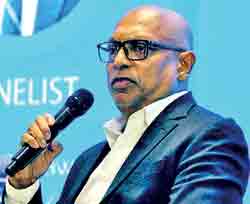 |
| Executive Director Sarath Ganegoda – Pic by Lasantha Kumara |
Hayleys PLC Executive Director Sarath Ganegoda yesterday said tighter lending limits and Sri Lanka’s sovereign constraints are making it increasingly difficult for large companies to sustain growth, expand exports, and invest overseas, even as macroeconomic conditions stabilise.
Speaking at the HNB Investment Bank Investor Forum titled ‘Recovery to Resilience,’ Ganegoda said access to funding has become the most pressing challenge for large conglomerates operating in a low-growth domestic economy.
The Central Bank of Sri Lanka (CBSL) last April issued revised directions limiting loans to a single borrower or a group of connected customers to 25% of Tier I capital, compared to earlier thresholds of 30% for a single borrower and 33% for a group. State-owned enterprises (SOEs) are also covered under the revised framework.
“During the past 10 years, in USD terms, we have been growing at 8-9%, whereas Sri Lanka’s GDP has been growing at around 2%,” he said.
Ganegoda said maintaining that growth trajectory in an economy with weak underlying expansion is increasingly difficult without access to external credit. “To maintain our growth momentum—and our intention is to put this into double digit growth—when you operate in an environment where the growth is either low, single-digit or no growth, it is very challenging,” he said. “So the only way you can do this is through external credit.”
He said Hayleys, which operates across 16 business sectors and records turnover of about $ 1.6 billion, aims to remain a net foreign exchange earner, with at least half of its revenue coming from exports.
“We always try to be a net forex earner, meaning at least 50% of our turnover, which is currently around $ 1.6 billion, to come from exports,” he said.
However, Ganegoda said Sri Lanka’s export structure has remained largely unchanged for decades, making it difficult to achieve scale and sustained growth.
“If you take our number one export, it is tea, and 30 years ago, it was tea. Even today, after so many years, it is still struggling around $ 1.4 to $ 1.6 billion,” he said. “So it is very challenging to add new products and new commodities with scale and growth potential.”
Turning to financing constraints, Ganegoda said the reduction of the single borrower limit has created difficulties for large companies seeking capital.
“All the bankers here know that our single borrower limit may have been 30% on Tier I and Tier II capital, but from this year, it has been revised to 25% on Tier I capital,” he said. “So that puts a lot of organisations like us into difficulties looking for capital for growth.”
He said the constraint also affects the ability of Sri Lankan companies to expand overseas. “Even to go external with our current trading, given the sovereign constraints, it is a challenge,” Ganegoda said. “We even asked the Government to pause reduction of the single borrower limit for a couple of years and allow capital markets to grow.”
Ganegoda also pointed to regulatory hurdles faced by companies seeking to invest abroad. “Those who have tried to invest outside Sri Lanka know how difficult it is to get approval to invest even $ 10 million outside,” he said.
While noting that macroeconomic indicators have stabilised, Ganegoda said funding availability remains the core issue.
“Macro-wise, we are in a fairly stable situation in relation to exchange rates and interest rates,” he said. “But if you ask me, the number one challenge is the availability of funds.”


