Tuesday Nov 24, 2026
Tuesday, 24 November 2026 01:56 - - {{hitsCtrl.values.hits}}

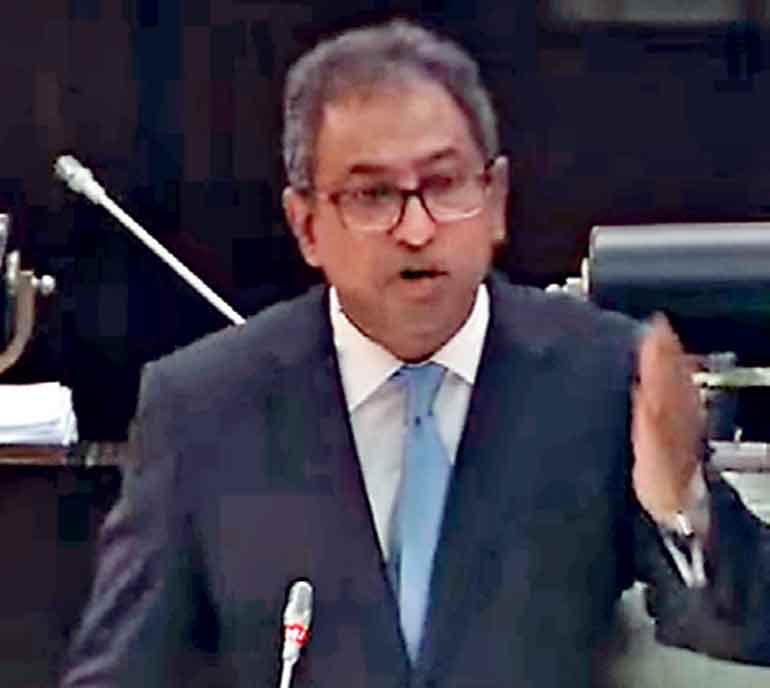
Samagi Jana Balawegaya (SJB) MP Dr. Harsha de Silva yesterday accused the Government of lacking urgency on economic ties with India. He urged it to finalise the long-stalled Economic and Technology Cooperation Agreement (ETCA) and to rework the country’s ports strategy so that it complements, rather than competes with, India’s port expansion.
Speaking in Parliament, Dr. de Silva said India was not simply a trading partner. It was Sri Lanka’s largest trading partner, its second-largest export market as a single country, its largest source of tourists and one of its largest investors, as well as the fastest-growing large economy in the world. Sri Lanka’s economic and strategic future, and its goal of becoming the maritime and logistics hub of the Indian Ocean, were closely tied to India, he said.
He said roughly 60-70% of India’s transshipment cargo went to the Port of Colombo, which made India part of the economic infrastructure that sustained the port’s operations rather than just a market. He questioned whether India’s Vizhinjam port would compete with or complement Colombo. He also noted that MSC had recently bought 49% of Adani Vizhinjam Port Private Ltd for $ 1.4 billion.
Dr. de Silva said Sri Lanka had to decide how far it would liberalise trade in services. He asked whether the country would continue to protect “one or two or three big business houses” by keeping the Port of Colombo’s logistics services closed above a 40% equity ownership limit. An integrated logistics base would require equity ownership to be opened up not only in warehousing and logistics but also in shipping agency and freight forwarding, which he said was the model in India, Dubai and Singapore.
“If we want to really become the maritime and logistics hub of this ocean, you have to understand that what matters to the investor has to be what we are willing to offer. If not, forget the idea of becoming the maritime hub of the Indian Ocean,” he said.
Turning to trade agreements, Dr. de Silva noted that the free trade agreement with India had been signed under the Chandrika Bandaranaike Kumaratunga Government. He said the Minister had stated that it would be looked at again. The agreement had been reviewed repeatedly, he said, but neither the proposed Comprehensive Economic Partnership Agreement (CEPA) nor the ETCA had materialised.
He said the Janatha Vimukthi Peramuna (JVP) had vowed in Opposition never to allow the ETCA to be signed, and said he would table material he had downloaded from its website.
“Now, I know you all have changed. As a matter of fact, from what I see, you have changed 180 degrees. The anti-India sentiment has become a very pro-India sentiment, which we encourage and which we welcome,” Dr. de Silva said.
He questioned whether the Government’s prioritisation of India was “just grand rhetoric” or backed by a realistic plan. If it was serious, he said, it should understand and resolve the outstanding issues and sign the ETCA. He said the Government had appointed a committee but showed no urgency. He asked whether its members had the expertise to understand the problems Sri Lankan exporters faced in India over standards, certifications and other barriers.
“It is not about selling. It is about participating in a structured, integrated production engine,” he said, adding that the relationship was about manufacturing, services and logistics.
However, Dr. de Silva said India was not the be-all and end-all. China, the East and the West were also important partners, and each relationship, including those with the European Union and the United States, had to be handled on its own terms.
He criticised the Government for failing to appoint ambassadors to Washington, Beijing, Berlin and Ottawa, among other capitals, two years after the Minister took office.
Dr. de Silva also called for foreign missions to be held to account for investment results. He noted that the Ministry of Foreign Affairs had launched an integrated mechanism with the Ministry of Industries and Trade in September 2025 to coordinate missions with trade and investment institutions, with identifying potential foreign investors among its objectives. He asked the Minister to table, for each mission, the number of qualified investors introduced to the Board of Investment (BOI), the foreign direct investment (FDI) actually realised, and the targets set and achieved. The Ministry’s 2024 report had claimed 75% achievement of its FDI promotion target, which he described as a very vague figure.
“It can no longer be the number of meetings or networking events. It has to actually deliver,” he said.