Tuesday Nov 17, 2026
Tuesday Nov 17, 2026
Tuesday, 17 November 2026 04:05 - - {{hitsCtrl.values.hits}}
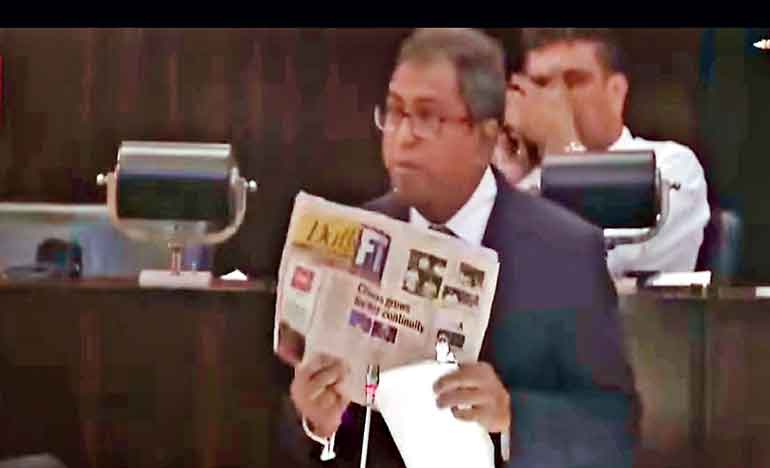
SJB MP Dr. Harsha de Silva yesterday quoting the Daily FT during his speech at the Budget 2027 debate in Parliament
Delivering the much-anticipated Opposition response to the Government’s Budget 2027 yesterday, Samagi Jana Balawegaya (SJB) MP Dr. Harsha de Silva slammed the Government of failing to think beyond traditional solutions, not providing relief at household level, and called for policies to build an asset-owning population and to protect borrowers from losing their assets to banks.
Speaking in the Budget 2027 debate in Parliament, Dr. de Silva said asset ownership was what set the SJB apart from the Government. “Mr. Speaker, the difference between us and them is very clear. We want to create an asset-owning population,” he said.
He questioned why the Government had not considered employee share ownership, including at State-Owned Enterprises (SOEs). “Why didn’t you think about an employee shareholdership program?” he asked.
Dr. de Silva welcomed a Budget move to introduce schoolchildren to the stock market and said it should have been done earlier. But he said the SJB wanted to go further, with Sri Lankans owning shares in global companies such as Tesla, Nvidia and Microsoft. “That is the asset-owning democracy we believe in,” he said.
Turning to parate execution, which allows banks to auction property mortgaged against defaulted loans without going to court, Dr. de Silva said borrowers who ran into difficulty should not be stripped of all their assets.
“A farmer starting a business does not mean that he has to give up everything he has and become bankrupt,” he said.
He said businesses needed a restructuring mechanism similar to Chapter 11 bankruptcy protection in the US, under which a company keeps control of its assets while it restructures its debts. He said this had been agreed with Parliament’s Finance Committee but had not been implemented, leaving borrowers’ land at risk of being taken over.
Had the Government thought out of the box and set up a credit guarantee corporation, the amounts owed could have been settled within three or four quarters, he said. He added that the Government had promised to set up a development bank, but it was not in the Budget.
Dr. de Silva also called for a dedicated housing finance institution. He said Colombo was among the least affordable cities in the world for buying a home and that small loans still carried high interest rates. “Why don’t you think of a housing finance institution? You are so traditional,” he said. He cited Freddie Mac in the US and similar institutions in India, and warned that the problem could not be solved with “traditional tricks”.
He also called for the interest on housing loans and health insurance premiums to be made deductible from taxable income.
On revenue, he said cigarette taxes had not been set against a global benchmark. He also questioned the taxation of online casinos when the country had no casino regulator.
Dr. de Silva accused the Government of starting new initiatives instead of implementing the Economic Transformation Act. “Why don’t you implement the Economic Transformation Act? Why reinvent this? There is no need to reinvent the wheel,” he said. He said Sri Lanka did not have a single private investment zone. Under the Budget, zones would come through the Board of Investment (BOI), while India, Thailand and Vietnam had many such zones, he said.
On agriculture, he urged the Government to help small farmers build strong brands for their produce. “Don’t be patronising. Don’t think that you know better than the farmers,” he said, adding that the issue concerned the two million families engaged in agriculture.
Dr. de Silva said the Budget offered little for young people, as artificial intelligence (AI) eroded software, internship and accounting jobs. “Yes, we are talking about giving a little here, giving a little there. But where is your grand plan? What are you going to do for Gen Z? What are you going to do for the lower-age millennials?” he asked.
He said the International Monetary Fund (IMF) program would end in March 2027 and the Government needed to decide on the way forward. He also questioned how a Marxist party that had been anti-IMF in the past was now pro-IMF. Dr. de Silva further said the Government’s tax policies were worsening protein deficiency among vulnerable groups.
He ended by citing economist Prof. Premachandra Athukorala, who has described Sri Lanka as a land of missed opportunities. “We have to have a vision. We have to have a team. We need a path, and we will build that path,” Dr. de Silva said.


