Wednesday Sep 16, 2026
Wednesday Sep 16, 2026
Wednesday, 16 September 2026 00:00 - - {{hitsCtrl.values.hits}}
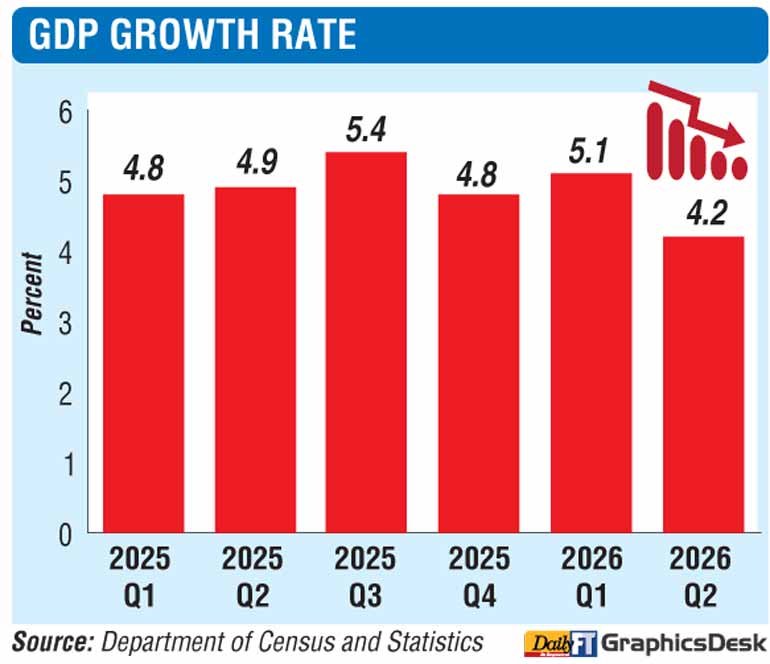
Sri Lanka’s economic growth eased to 4.2% in the second quarter of 2026, slowing from the 5.1% expansion recorded in the first quarter, the Department of Census and Statistics (DCS) said in its National Accounts Estimates for the production approach, base year 2015.
This is the lowest quarterly growth rate since 2024.
Real GDP at constant (2015) prices rose to Rs. 3,029,816 million in 2Q 2026, up from Rs. 2,908,570 million in the corresponding quarter of 2025. Nominal GDP increased 11.3% year-on-year, to Rs. 8,254,176 million from Rs. 7,414,306 million.
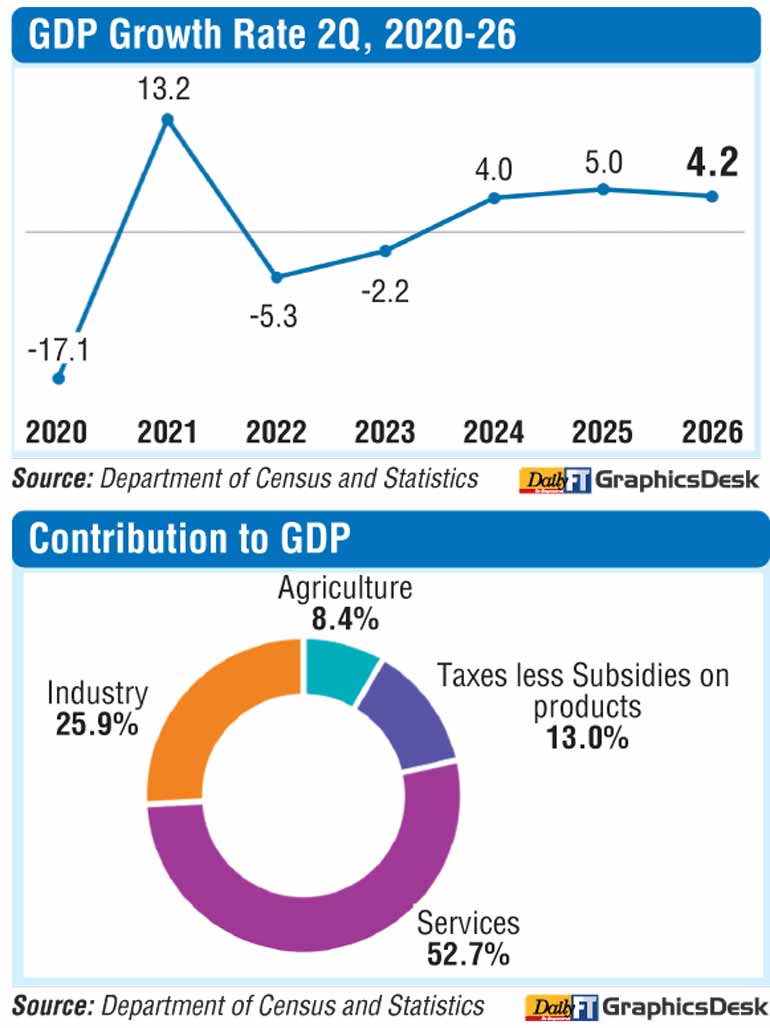
Agriculture, Industry and Services contributed 8.4%, 25.9% and 52.7% of GDP respectively at current prices in 2Q, with taxes less subsidies on products accounting for 13%.
Agriculture, which had expanded 1.1% in the first quarter of 2026, swung to a 2.3% contraction in the second quarter, also reversing from the 2.5% growth recorded in the second quarter of 2025. Industry sustained its momentum, growing 7.3% in 2Q 2026, marginally ahead of the 7.2% recorded in 1Q 2026 and well above the 5.7% growth seen in 2Q 2025. Services activity slowed on both counts, expanding 2.7% in 2Q 2026 against 3.4% in the preceding quarter and 4.0% in the corresponding quarter of last year.
The DCS said the quarter began without much optimism about the economy, weighed down by uncertainty arising from tensions in the Middle East and their impact on crude oil supply. Slower activity in the tourism sector further reflected the unfavourable conditions, while agricultural economic activity contracted and several major economic activities, including accommodation and food and beverage services, financial services and insurance activities, reported comparatively lower growth than in 2Q25.
Import volumes continued a multi-quarter uptrend, rising further in 2Q26. The DCS said this supported domestic industry by easing access to raw materials and machinery, while also boosting Government revenue through import-related taxes. Manufacturing activity expanded overall during the quarter, and taxes on goods and services rose in value. Increased supply of construction material supported further expansion in the construction industry, which in turn had a favourable effect on growth in mining and quarrying.
Agricultural economic activity, which grew 2.5% in 2Q25, contracted 2.3% overall in 2Q26. The contraction was driven by declines in freshwater fishing and aquaculture (-61.0%), paddy cultivation (-15.1%), sugarcane, tobacco and other non-permanent crops (-14.7%), marine fishing and aquaculture (-10.1%), plant propagation (-7.7%), rubber cultivation (-2.2%), tea cultivation (-1.9%), other permanent crops (-1.7%) and agricultural support services (-1.5%).
Positive growth was recorded in forestry and logging (9.7%), spice crops (7.0%), oleaginous fruits including coconut (6.2%), cereal crops (5.2%), fruit crops (1.9%), animal production (1.6%), coffee and cocoa (1.3%) and vegetable cultivation (0.8%).
Overall industrial activity grew 7.3% in 2Q26, up from 5.7% in 2Q25. Construction expanded 13.9% and mining and quarrying grew 17.4%. Manufacturing activity as a whole grew 3.2%, led by wood and wood products (13.9%), other non-metallic mineral products (13.1%), furniture (12.8%), machinery and equipment (12.4%), basic and fabricated metal products (7.3%), paper products (5.6%), food, beverages and tobacco (3.7%), other manufacturing (3.3%) and chemical and pharmaceutical products (1.7%).
Contractions were reported in refined petroleum products (-15.2%), rubber and plastic products (-4.2%), and textiles, wearing apparel, leather and related products (-1.4%). Electricity, gas, steam and air conditioning supply grew 6.8%, while water collection, treatment and supply and sewerage and waste treatment activities grew 4.6% and 1.5%, respectively.
Services activity, which grew 4.0% in 2Q25, expanded 2.7% in 2Q26. Growth was led by IT programming and consultancy services (10.0%), insurance services (8.0%), financial services (7.7%), telecommunications (4.8%), real estate activities and ownership of dwellings (4.1%), postal and courier services (4.0%), transportation and warehousing (3.1%), accommodation and food and beverage services (2.9%), professional services (2.4%), programming and broadcasting (1.5%), wholesale and retail trade (1.4%), health services (1.4%), education (1.3%) and other personal services (0.7%).
Public administration was the only services activity to contract, down 2.4% during the quarter.


