Thursday Oct 22, 2026
Thursday Oct 22, 2026
Thursday, 14 May 2026 00:00 - - {{hitsCtrl.values.hits}}
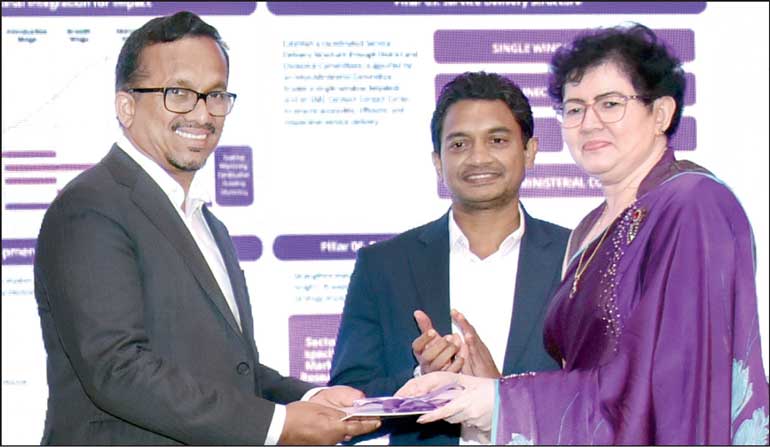
National SME Strategy Framework launch and first copy. Industry and Entrepreneurship Development Minister Sunil Handunneththi (left) receives the copy of the National SME Strategy Framework from Ministry Secretary Thilaka Jayasundara whilst Deputy Minister Chathuranga Abeysinghe looks on at its launch yesterday – Pic by Ruwan Walpola
By Nisthar Cassim
The Government yesterday announced plans to triple Sri Lanka’s economy to $ 300 billion by transforming the critical small and medium enterprise (SME) sector via the first-ever National SME Strategy Framework.
The Framework, branded ‘SME NEXUS’ has a five-pronged strategic outlook – transformational growth; integrated approach; market orientation; entrepreneurial society; and outcomes and impact focus; three implementation approaches – institutional strengthening; capability enhancement; and growth enablement and problem solving; and 11 strategy pillars – technology and digital enablement; institutional integration for impact; service delivery structure; incubation and new business support; market development and value chain integration; business intelligence research and impact assessment; recognition of ecosystem partners; relationship management to level up; and access to finance and growth fund.
The Framework has been developed by the Industry and Entrepreneurship Development Ministry, with input from the SME Advisory Committee and key system stakeholders.
At present, micro, small and medium enterprises (MSMEs) account for 75% of all registered businesses, employ nearly 45% of the workforce, and contribute 52% to GDP, with plans to increase it to 80% via the Framework.
Chief Guest at the launch, Industry and Entrepreneurship Development Minister Sunil Handunneththi described the Framework as a turning point and a milestone for Sri Lanka and SMEs – the economy’s backbone – as well as the Government led by President Anura Kumara Dissanayake. He opined that the SME sector has struggled over the years and the country is not reaping the fuller benefits because SME development institutions have been working in silos or in isolation, whilst efforts have been fragmented.
“The Framework brings together all stakeholders of the ecosystem, ensuring a collective effort for the common good of SMEs and the economy,” added Minister Handunneththi at the ceremony, attended by public and private sector leaders, international donor agencies, and the financial services industry.
As per a World Bank Enterprise Survey, the top 10 business environment constraints for SMEs are tax rates; business licences and permits; tax administration, access to finance; inadequately educated workforce; practice of the informal sector; Customs and trade regulation; electricity; transportation and crime; and theft and disorder.
Minister Handunneththi assured controllable factors will be resolved or better managed so as to empower SMEs to achieve the desired growth.
Deputy Minister Chathuranga Abeysinghe, who described the Framework as a “dream come true,” itself, said it was a collective effort that took around 15 months to finalise. He also said that, in a highly competitive global economy, fragmented efforts to develop SMEs won’t work, nor will a few successful SMEs graduating be sufficient to win world markets.
“Sri Lanka needs to develop and support a new generation of successful entrepreneurs,” he stressed, adding that the National SME Strategy Framework would spearhead this goal.
At the launch, the support of Australia Aid, the World Bank, and the Asian Development Bank, as well as Sri Lanka Institute of Marketing, among others, was acknowledged.
At a separate forum today, stakeholders will hold an in-depth discussion and review the Framework, which is evolving and will be progressively revised as and when required.


