Thursday Oct 22, 2026
Thursday Oct 22, 2026
Thursday, 4 June 2026 00:00 - - {{hitsCtrl.values.hits}}
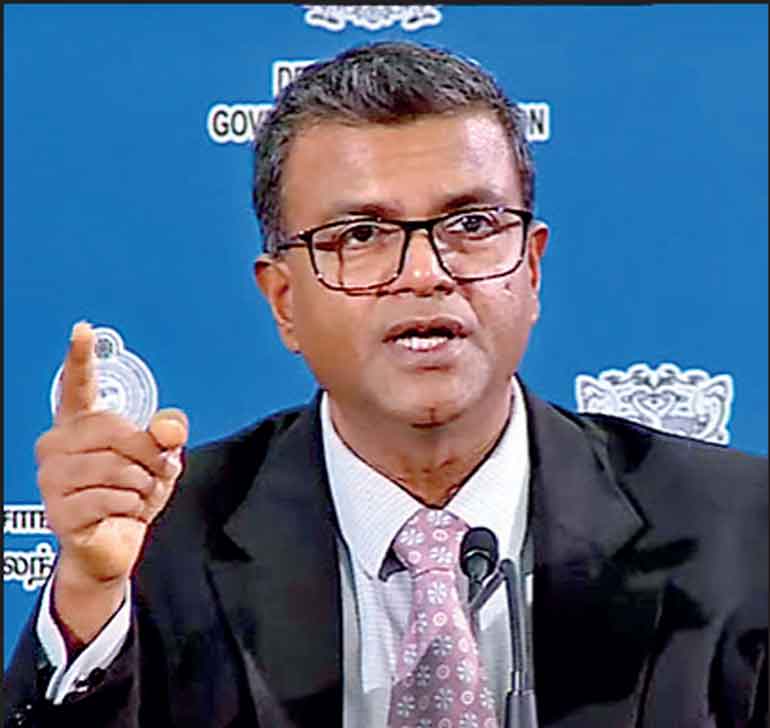
Treasury Secretary
Dr. Harshana Suriyapperuma
Treasury Secretary Dr. Harshana Suriyapperuma yesterday signalled that Sri Lanka will seek to explore options within its International Monetary Fund (IMF) program to address the economic fallout from the Middle East crisis.
He said that authorities will continue discussions with the Fund to secure the best outcome for businesses, investors, entrepreneurs, small and medium enterprises (SMEs), and vulnerable communities as external risks intensify.
The comments come days after the IMF Executive Board approved the Fifth and Sixth Reviews under Sri Lanka’s Extended Fund Facility (EFF), unlocking $ 695 million in financing and endorsing progress on a series of governance, fiscal, and institutional reforms implemented since the country’s 2022 sovereign default.
“Going forward, we will continue to engage with IMF team members within the program to understand the better ways and options available to move forward and secure the best benefit for Sri Lanka, our businesses, investors, entrepreneurs, and SMEs, while looking after vulnerable communities as well,” Dr. Suriyapperuma said.
He said the successful completion of the two reviews demonstrated the country’s ability to remain on program despite significant external shocks, including Cyclone Ditwah and the recent escalation of tensions in the Middle East.
The Treasury Secretary said the outcome reflected the combined efforts of Government institutions, public officials, businesses, investors, and other stakeholders who contributed to implementing the reform agenda agreed upon with the IMF.
Among the reforms highlighted during the review process were the full operationalisation of the Public Financial Management Act, beneficial ownership disclosure requirements, anti-corruption measures, tax administration reforms, amendments to investment approval processes, and legislative changes linked to the Colombo Port City framework.
Dr. Suriyapperuma said authorities had also introduced a more transparent and rules-based framework for evaluating investment proposals, replacing discretionary approaches with criteria linked to investment value, employment generation, and broader economic benefits.
He noted that regular tax expenditure reporting had also been introduced, while governance reforms across multiple institutions had been implemented to meet program benchmarks.
A key feature of the latest reviews was stronger-than-expected revenue performance, with the Inland Revenue Department (IRD), Sri Lanka Customs, and the Excise Department exceeding targets.
“The performance of the IRD, Sri Lanka Customs and the Excise Department demonstrates that these reforms are not only being designed but are also being implemented effectively,” he said.
Dr. Suriyapperuma argued that the reforms undertaken since the crisis were generating structural improvements rather than temporary gains.
“The Government was able to deliver these outcomes because of the financial discipline that has been brought into the system and the consistent implementation of the reform agenda. These are not ad hoc measures; they are structural reforms that continue to generate results,” he said.
The IMF’s latest review recognised progress in fiscal management, governance reforms, and revenue mobilisation, while acknowledging the challenges posed by Cyclone Ditwah and the deteriorating external environment.
Dr. Suriyapperuma said the Government had also moved to cushion vulnerable groups and businesses from recent shocks, including allocating additional resources to support those affected by the Middle East crisis.
He said the reforms implemented over the past two years had helped create buffers that allowed Sri Lanka to absorb external shocks while maintaining macroeconomic stability.
“The ability of the administration, State institutions, the private sector, and other stakeholders to work together has demonstrated that Sri Lanka is on a path of recovery, and that stability has been restored to the system,” he said.
For policymakers, the completion of the Fifth and Sixth Reviews marks more than the release of a further tranche of IMF financing. It provides validation of reforms that have reshaped public financial management, governance, and revenue administration, while opening discussions on how the program can respond to a more challenging global environment.
As the Middle East crisis, trade disruptions, and energy market volatility continue to cloud the outlook, the next phase of Sri Lanka’s IMF program is likely to focus increasingly on preserving stability while ensuring businesses, investors, and vulnerable communities remain protected from emerging risks.


