Friday Sep 25, 2026
Friday Sep 25, 2026
Thursday, 18 December 2025 06:41 - - {{hitsCtrl.values.hits}}
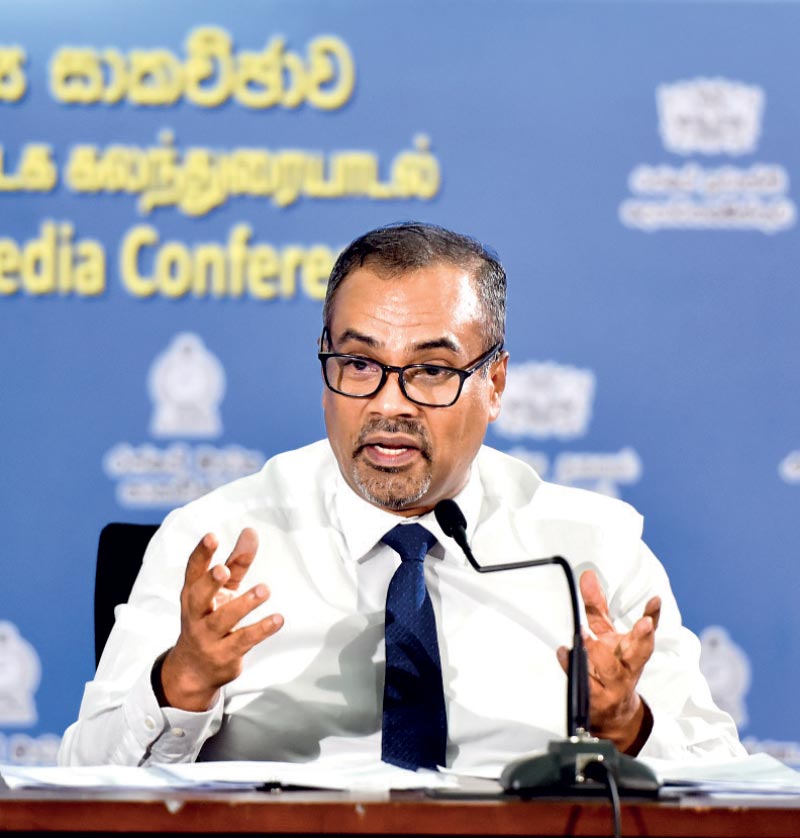
Finance and Planning Deputy Minister Dr. Anil Jayantha Fernando - Pic by Upul Abayasekara
By Charumini de Silva
The Government yesterday said the proposed Rs. 500 billion Supplementary Estimate for post-Cyclone Ditwah recovery will be funded through reallocated capital spending, excess revenue, Treasury resources, and external assistance, while remaining fully within the 2026 debt ceiling and the available fiscal space.
Addressing a special media briefing organised by the Government Information Department, Finance and Planning Deputy Minister Dr. Anil Jayantha Fernando said the scale of destruction caused by the worst natural disaster in over two decades had underscored the need not merely to replace what was lost, but to improve on it.
“When we reconstruct, we have to make something that is better than what it was. The Government is confident that Sri Lanka will rebuild better and stronger,” he said, stressing that recovery efforts would prioritise durability, sustainability, and resilience.
He announced that the Government will convene a special sitting of Parliament today (18) and tomorrow to seek approval for a Rs. 500 billion Supplementary Estimate for 2026. The allocation is intended to expand the State’s capacity to meet immediate humanitarian needs while accelerating reconstruction and longer-term recovery.
Providing a breakdown, Dr. Fernando said Rs. 100 billion would be channelled towards rebuilding around 5,000 damaged homes, Rs. 250 billion towards restoring critical infrastructure such as roads, railway lines, and bridges, and Rs. 150 billion towards reviving livelihoods, including support for small and medium-sized enterprises (SMEs), farmers, and entrepreneurs affected by the disaster.
He noted that relief operations are already underway, with the Government having begun utilising Rs. 72.2 billion that had been allocated for disaster management in this year. The proposed supplementary allocation, he said, would significantly scale up these efforts.
Explaining how the Rs. 500 billion package would be financed, Dr. Fernando said: “The Government would repurpose underutilised capital expenditure from line ministries, draw on excess revenue collections, utilise available funds at the Treasury Operations Department (TOD), and mobilise external assistance.”
He assured that despite being an additional borrowing requirement, the allocation would remain within the Rs. 3,740 billion debt ceiling set for 2026.
“The supplementary allocation would increase primary expenditure to 14.4% of GDP, raising it from Rs. 7,157 billion to Rs. 7,657 billion,” the Deputy Minister acknowledged, adding that the move was well within the Government’s legal and fiscal authority.
Despite the economic disruption caused by the cyclone, Dr. Fernando said Sri Lanka’s underlying growth momentum remained intact, noting that the economy had outperformed several international forecasts.
“GDP growth accelerated from 4.8% in the first quarter to 4.9% in the second and 5.4% in the third quarter. This propelled 4.8% GDP growth in the first half of 2025 and I hope we can expect a growth of around 5% next year,” he said.
He argued that the temporary setback caused by the disaster could, in fact, create opportunities for foreign investors, given ongoing reforms in infrastructure, legal and financial frameworks and improvements in key economic indicators. “Policies such as easing imports, maintaining single-digit interest rates, a flexible exchange rate and inflation below 5% had helped stabilise the economy,” he said.
Dr. Fernando also highlighted improvements in external sector performance, noting that foreign reserves stood at $ 6.2 billion, equivalent to 3.7 months of imports and were expected to rise further by the end of the month.
“Worker remittances are set to record their highest-ever annual inflow, surpassing the previous peak of $ 7.24 billion. We also hope for a steady and improved tourism earnings and export income from 2026 onwards following a five-year strategy to diversify product basket and market,” he added.
Reaffirming the Government’s commitment to fiscal discipline, the Deputy Minister said transparency and accountability would underpin the rebuilding effort, enabling Sri Lanka to construct a more sustainable and resilient economy.
Economic Development Deputy Minister Nishantha Jayaweera said all three key revenue-collecting State agencies were on track to exceed their targets by over Rs. 400 billion in 2025, helping keep the budget deficit below its original target despite increased cyclone-related spending.
He said the Inland Revenue Department was expected to exceed its Rs. 2,195 billion target by about Rs. 50 billion, while the Department of Customs had already surpassed its Rs. 2,115 billion target by nearly Rs. 300 billion. The Department of Excise, he added, was also likely to exceed its Rs. 228 billion target by Rs. 4-5 billion.


