Tuesday Oct 13, 2026
Tuesday Oct 13, 2026
Wednesday, 24 June 2026 00:00 - - {{hitsCtrl.values.hits}}
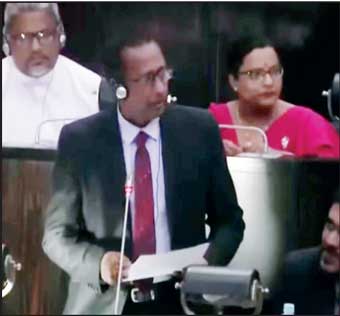 |
| Economic Development Deputy Minister Nishantha Jayaweera |
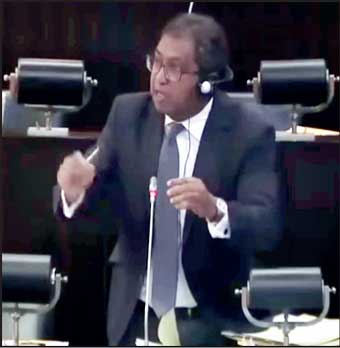 |
| CoPF Chairman MP Dr. Harsha de Silva |
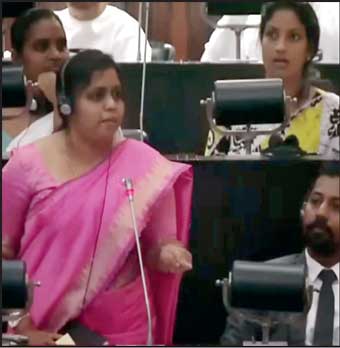 |
| NPP MP Lakmali Hemachandra |
The Government yesterday withdrew plans to lower the Value Added Tax (VAT) registration and Social Security Contribution Levy (SSCL) thresholds, sparing thousands of small and medium-sized enterprises from being brought into the tax net at a time when businesses are grappling with the economic consequences of Cyclone Ditwah and the conflict in the Middle East.
Opening the second reading debate on the Value Added Tax (Amendment) Bill and other changes, Economic Development Deputy Minister Nishantha Jayaweera announced that the Government would retain the existing Rs. 60 million annual turnover threshold instead of proceeding with the reduction to Rs. 36 million proposed in the 2026 Budget.
The intension was net 10,000 businesses into the tax base.
“The economic recovery was beset by unforeseen events out of our control, Cyclone Ditwah and the Middle East war, which have negatively impacted businesses particularly SMEs who are facing considerable challenges,” Jayaweera told Parliament.
He said President and Finance Minister Anura Kumara Dissanayake and the Cabinet had decided against proceeding with the reduction, citing concerns that it would place additional pressure on smaller enterprises already facing difficult trading conditions.
The reversal means businesses with annual turnover between Rs. 36 million and Rs. 60 million will remain outside the VAT net. The measure had originally been intended to broaden the tax base and strengthen revenue mobilisation, a key objective of the Government’s fiscal reform agenda.
Jayaweera argued that the Government had already achieved significant improvements in tax compliance without altering the threshold.
According to him, the number of VAT files has increased from around 18,000 when the National People’s Power administration assumed office to more than 35,000 currently, with much of the growth coming through voluntary registration.
He encouraged businesses below the threshold to register voluntarily, arguing that VAT registration enables firms to recover input taxes paid to suppliers while facilitating transactions with larger businesses that require VAT documentation.
The Government, he said, remained committed to expanding the tax base over time as part of a broader effort to create a simpler and more credible tax system capable of supporting lower rates in the future.
The announcement of suspending the VAT threshold reduction was met with raucous protest from the Opposition ranks.
Committee on Public Finance (CoPF) Chairman Dr. Harsha de Silva objected that Parliament was being asked to debate provisions that differed materially from those previously considered by the committee.
“You are now bringing something different to Parliament which goes against the established traditions of this House,” he said.
De Silva stressed that he was not opposing the decision to retain the higher threshold. Rather, he argued that changes to legislation examined by CoPF should be referred back to the committee before being taken up by Parliament.
“If you wish to proceed, then suspend the Standing Orders and present a separate motion. If not, why have CoPF and other committees? You might as well do away with them,” he said.
The intervention prompted a sharp response from Government MP Lakmali Hemachandra, who challenged what she characterised as an expansive interpretation of CoPF’s authority.
Hemachandra argued that Parliamentary committees are empowered to scrutinise and make recommendations, but do not possess approval powers over legislation or Government policy.
“There is no standing order saying that the Public Finance Committee has to approve any motion coming to Parliament. There is no such standing order saying that the Public Finance Committee has to approve,” she said.
She maintained that while CoPF plays an important oversight role, the authority to approve or reject legislative proposals ultimately rests with Parliament itself.
“The Public Finance Committee can make recommendations. The Chairman of the Committee can very well make recommendations, but there is no requirement of approval. Parliament is a body with public finance control. Parliament will approve. If Parliament approves, it will go forward,” Hemachandra said.
When de Silva argued that her position undermined Parliamentary traditions, Hemachandra rejected the suggestion and insisted she was not questioning the relevance of Parliamentary committees.
“I am not saying that the Public Finance Committee has nothing to do in Parliament. Any committee in Parliament can make recommendations, but the power to approve lies with Parliament. The Committee cannot approve or disapprove anything that comes into Parliament,” she said.
Hemachandra further challenged Dr. de Silva’s interpretation of the Standing Orders, arguing that no provision exists requiring committee approval before legislation can proceed to the House.
The exchange exposed differing interpretations of CoPF’s role in the legislative process, particularly when Government amendments diverge from proposals previously examined by the committee.
Speaking again later, MP Hemachandra charged that the various Parliamentary committees, especially a few of its prominent members, cannot be allowed to usurp the rights of 225 members of the legislature. “If it was done so because of tradition, as the CoPF Chairman stated, then this has to change,” she quipped.
Dr. de Silva attributed the Government’s decision to suspend the VAT threshold reduction to pressure brought on by the Opposition on behalf of the people. He said the Opposition was not against widening the tax base, but did not agree to burdening small businesses already fighting for survival. “This is a win for the Opposition, through whom people spoke,” he said.


