Sunday Sep 13, 2026
Sunday Sep 13, 2026
Tuesday, 10 February 2026 05:40 - - {{hitsCtrl.values.hits}}
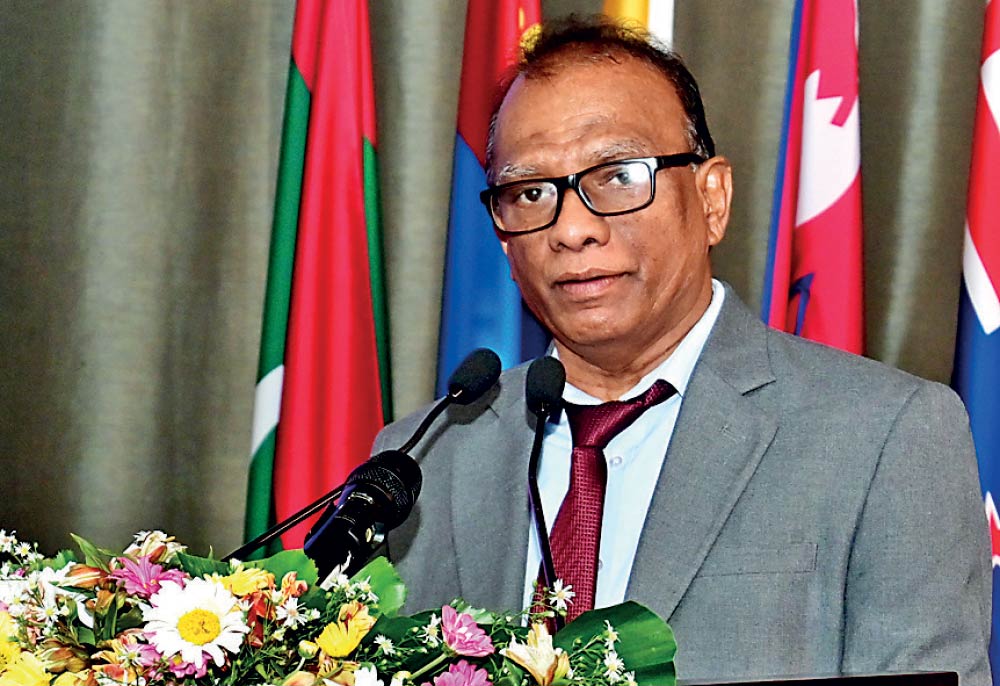
Ports and Civil Aviation Minister Anura Karunathilaka
By Charumini de Silva
The Government yesterday reaffirmed its commitment to strengthening the country’s ports sector through targeted investment, technology adoption, and international partnerships, underscoring the strategic importance of the Port of Colombo to economic recovery and long-term growth.
Ports and Civil Aviation Minister Anura Karunathilaka speaking at the Terminal Technology and Trade Engagement 2026 held under the Colombo Plan Maritime Advisory Program (MAP), described the program as a critical technical training initiative for the Sri Lanka Ports Authority (SLPA) and terminal operators, at a time when Colombo is undergoing significant expansion and transformation.
“The Port of Colombo has embarked on a major expansion program and continues to lead South Asia as a premier transshipment hub and maritime and logistics centre,” Karunathilaka said, noting that ongoing infrastructure improvements are aimed at delivering efficient, reliable, and seamless transshipment services.
He said the Government views port development as a national priority, with the sector expected to make a growing contribution to the economy. “The Government is firmly committed to developing the Sri Lankan ports sector into a major contributor to our national economy,” he said, adding that steps will be taken to ensure Colombo remains competitive and service-oriented.
The Minister highlighted the importance of shipping lines, terminal operators, and logistics partners, defining them as key stakeholders who bring business to the port, while providing vital connectivity for Sri Lanka’s exporters, importers, and regional shippers.
“The Port of Colombo has served as a leading transshipment hub for many decades, and this position must be secured through the right policy framework and timely intervention,” he said, pledging Ministerial support to ensure ports receive the necessary technical upgrades and operational backing.
Karunathilaka acknowledged that while capacity expansion, particularly through the addition of new terminals, has been a longstanding focus, improving operational efficiency across existing infrastructure has become equally critical, especially in light of current financial constraints.
“For many years, we have discussed capacity expansion and productivity improvements through additional terminals. At the same time, efficiency and productivity of overall operations remain a key concern, given the financial challenges we are currently facing,” he said.
In this context, he stressed the need to attract international investment, particularly through public-private partnerships (PPPs), and signalled the Government’s intent to create a more investor-friendly policy environment. “At the policy level, we must be more persuasive and consistent in order to attract foreign investment,” he said.
The Minister also acknowledged the role played by the Colombo Plan and its Maritime Advisory Program in supporting the SLPA, noting that the collaboration has helped strengthen port security, operational efficiency, and technology upgrades over recent years.
Welcoming delegates from the US and other countries, Karunathilaka said the sharing of innovative technological solutions was vital as Sri Lanka seeks to align its ports with international best practices.
He expressed appreciation for the support extended by the US Government through the Colombo Plan, describing it as “highly valued” as Sri Lanka modernises its port operations.
Despite recent economic and global challenges, the Minister said the Government remains confident that ongoing and planned initiatives will continue, particularly projects already underway.
He reiterated Sri Lanka’s ambition to become the leading transshipment hub in South Asia and a major hub within the wider Asian region. “Our ambition is to become the number one transshipment hub in South Asia and a major transshipment hub in Asia,” he said, adding that the technical support provided through the current program would play an important role in achieving this goal.
– Pix by Lasantha Kumara


