Tuesday Sep 15, 2026
Tuesday Sep 15, 2026
Friday, 5 June 2026 04:19 - - {{hitsCtrl.values.hits}}
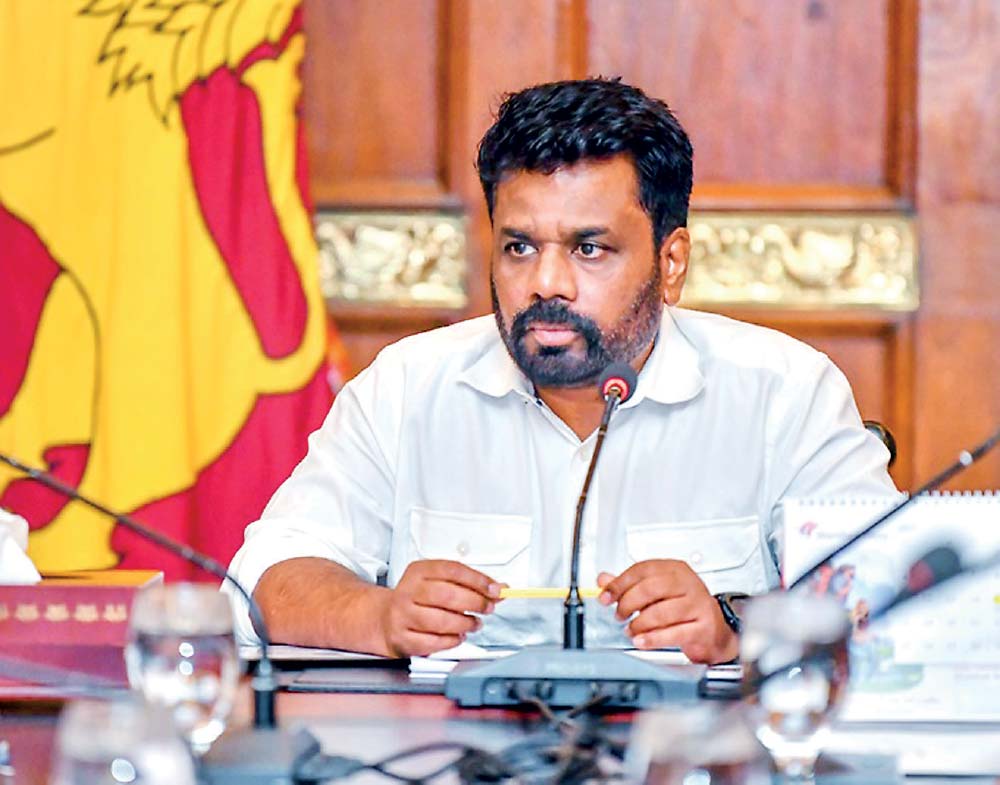
President and Finance Minister Anura Kumara Dissanayake
The Government has reaffirmed its commitment to structural reforms aimed at strengthening economic resilience and sustaining fiscal consolidation, even as Sri Lanka’s primary surplus is projected to moderate to 1% of GDP in 2026 from a record 5.4% in 2025.
According to the Finance, Planning and Economic Development Ministry’s Final Budget Position Report 2025 released yesterday, the projected decline reflects higher expenditure associated with a Rs. 500 billion supplementary allocation for Cyclone Ditwah relief and Middle East war-related external pressures rather than a reversal of fiscal policy.
It noted the Government’s intention to restore the primary surplus to at least 2.6% of GDP from 2027, while maintaining the broader reform agenda agreed under the International Monetary Fund’s (IMF) Extended Fund Facility (EFF) program.
The Treasury also warned that Sri Lanka remains vulnerable to external shocks despite the improvement in public finances and stressed the need for structural reforms, export diversification, stronger domestic value addition, and improved competitiveness to sustain long-term growth and macroeconomic stability.
“The evolving global environment underscores the heightened vulnerability of small open economies such as Sri Lanka to external shocks. Heavy reliance on a concentrated set of export products, tourism markets, and remittance sources increases exposure to geopolitical disruptions and global demand fluctuations,” the report noted.
“These structural vulnerabilities highlight the urgent need for Sri Lanka to diversify its export base, expand into new markets, strengthen domestic value addition, and build external buffers. Enhancing economic resilience through prudent macroeconomic management, structural reforms, and improved competitiveness will be essential for sustaining stability and supporting long-term growth in an increasingly complex and interconnected global economy.”
The projected decline follows a year in which Government finances improved sharply. Revenue and grants rose to 16.7% of GDP in 2025 from 13.6% a year earlier, while expenditure fell to 19% of GDP from 20.4%. The overall Budget deficit narrowed to 2.3% of GDP and the current account balance recorded a surplus of 0.7% of GDP.
In nominal terms, revenue and grants increased 34.1% to Rs. 5,485.6 billion in 2025 from Rs. 4,090.8 billion a year earlier. Total expenditure rose only 1.6% to Rs. 6,230.4 billion, allowing the primary surplus to expand to Rs. 1,755.8 billion, while the overall deficit narrowed to Rs. 744.9 billion.
The revenue increase was driven by stronger tax collections following the reopening of vehicle imports, Budget 2025 tax measures, and improvements in tax administration. Tax revenue rose 36.3% to Rs. 5,049.2 billion, lifting the tax-to-GDP ratio to 15.4% from 12.3%.
Taxes on goods and services increased 45.3% to Rs. 3,198.1 billion, while taxes on external trade rose 49.1% to Rs. 711.7 billion. Excise revenue increased 76.9% to Rs. 1,058.7 billion, reflecting higher vehicle imports and revisions to excise duties on motor vehicles, liquor, cigarettes, and sugar-sweetened beverages. Value Added Tax (VAT) collections rose 33.4% to Rs. 1,746.9 billion, while import duty revenue increased 148.2% to Rs. 275.9 billion.
Vehicle imports were a significant source of additional revenue during the year, alongside stronger VAT collections, higher excise revenue, Budget 2025 tax measures, and improvements in tax administration. Income tax collections also increased 11% to Rs. 1,139.4 billion following tax policy changes and improved compliance.
On the expenditure side, recurrent spending fell 2% to Rs. 5,232.4 billion. Interest payments declined 7% to Rs. 2,500.7 billion and absorbed 45.9% of Government revenue, down from 80.5% in 2023. Spending on goods and services fell 4.6%, while expenditure on subsidies and transfers remained largely unchanged.
The Government increased spending on welfare and public investment. Aswesuma expenditure rose 27.7% to Rs. 238 billion, while spending on free medicine and nutrition programs increased 25.4% to Rs. 187.1 billion. Public investment rose 24.3% to Rs. 1,015.8 billion, equivalent to 3.1% of GDP, although project implementation reached 77.2% of the annual Budget estimate.
The Rs. 744.9 billion budget deficit was financed mainly through domestic sources, which accounted for 80.9% of total financing. Domestic financing amounted to Rs. 602.5 billion, including Rs. 496.1 billion from non-bank sources. Net external financing contributed Rs. 142.4 billion.
According to the Public Debt Management Office, outstanding Central Government debt increased 5% to Rs. 31.1 trillion at end-2025 from Rs. 29.6 trillion a year earlier. However, the debt-to-GDP ratio fell to 94.9% from 98.4% as revenue growth, fiscal consolidation, and nominal GDP growth outpaced the increase in debt. Domestic debt declined to 59.3% of GDP from 62.8%, while foreign debt remained broadly unchanged at 35.6% of GDP.


