Saturday Nov 14, 2026
Saturday Nov 14, 2026
Saturday, 14 November 2026 00:55 - - {{hitsCtrl.values.hits}}
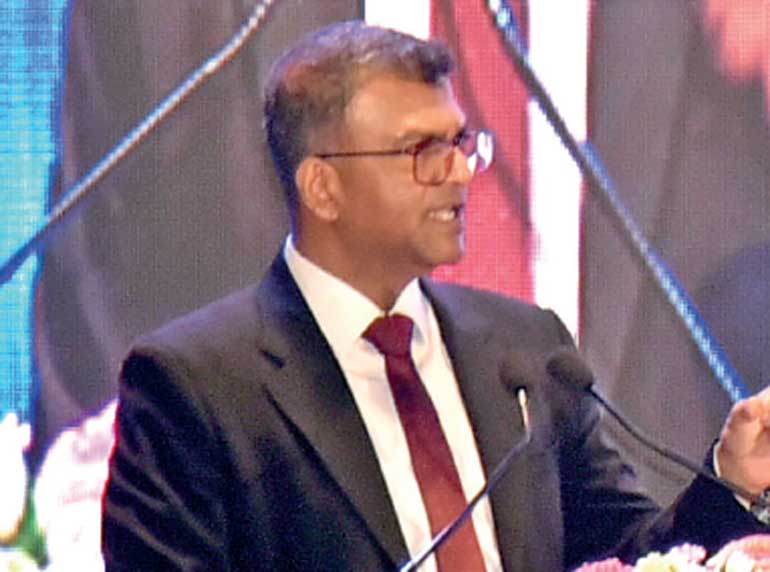
Treasury Secretary Dr. Harshana Suriyapperuma - Pic by Upul Abayasekara
By Charumini de Silva
Treasury Secretary Dr. Harshana Suriyapperuma yesterday said the private sector could tap an estimated Rs. 2 trillion in public investment opportunities in 2027, but through transparent and competitive procurement rather than unsolicited proposals. This comes as the Government moves to legislate a level playing field between State-owned Enterprises (SOEs) and private businesses.
Delivering the keynote address at the 16th edition of the Daily FT-Colombo University MBA Alumni Association Post-Budget Forum, he said Budget 2027 was designed to consolidate the macroeconomic stabilisation achieved over the past two years, whilst shifting the focus towards production, competitiveness, technology and broader economic participation.
Dr. Suriyapperuma stressed that the Government’s development agenda could not be delivered by the State alone, calling for businesses, professionals, consultants and human resource specialists to contribute their expertise and capacity to execute an expanding pipeline of public investment projects.
“The challenge is no longer simply to formulate ambitious plans, but to build the national capacity to implement them, withstand external shocks and create a competitive economy in which both public and private enterprises could thrive,” he said.
Dr. Suriyapperuma said the Rs. 2 trillion allocation for 2027 would create substantial opportunities across highways, roads, railways, ports, airports, sports infrastructure and other development projects, whilst providing a pathway for businesses to expand beyond the 22 million domestic market.
He outlined implementation capacity, financing capacity and resilience against external shocks as three critical tests for the country’s ability to deliver on its ambitions. “These could translate Budget allocations into tangible economic outcomes amid geopolitical uncertainty, climate-related disasters and other risks beyond our control.”
The Treasury Secretary asserted that the Government has demonstrated its capacity and ability to stabilise the economy through improved fiscal discipline, stronger foreign reserves and sovereign rating, while successfully progressing through the IMF-supported program, with its final review expected in March 2027.
“This progress should help restore investor confidence, particularly among long-term domestic and foreign investors who had become cautious following the economic crisis,” he said, adding that the Government’s commitment to the rule of law, equal treatment and zero tolerance for corruption was essential to creating a more predictable investment environment.
He said a key distinction in the new investment approach was the rejection of unsolicited proposals and projects that lacked adequate feasibility assessment in favour of transparent and competitive procurement.
Citing the renewable energy sector as an example, he said wind and BESS projects awarded through an open process had demonstrated the benefits of competition and procurement reforms. Dr. Suriyapperuma pointed out that those were not evidence of the Government turning away investment, but of its determination to secure better value for citizens and taxpayers, whilst strengthening the competitiveness of the economy.
“Budget 2027 rests on seven broad objectives and six strategic pillars, supported by around 40 implementation measures. These include: macroeconomic stability, a production-oriented economy, technology, human capital development, regional economic integration, energy security and climate resilience alongside improvements to the Government’s delivery mechanism,” he outlined.
He said a key priority is to reposition Sri Lanka as a production economy to compete for global markets, which would require targeted investment in manufacturing and services, technological advancement, research and development, skills and productivity.
Dr. Suriyapperuma also stressed the need to connect rural and regional economies more effectively with national economic activity through improved infrastructure, access to finance, digital tools and business advisory services.
Highlighting the Government’s efforts to improve public sector efficiency, he cited the implementation of the digital VAT refund mechanism as an example of how long-standing administrative bottlenecks could be addressed through engagement with business and institutional reform.
In addition, he highlighted the paperless Customs initiative introduced on 1 October and the National Single Window (NSW) platform, which went live in a limited implementation phase on 5 November. “The NSW is being rolled out in phases, beginning with exports, followed by imports and transhipment. Tea and coconut have been selected for the first phase covering over 120 HS codes, with initial shipments successfully processed via the digital system. These initiatives are intended to reduce administrative delays, improve transparency and allow businesses to concentrate on operations, rather than navigating multiple agencies for approvals and clearances,” he explained.
The Treasury Secretary said the SME sector will receive a larger financing allocation in 2027, with Rs. 174 billion earmarked compared to Rs. 97 billion in the 2026 Budget.
Noting that the Government has achieved full commitments under most of the 2026 lending initiatives by 30 September, he said an additional Rs. 7 billion allocation was approved by the Cabinet of Ministers for disbursement during November and December.
He attributed the progress to closer monitoring by the Treasury through monthly discussions with commercial banks and relevant State institutions, whilst adding that in the 2027 package, the commercial banks will have a key role in identifying and financing eligible enterprises through their networks.
In addition, Dr. Suriyapperuma said the Government’s delivery record had attracted further support from a multilateral development partner, which had pledged additional financing to expand the collateral-free lending initiative.
In fisheries, he cited a financing facility enabling businesses to borrow up to Rs. 500 million at an interest rate of 5% to acquire a single fishing vessel, underscoring the Government’s ambition to develop a competitive deep-sea fishing fleet.
He said the Government is also pursuing reforms to facilitate public-private partnerships (PPPs), with the PPP Bill gazetted, aiming to provide a clearer framework for private sector participation in public projects.
Dr. Suriyapperuma also noted that the legislation to establish a level-playing field between State-owned Enterprises (SOEs) and private businesses was being finalised, with the draft currently under consideration by the Attorney General and expected to be presented to Parliament in the first quarter of 2027.
He said the recent improvement in SOE performance showed that better governance rather than preferential treatment or excessive borrowing could deliver stronger results. “The SOEs are expected to finance parts of their own development programs through improved profitability and reserves, reducing the burden on the Treasury,” he added.
In addition, he said the Budget envisages greater investment in regional airports and connectivity including facilities to enable international visitors arriving at Bandaranaike International Airport (BIA) to connect more conveniently with domestic airports.
The Treasury Secretary also highlighted commercialising the country’s mineral resources via identification, feasibility assessments and international technical partnerships, alongside reforms in agriculture, livestock, irrigation and plantation sector. “A committee has been appointed to review lease extensions and assess companies based on productivity, replanting and land utilisation rather than balance-sheet size alone,” he pointed out.
He said the Government is also seeking to rationalise the tax and regulatory burden on tourism businesses. Responding to long-standing industry concerns regarding overlapping central and provincial-level charges, he said the Government has decided to remove one layer of taxation, with the Treasury providing financial support to the Sri Lanka Tourism Development Authority (SLTDA).
He also referred to the need to address the financial burden of SriLankan Airlines, which has accumulated losses exceeding Rs. 500 billion since its inception, with a committee appointed to examine the most viable options to minimise the future cost to the Treasury.
Dr. Suriyapperuma reiterated that Budget 2027 was an invitation for businesses to work alongside the Government in translating public investment and policy reforms into sustainable economic goals.
The Forum also featured a panel discussion, comprising Advocata Institute Chairman Murtaza Jafferjee, Standard Chartered Bank Sri Lanka CEO Bingumal Thewarathanthri, who is also Vice Chairman of The Ceylon Chamber of Commerce, Small and Medium Enterprise (SME) and export champion Selyn Group of Impact Companies Chief Growth Officer Selyna Peiris, A. Baur and Co Ltd. Managing Director/CEO Rolf Blaser and Treasury Secretary Dr. Suriyapperuma. The panel was moderated by Daily FT Chief Editor/CEO Nisthar Cassim.
The post-Budget Forum’s strategic partner was Standard Chartered Bank; Baurs served as the Gold Sponsor, with Nanaska as Strategic Learning Partner, CICRA as the Technology Partner, Cinnamon Grand as Hospitality Partner and Ogilvy Digital as the Creative Partner.


