Tuesday Sep 15, 2026
Tuesday Sep 15, 2026
Wednesday, 21 January 2026 00:00 - - {{hitsCtrl.values.hits}}
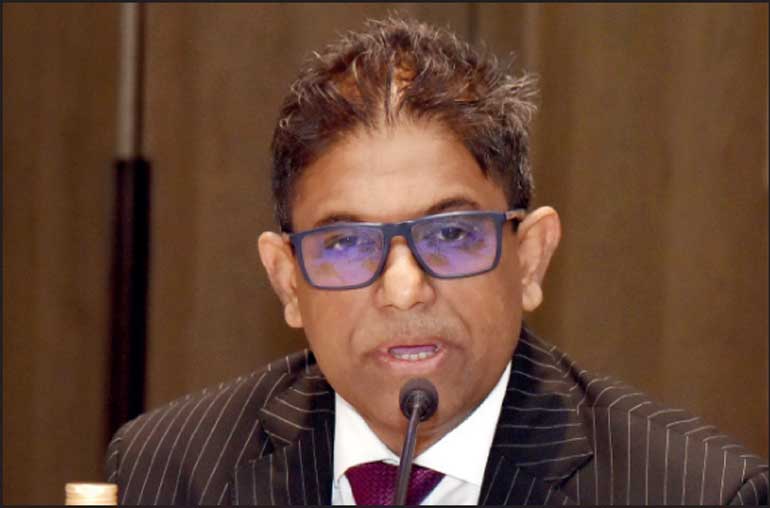
Standard Chartered Bank Sri Lanka CEO Bingumal Thewarathanthri
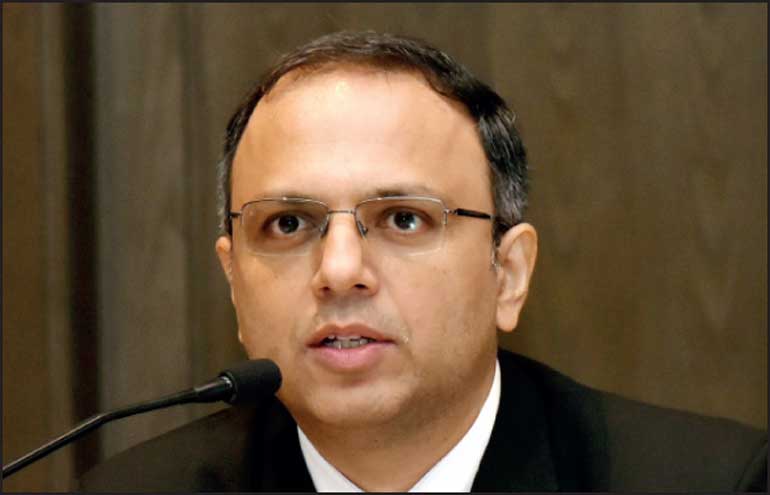
Standard Chartered Bank Economist Saurav Anand
By Devan Daniel
Standard Chartered Bank CEO Bingumal Thewarathanthri said Sri Lanka’s economic outlook for 2026 was cautiously optimistic but warned that delays in reforms and policy execution could weaken the investment climate and slow foreign direct investment inflows projected to reach between $ 600-900 million in 2026.
“As a country with a CCC-plus credit rating, Sri Lanka is vulnerable to external shocks, and that is something we have consistently stated over the past year,” he said, noting that the economy had nevertheless remained more stable than expected following Cyclone Ditwah.
“We are in a fairly stable position compared to where we were in December, and we are reasonably confident,” Thewarathanthri said, adding that maintaining fiscal discipline on both revenue and expenditure would be critical in 2026.
He said infrastructure spending could not be fully financed through domestic budgets alone and stressed the importance of careful fiscal management. “If we manage fiscal discipline in terms of revenue and expenditure, we should be able to manage the situation,” he said.
Tourism was identified as a near-term growth opportunity, though he cautioned against focusing solely on arrivals. “We had decent numbers last year, but income was lower because of the mix,” he said, arguing that Sri Lanka needed to attract higher-value segments, particularly from India.
“India’s outbound tourism market is very large at $ 40 billion, and even capturing a small share can make a meaningful difference, about 10% of the market is about $ 4 billion, but the enabling environment has to move faster,” he said.
On trade, Thewarathanthri said Sri Lanka’s location placed it at the centre of expanding South-South trade flows. “There is a significant opportunity for Sri Lanka in warehousing, re-invoicing and trade-related services,” he said, while reiterating long-standing private-sector calls for a single trade window to streamline procedures.
Exports remained under pressure, he said, with concentration in a small number of markets posing risks. “We cannot rely only on the US, the UK and Europe,” he said, calling for greater diversification toward China, ASEAN and other Asian markets, supported by updated and renegotiated trade agreements.
He said digitisation initiatives, including digital identity systems and automated processes, were essential to improving efficiency and investor confidence. “These initiatives are critical, and we should not lose sight of them,” he said.
Renewable energy was highlighted as a potential new export pillar. “There is a massive opportunity in wind and solar, including discussions around exporting energy, but it requires clear frameworks and decisive action,” he said.
Thewarathanthri said finalising the public-private partnership law was a priority for attracting long-term capital. “These are multi-billion-dollar projects, and investors need a clear and credible PPP framework,” he said.
Despite the reform gaps, he said Sri Lanka had demonstrated resilience. “The country is still sailing strong, but execution will be critical in the period ahead,” he added.
Standard Chartered Bank Economist Saurav Anand said Sri Lanka’s foreign direct investment outlook for 2026 would remain subdued unless reforms accelerate and confidence improves, noting that weak FDI inflows were a regional trend rather than a Sri Lanka-specific issue.
He said most countries in South Asia had struggled to attract meaningful FDI over the past year. “If you look at the region, countries such as India, Bangladesh and Sri Lanka have all seen subdued FDI inflows,” Anand said, adding that the slowdown reflected broader global conditions rather than domestic factors alone.
Anand said earlier periods of stronger FDI had been driven by specific one-off factors and could not be taken as a baseline. “This is not unique to Sri Lanka,” he said, noting that while inflows had fallen, there was scope for a gradual recovery if reforms progressed and confidence improved.
Referring to international forecasts, he said the IMF was projecting FDI inflows of $ 600 million to $ 900 million for Sri Lanka, equivalent to around 0.6% to 0.9% of GDP. “That is still subdued, but it is an improvement,” Anand said, stressing that outcomes would depend heavily on the Government’s ability to deliver on reforms and facilitate specific large investment projects.
He added that global FDI conditions remained weak and volatile, which limited near-term upside even for reforming economies. Against that backdrop, Anand said pushing ahead with structural reforms, improving the ratings outlook and providing greater policy certainty would be critical to lifting Sri Lanka’s FDI performance beyond current projections.


