Tuesday Oct 27, 2026
Tuesday Oct 27, 2026
Saturday, 25 July 2026 00:12 - - {{hitsCtrl.values.hits}}
 July 10 Gazette by President qualified Sri Lanka for 10% rate under Section 301 framework
Govt. says development will boost export competitiveness
Sri Lanka secured a lower United States tariff rate on its exports after the Government moved quickly to prohibit imports produced using forced labour, even as Washington introduced a new tariff regime following legal setbacks to President Donald Trump’s earlier trade measures.
Private sector trade chambers including the Ceylon Chamber of Commerce, JAAF and the Exporters’ Association of Sri Lanka praised the Government for its decisive and prompt action that ensured Sri Lankan exports to the US secured the lower tariff rate of 10%.
A notice issued by the Office of the United States Trade Representative (USTR) said Sri Lankan goods entering the US will be subject to a 10% tariff from yesterday (24), instead of the higher 12.5% rate imposed on trading partners that have not adopted comparable forced-labour import restrictions.
The decision follows President Anura Kumara Dissanayake’s July 10 Gazette prohibiting the importation of goods produced wholly or partially using forced labour after Sri Lanka was warned its exports could face the higher tariff.
According to the USTR, economies that have imposed, partially implemented or committed to enforcing forced-labour import prohibitions qualify for the 10% tariff.
“10% is the appropriate rate of Section 301 duties for investigated economies that (i) impose a forced labour import prohibition; (ii) have committed to impose and enforce such a prohibition through an Agreement on Reciprocal Trade; or (iii) have imposed a partial regime with the effect of preventing the importation of certain forced labor good,” the USTR said.
Sri Lanka qualified for the lower rate because it had adopted measures linked to forced-labour imports.
US Trade Representative Jamieson Greer said the tariffs, ranging from 10% to 12.5%, were intended to address forced-labour violations among trading partners.
Sri Lanka joins India, Bangladesh, Pakistan, Canada, Mexico, Malaysia, Indonesia, the United Kingdom, the European Union and Taiwan in the 10% tariff category. China, Japan, Singapore, Australia, South Korea, Thailand, Vietnam and several Middle Eastern countries are among 41 trading partners facing the higher 12.5% rate.
The latest tariff regime also reflects continuing changes in US trade policy following a US Supreme Court ruling in February that struck down several Trump administration tariffs and limited the President’s ability to impose broad import duties under the legal authority previously used.
Following that ruling, the Trump administration invoked alternative legal powers to introduce a temporary 10% tariff on imports for 150 days. With that measure expiring on Friday, the administration has implemented the new tariffs proposed in June under Section 301 of the US Trade Act of 1974, which permits duties in response to trade practices the US considers unfair or harmful.
Under Sri Lanka’s new regulation, importers must submit certified documentation to Sri Lanka Customs demonstrating that imported goods comply with the forced-labour prohibition.
The Finance, Planning and Economic Development Ministry yesterday said the United States’ decision to reduce the additional Section 301 tariff on Sri Lankan goods to 10% from the initially proposed 12.5% would strengthen the country’s export competitiveness and support investor confidence.
The Ministry said the lower tariff followed Sri Lanka’s decision to prohibit imports of goods produced using forced labour, enabling the country to qualify for the reduced rate while non-compliant economies face the default 12.5% tariff.
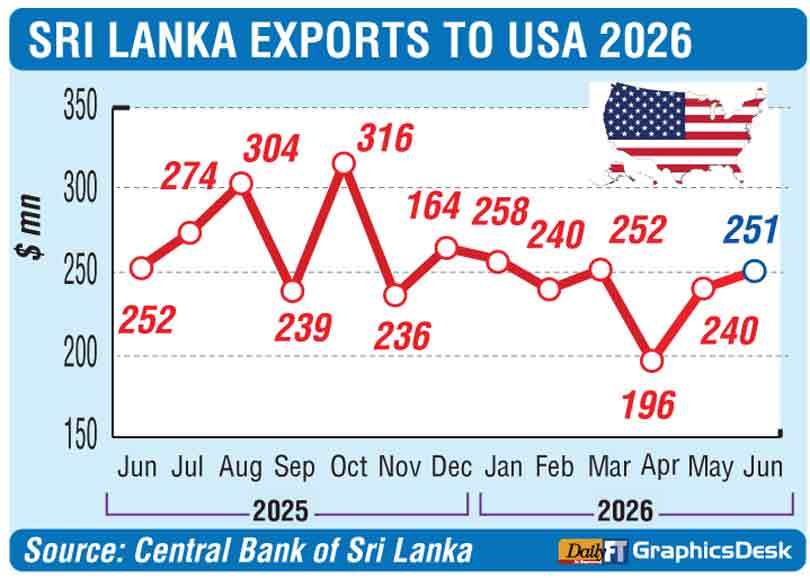
It said the revised tariff structure would improve the competitiveness of Sri Lankan exports in the US, the country’s largest export market, and demonstrate Sri Lanka’s commitment to fair trade, responsible business practices and internationally accepted labour standards.
“This situation creates a positive outcome for exporters and reflects Sri Lanka’s continuous commitment to promoting fair trade, responsible business practices, and internationally accepted labour standards,” the Ministry said.
It added that the decision sends a positive signal to foreign buyers and investors regarding Sri Lanka’s ongoing economic reforms.
The revised tariff follows a Section 301 investigation by the United States into 60 trading partners over forced labour practices. The US accounts for more than 20% of Sri Lanka’s merchandise exports.